
Evidence / Updated 2026-07-16 / 3 min read
Camera bokeh and digital zoom in UFO videos
A distant point light can become a disc, triangle or pulsing shape when focus, aperture, stabilization and enlargement interact. The recorded outline may belong to the camera.
Reviewed and maintained byGlobal UFO Archive Editorial DeskEditorial policy
Quick answer
When a distant point light is out of focus, the camera records a blur circle rather than the object's true outline. That shape can reflect the lens aperture and may appear round, polygonal or triangular. Digital zoom then enlarges pixels and compression blocks, while stabilization can make the light pulse or jump. Refocusing on stars, including fixed references, reducing zoom and examining the original file are the practical tests. Bokeh is a camera explanation, not a label for every unclear video.

Key points
- An out-of-focus point source records the optical system's blur shape, not a resolved silhouette of the distant object.
- Digital zoom does not recover missing detail; it enlarges existing pixels, sharpening and compression artifacts.
- Focus changes, neighboring stars and the original uncompressed sequence can reveal whether the shape belongs to the lens.
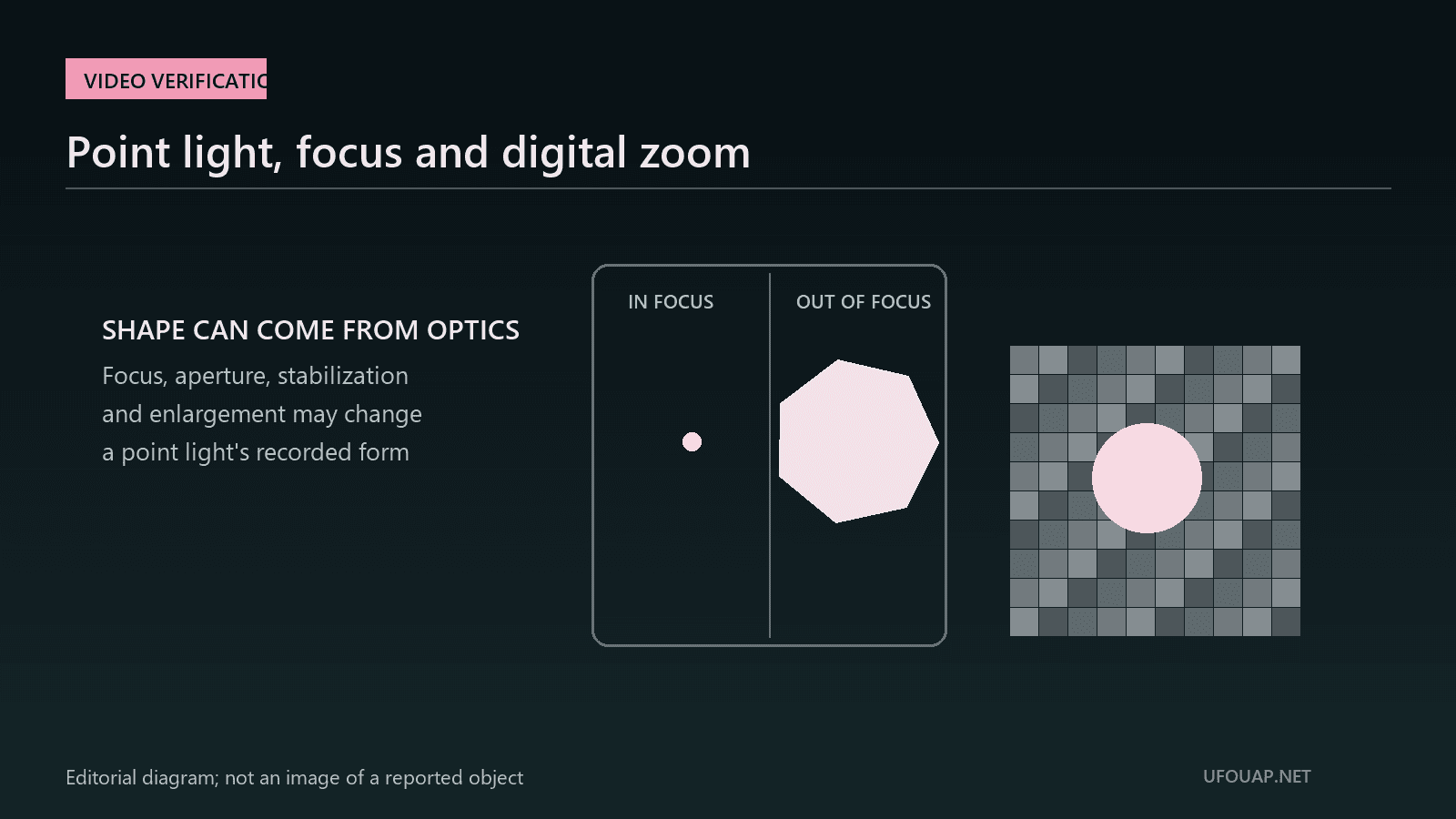
How a point light becomes a shape
A star, planet, aircraft lamp or distant reflection may occupy less than one sensor pixel when properly focused. If focus shifts, rays from that point spread into a circle of confusion. The blur can take the form of the aperture opening and inherit rings, edges or asymmetry from the optical path. A stable triangle or disc in a defocused clip therefore does not by itself describe the target's physical geometry.
What digital zoom and processing add
Optical zoom changes the image projected by the lens; digital zoom crops and enlarges sensor data already captured. It can expose square pixels, edge halos, denoising smears and block compression. Automatic exposure makes a bright point expand and contract, while autofocus searches and stabilization repositions the frame. Social platforms may recompress the result, creating a second layer of artifacts.
How to test the camera explanation
Preserve the original file and device model. Compare the light with stars in the same frame: if they share the same polygonal outline or expand together during focus changes, an optical cause is likely. Repeat the recording with manual focus at infinity, lower exposure, no digital zoom and a fixed support. A wide shot containing the horizon makes motion and scale easier to evaluate than a tight crop.
What metadata and context add
Frame rate, focal length, focus mode, exposure time, stabilization setting and edit history help reconstruct what the camera did. Weather, viewing direction and candidate aircraft or celestial objects explain what supplied the point light. A screenshot or repost normally lacks these details. Analysts should state that limitation instead of treating an enlarged shape as measured structure.
Careful assessment
Bokeh is strong when the target is unresolved, the outline matches the aperture, nearby point lights behave similarly and the shape changes with focus. It is weak when a sharply focused object retains detailed structure across independent cameras. The archive should distinguish an optical artifact from a hoax: an ordinary camera effect may be shared sincerely. If the original is unavailable, the correct conclusion may remain indeterminate.
FAQ
Can bokeh make a light look triangular?
Yes. The blur can reflect aperture geometry or an obstructed optical path. A triangular image does not automatically mean a triangular object.
Can software enhancement recover the real object shape?
Only if the source contains recoverable detail. Enlarging or sharpening an unresolved, compressed point cannot create reliable structure that the sensor never recorded.
Official sources used
- NASAUAP Independent Study Team Final Reportscience.nasa.gov
- ScienceDirect TopicsCircle of Confusionwww.sciencedirect.com
- AAROOfficial UAP Imagerywww.aaro.mil