
Skywatching / Updated 2026-07-16 / 3 min read
Space debris reentry or UFO? How to identify a breakup
Reentering spacecraft and rocket bodies can create slow processions of glowing fragments across a wide sky. Timing, trajectory and reentry notices are central to identification.
Reviewed and maintained byGlobal UFO Archive Editorial DeskEditorial policy
Quick answer
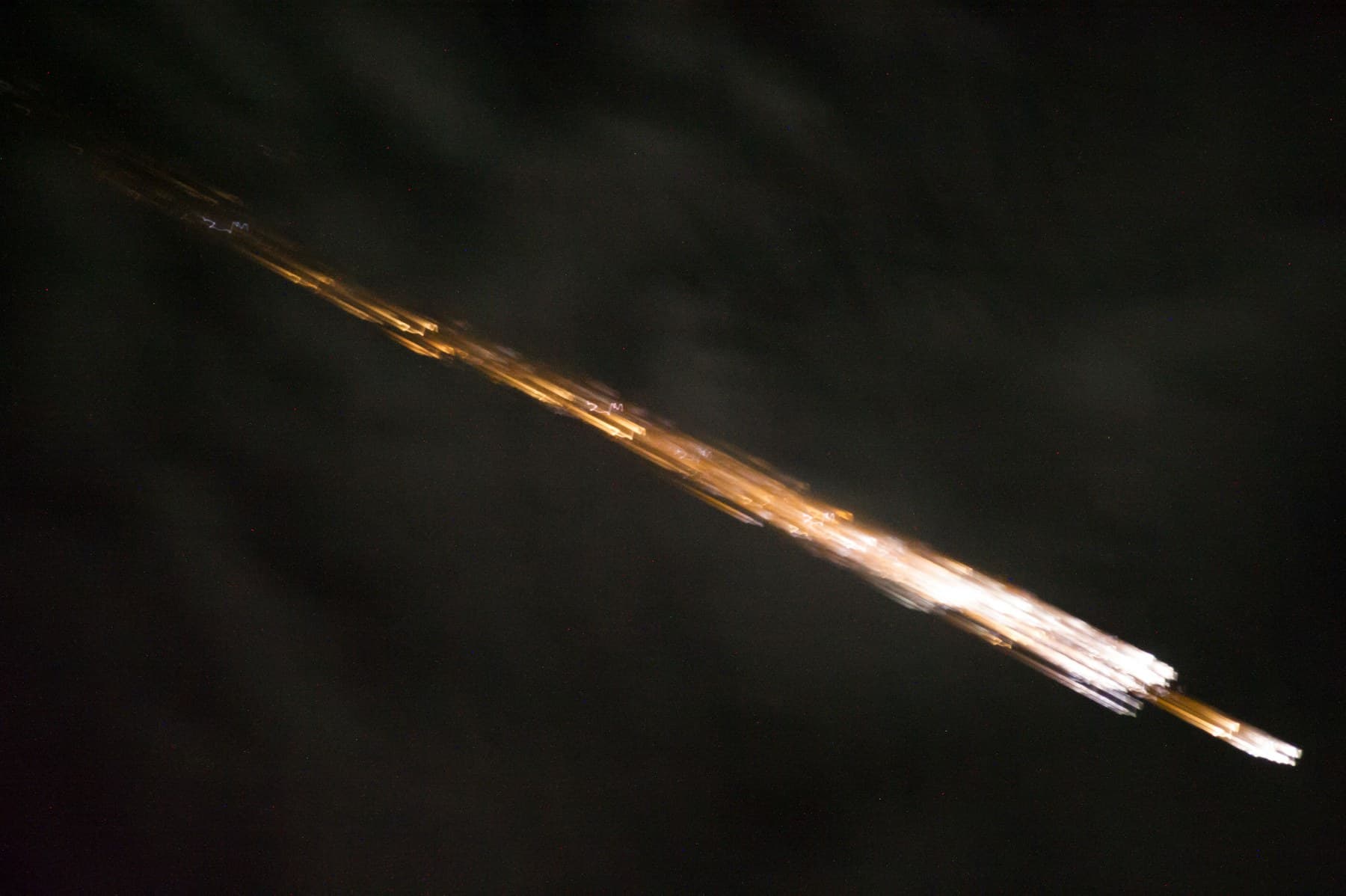
A long procession of glowing fragments moving together on related, nearly parallel paths is often consistent with a spacecraft or rocket-body reentry. Compared with a single meteor, the display may develop more slowly and remain visible longer. Confirmation requires the exact time, direction and reports from other locations, followed by a check of ESA, NASA, launch-provider and orbital-tracking information. Reentry predictions can shift, so a rough forecast alone is not proof.
Key points
- Reentry can produce multiple fragments that brighten, fade and separate while continuing along a common direction.
- Atmospheric drag and the object's attitude make the final time and location difficult to predict precisely until shortly before reentry.
- A correct identification should match time, direction and a broad ground track, not merely a similar-looking online video.
What reentry looks like
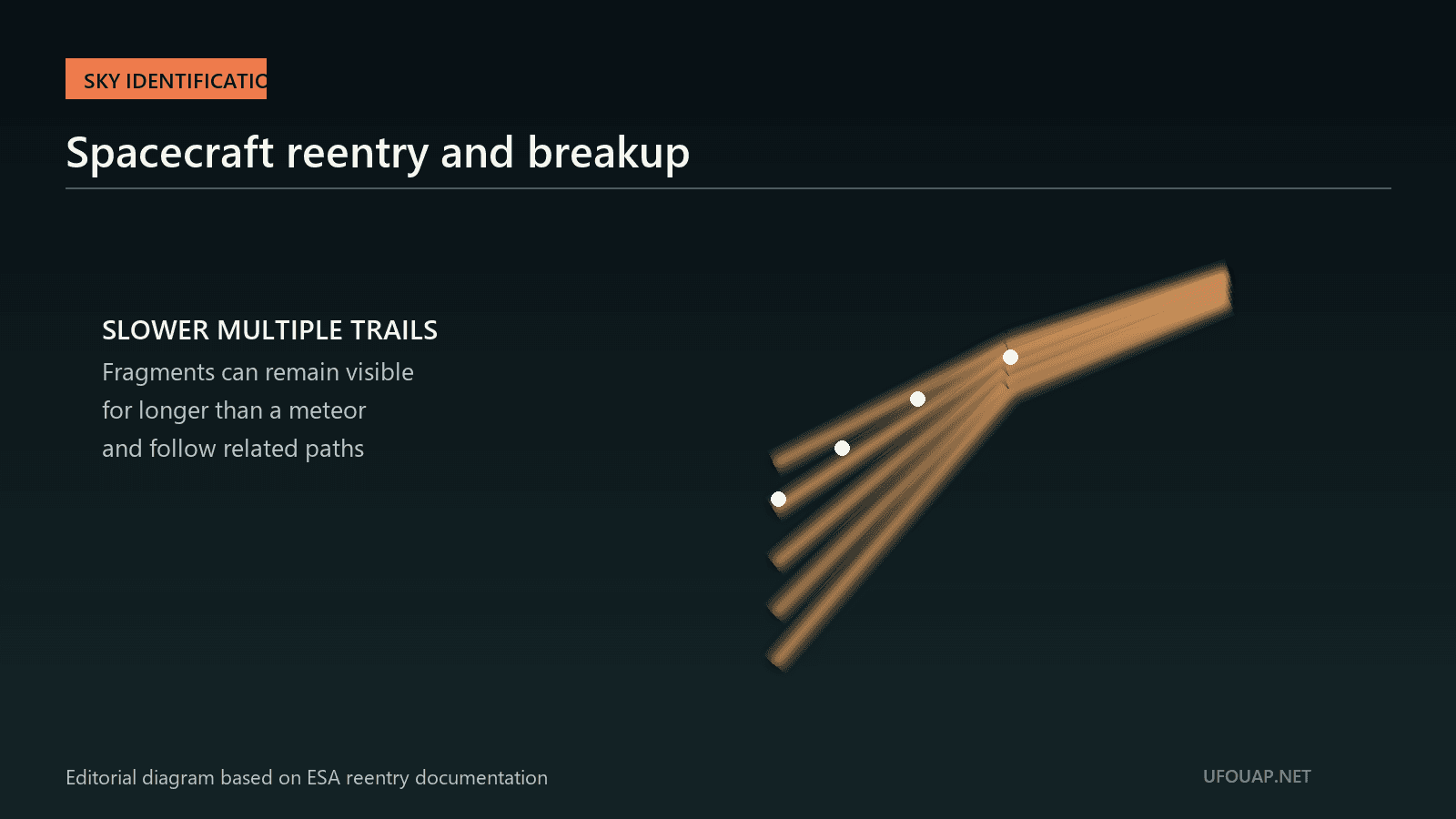
An uncontrolled spacecraft, upper stage or other large orbital object may heat and break apart as it descends into denser atmosphere. Observers can see a cluster or procession of orange, white or greenish points with luminous trails. The pieces usually share an overall direction and speed even as individual fragments brighten or disappear. The display may span a large angle of sky and be reported from locations hundreds of kilometers apart.
Why breakup occurs
Increasing atmospheric drag heats and loads the structure until components separate. Different materials and shapes decelerate and glow differently, producing a train rather than one compact light. ESA's Aeolus documentation expected most of that 1,360-kilogram spacecraft to burn up around 80 kilometers altitude, while allowing that some fragments could survive. That mission-specific figure should not be treated as a universal breakup altitude for every object.
Why predictions contain uncertainty
The final orbit depends on upper-atmosphere density, solar activity, the object's mass, shape, rotation and orientation. Small changes accumulate rapidly during the last orbits. Agencies can narrow the window as tracking improves, but an early prediction may cover many possible ground tracks. Analysts should compare the reported event with the latest available notice rather than a forecast copied days earlier.
How to verify a suspected reentry
Preserve the exact local time, viewing direction, start and end points, duration and an uncropped copy of the media. Look for matching reports along the direction of travel. Then check ESA or NASA reentry notices, launch and mission statements, and reputable orbital catalogs. A successful match should explain the timing and path. If only the visual resemblance matches, the attribution remains provisional.
How it differs from meteors and aircraft
A meteor commonly presents one fast dominant streak and lasts only seconds, although fragmentation can occur. Reentry often shows many related lights and can unfold more slowly. Aircraft lights repeat in regulated patterns and remain associated with a navigable flight path; clouds may hide and reveal them. These are tendencies, not absolute rules, so duration and independent trajectory data matter more than color.
Careful assessment
A documented reentry is an ordinary aerospace event, not a UAP simply because the original witnesses did not recognize it. When official tracking and multiple reports align, the archive can mark the event identified. When no candidate matches, the correct status is unresolved pending better timing and trajectory data, not evidence of extraordinary technology. The distinction protects both useful witness records and the quality of the archive.
FAQ
Can space debris reentry look like a fleet of UFOs?
Yes. A breaking spacecraft or rocket body can produce many related glowing fragments. Their common direction and an official timing match are stronger evidence than the number of lights.
Why can agencies not predict the exact reentry point far in advance?
Upper-atmosphere density, solar activity and the object's changing attitude affect drag. These uncertainties grow across the final orbits, so forecasts usually narrow only close to reentry.
Official sources used
- European Space AgencyAeolus reentry: liveblogs.esa.int
- European Space AgencyEuropean experts follow satellite reentrywww.esa.int
- NASANASA Orbital Debris Program Officeorbitaldebris.jsc.nasa.gov