
Sweden / 1946 / UNRESOLVED
Ghost rockets
The “ghost rockets” were not one encounter but a 1946 file of many separate reports from Sweden and neighboring Nordic countries. Sweden's National Archives traces the main wave from fireball reports on 23-24 May through a Defence Staff reporting order, a multi-agency committee, lake searches and a peak of more than 300 reports on 11 August. Some reports were classified as meteors or other celestial phenomena; officials also investigated whether the Soviet Union was testing captured German missile technology. No projectile was recovered, witness directions and descriptions did not form one coherent track, and the Swedish committee ended in December without a durable explanation for the whole file. Later extraterrestrial readings are not a 1946 official conclusion.
This case remains unresolved in the public record, with credibility grade B.
- Documentation
- High documentation
- Primary location
- Sweden and wider Scandinavia
- Source base
- 2 linked records
- Research use
- Comparison case
What the 1946 archive supports
- Case scope
- The archive concerns many separate 1946 reports across Scandinavia, not one witnessed object or continuous flight.[1][2]
- Official response
- Sweden established a standard military reporting order on 12 June and a multi-agency Space Projectile Committee in July.[1]
- Physical recovery
- Searchers used sampling and metal detection at Kölmjärv but recovered no projectile; an alleged impact was not confirmed by hardware.[1]
Case dossier
“Ghost rockets” is an umbrella label for a report wave, not the name of one observed object. The Swedish archive describes luminous points, tailed fireballs, rocket-shaped forms, alleged impacts and a smaller residue of aircraft-like accounts. Reports came from different people, places and dates, so details from one cannot be transferred to another or assembled into a single witnessed flight.
The Swedish National Archives places the opening of the main Swedish wave on the night of 23-24 May 1946, when one or more tailed fireballs were reported around the country. Investigators valued the earliest accounts because they preceded wide press attention. Even those reports pointed in conflicting directions, however, requiring either unusual maneuvering or ordinary errors in judging bearing and distance.
Reports also arrived from Finland, Norway and Denmark. On 12 June the Swedish Defence Staff ordered military units to submit sky-phenomenon reports on a standard form to its Air Defence Department. A 6 July expert meeting provisionally discussed a reaction-driven craft with lifting surfaces rather than a simple rocket, showing that the working description was already changing with the incoming material.
The formal Rymdprojektilkommittén, or Space Projectile Committee, first met on 10 July after a day with more than 250 reports. It brought together the Defence Staff, air and naval materiel bodies, the Air Staff, FRA signals intelligence and FOA defence research. Experts classified most reports in that cluster as meteors or bolides. A residual group described as low, rocket-shaped or aircraft-like remained under discussion, but “not classified as celestial” did not mean “confirmed missile.”
Alleged impacts created a separate evidential problem. Reports came from Lake Mjøsa in Norway on 18 July and from several Swedish waters on 19 July. At Kölmjärv, Lieutenant Karl-Gösta Barthold led a search beginning on 20 July. The retrospective archive account records a reported depression on the lake bottom, metal-detector work and about 3,500 bottom samples, but no object was found. An impact report and an unsuccessful search are not physical confirmation of a projectile.
The reporting peak came on 11 August, when the Swedish archive says more than 300 accounts arrived. On 14 August, a B 18A bomber crew reported trying to follow an aircraft-like, wingless form between Malingsbo and Krylbo before it pulled away. That crew report is one distinct testimony within the wave. The accepted public archive page does not reproduce the original flight log, photographs or instrument traces, so the description remains a report rather than independently verified performance data.
Swedish officials examined whether Soviet forces had rebuilt German missile facilities at Peenemünde or were testing from the Baltic region. British War Office and Air Ministry files also treated the Scandinavian reports as an intelligence question in 1946-47; some analysts initially suspected modified V-2 tests, while Air Ministry intelligence director R. V. Jones favored a meteor-driven scare. The Swedish committee held its last meeting on 12 December. It had recovered no projectile and left no single, durable explanation for the complete wave.
Timeline
- Tailed fireballs reported across Sweden mark the opening of the main wave in the National Archives chronology.
- The Defence Staff orders military units to report sky phenomena on a standard form to the Air Defence Department.
- An expert meeting provisionally discusses a reaction-driven craft with lifting surfaces rather than a simple rocket.
- The multi-agency Space Projectile Committee first meets after a day with more than 250 reports; experts classify most of that cluster as celestial phenomena.
- Swedish impact reports are followed by the Kölmjärv lake search; later sampling and metal detection recover no object.
- The archive records the wave's largest daily total, with more than 300 reports.
- A B 18A crew reports trying to follow a wingless, aircraft-like form between Malingsbo and Krylbo.
- The Swedish committee holds its last meeting without recovered projectile or a durable explanation for the complete wave.
Ghost-rockets questions
What were the 1946 ghost rockets?
They were an umbrella category for many separate luminous, rocket-like and alleged impact reports in Sweden and neighboring Nordic countries, not one continuous event.
How many ghost-rocket reports were made?
The Swedish archive retrospectively describes nearly 1,000 reports and more than 300 on 11 August alone. Those are report counts, not confirmed objects.
Did Sweden recover a ghost rocket?
No recovered projectile is documented in the accepted sources. The intensive Kölmjärv lake search used metal detection and thousands of samples but found no object.
Were they Soviet missiles?
That was a serious Swedish and British intelligence hypothesis, influenced by captured German missile expertise. No accepted source ties a specific report to a Soviet launch with recovered hardware or launch records.
Were the ghost rockets meteors?
Meteors or bolides were the contemporary classification for many reports, and British analyst R. V. Jones favored that explanation for the scare. The reviewed sources do not prove that meteors explain every residual report.
Did officials conclude the ghost rockets were extraterrestrial?
No. The accepted archives describe missile, meteor and other technical discussions, but no 1946 official extraterrestrial conclusion. That interpretation belongs to later retellings.
Sources
- [1] Official fileThe Swedish National Archives: Ghost rocketsRiksarkivet (Swedish National Archives)
- [2] Official fileUK National Archives Research Notes 6: Unidentified Flying ObjectsThe National Archives (UK)
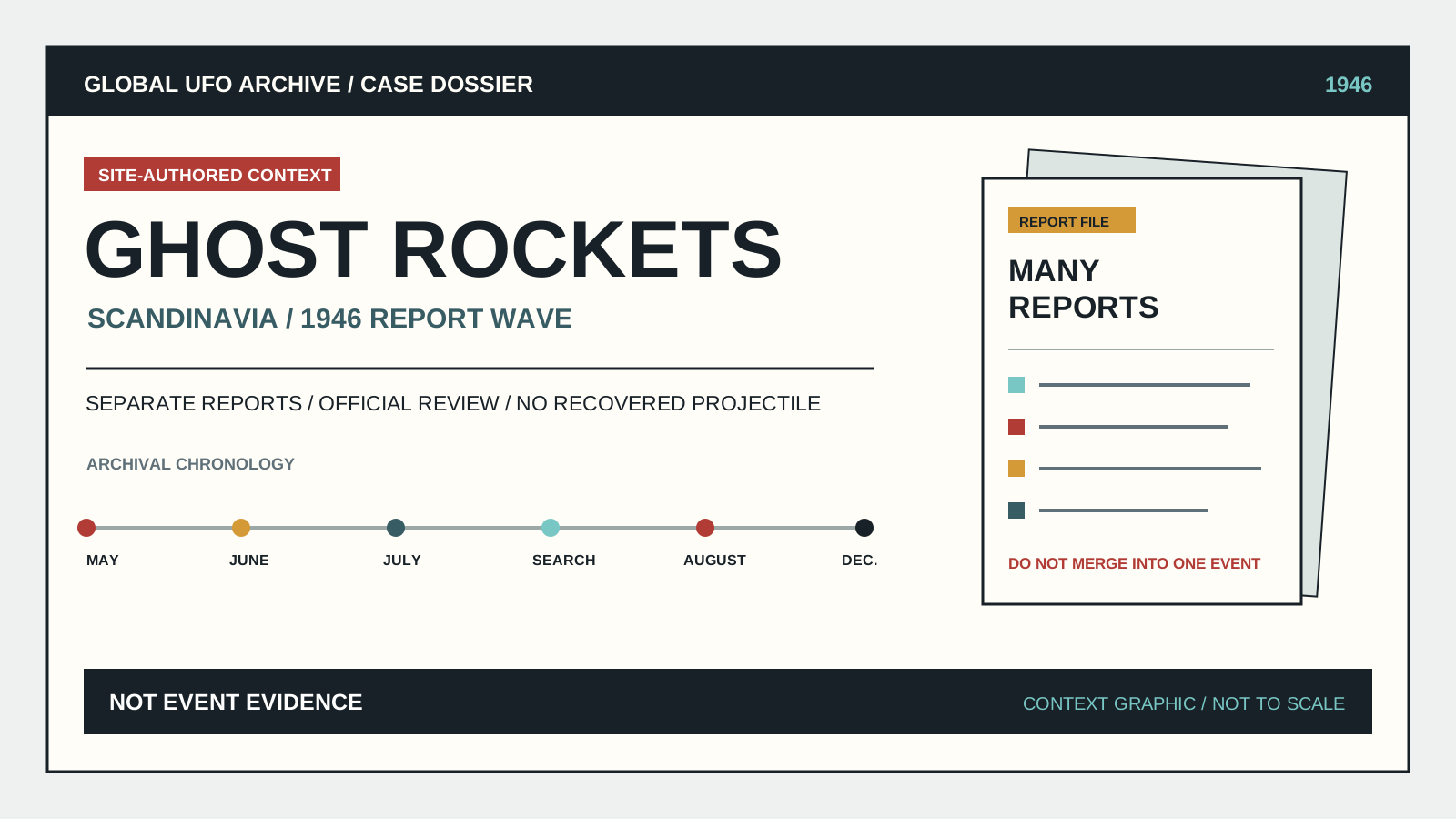
The displayed image is a site-authored archival cover, not a 1946 photograph, source-page screenshot, trajectory reconstruction or depiction of one reported object. No authenticated event image or original video was found in the accepted public sources; the legacy streak image is excluded because provenance and reuse rights were not verified.