United States / 1966 / DISPUTED
1966 Michigan Swamp Gas UFO Reports
On 20 and 21 March 1966, witnesses near Dexter and at Hillsdale College in Michigan reported unusual lights over wetland areas. Air Force consultant J. Allen Hynek proposed marsh gas for these localized observations, prompting objections and Gerald Ford's call for congressional scrutiny. Contemporary records establish the reports, official explanation and political dispute. They do not demonstrate an extraterrestrial craft, and the proposed explanation was not a laboratory identification of material collected from the lights.
This case is disputed. The archive preserves the claims while separating evidence from interpretation.
- Documentation
- High documentation
- Primary location
- Dexter and Hillsdale, Michigan
- Source base
- 4 linked records
- Research use
- Comparison case
Reports and explanations, separated
- Dates and places
- Dexter on 20 March and Hillsdale on 21 March 1966; no demonstrated flight connecting them.[1]
- Explanation
- Marsh gas was the official hypothesis for localized lights, not a chemical identification of collected evidence.[1]
- Political response
- Ford sought hearings and explicitly did not claim the reports proved visitors from another planet.[2]
- Media boundary
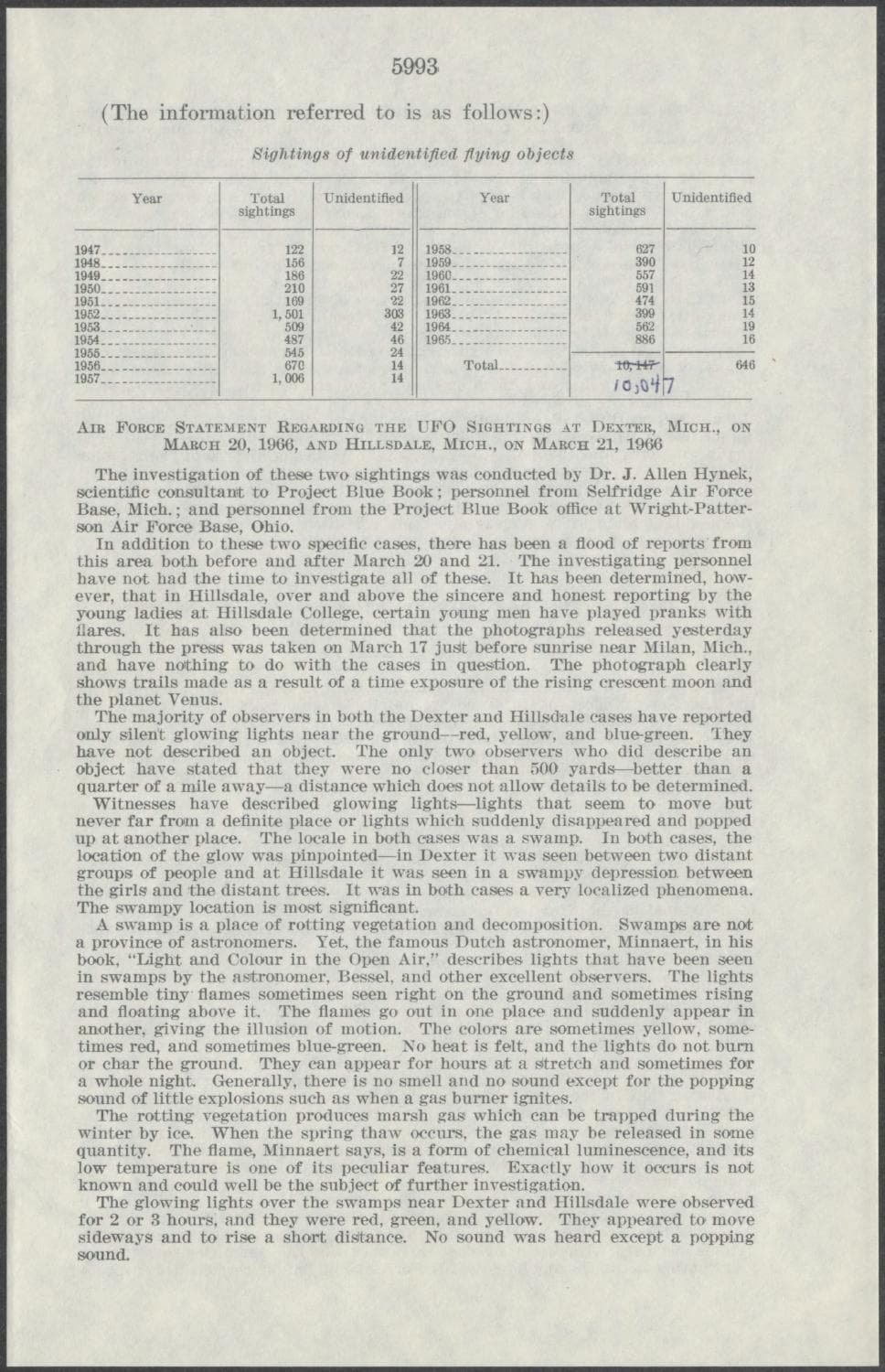
- The document image is an official statement; a circulating Milan photograph was a different observation.[1]
Case dossier
Two nights, two sites: The central reports concern the Mannor farm near Dexter on 20 March and the Hillsdale College arboretum on 21 March 1966. They belong to a larger Michigan reporting wave, but are not a documented flight between the two places. The Air Force statement printed in the 5 April hearing specifically addresses these two local incidents and acknowledges that other reports had not all been investigated. This distinction prevents an explanation proposed for low lights over wetlands from becoming an explanation for every aerial report that month.
What witnesses described at Dexter: Paul O'Neil's contemporary LIFE account, reproduced in the hearing, says Frank Mannor and his son Ronnie approached a glow in the marsh. They described a humped form with lights and a rough-looking surface. Police and other observers described lights, but the accounts were not identical: Mannor said he did not see a takeoff, while some officers interpreted a light as departing. Richard Hall's later compilation reproduces a police report describing a brightening and fading light and a search that found nothing. These are observations and interpretations, not a recovered vehicle, measured trajectory or agreed close-range description.
Hillsdale and the witness-count problem: Students observing from MacIntyre Residence reported lights toward the arboretum on the following evening. Civil-defense director William Van Horn joined the observation. The local historical society's retrospective describes lights appearing to rise and settle and records his later disagreement with Hynek. Published witness totals differ and do not establish that every person saw an identical object throughout the same interval. Van Horn's objections are evidence of a contested investigation, not independent instrument measurements resolving the lights' nature. A later recollection of a prank likewise cannot, without a matching date and observation, explain the original report.
What the Air Force actually proposed: Its statement emphasizes localized, mostly silent colored glows over marshy ground, dark-adapted observers and changing brightness. It proposes gas released during a thaw, with possible chemical ignition, as the likely explanation. That is an inference from reported conditions, not a sampled gas plume or a demonstrated recreation at the exact time. The statement itself says the precise luminescence mechanism could merit further investigation. Its treatment of the two witnesses who described a form as too distant for detail also differs from their confidence. Neither official wording nor witness certainty eliminates that evidential gap.
Photos, radar and unrelated reports: The Air Force identified a photograph circulating during the controversy as a 17 March exposure near Milan showing trails of the crescent Moon and Venus, not the Dexter or Hillsdale lights. That attribution should accompany any reuse, not disappear beneath a generic UFO caption. Hall also reproduces a police log mentioning an air-base response about objects over Lake Erie on 14 March, with no later confirmation at the log's close. That earlier entry is not radar corroboration of a landing on 20 March. The document image on this page is the official statement, not a photograph of a reported object.
Ford's demand was for scrutiny, not confirmation: Gerald Ford's 25 March press release called for an inquiry; his 28 March letter asked the House Armed Services or Science and Astronautics Committee to hear officials and witnesses. His office criticized the explanation, but on 3 April he explicitly said he had not asserted that sightings meant visitors from another planet. The Armed Services hearing on 5 April questioned Air Force officials and Hynek. Testimony and attached newspaper accounts are different evidential layers: their inclusion in a government volume does not make every allegation a congressional finding.
The later scientific review: On 7 October 1966, an Air Force release preserved with Ford's papers announced the University of Colorado investigation directed by Edward Condon. The same release attributes the research agreement to a Scientific Advisory Board recommendation. That board had met on 3 February, before the Michigan incidents. Ford's pressure is part of the political history, but the documents do not justify reducing the entire study to a single causal event. Nor was the creation of a research programme an admission that the Michigan lights were extraterrestrial.
Assessment and archival value: Marsh luminescence was the official interpretation of the two localized reports, while astronomical exposures and later pranks addressed different material. The surviving sources contain disagreement about form, movement and investigation quality, without a definitive physical identification for every claimed observation. This archive therefore treats the episode as disputed, not as demonstrated alien visitation or proof that every witness was mistaken in the same way. Grade B reflects substantial contemporary documentation. The case is valuable for comparing witness claims with the exact scope of an official explanation; the map marks Dexter approximately, not a landing point or route to Hillsdale.
Related checks and records
- How Project Blue Book classified reports
- Portage County: another disputed 1966 investigation
- Check whether a bright light is Venus
- Where to find UFO disclosure files
- Fort Belvoir: photographs and the smoke-ring identification
Compare the original sequence with the Condon investigation and later criticism, keeping demonstration photos separate.
- Lake Michigan 1994: did radar and witnesses see the same targets?
Compare the two contemporary newspaper accounts before treating reported radar echoes as corroboration of visual lights.
Timeline
- The scientific advisory panel reviews Blue Book before the Michigan incidents.
- Mannor family and police reports focus on the Dexter wetland.
- Students and Van Horn observe lights near Hillsdale College.
- Hynek presents the marsh-gas explanation; Ford calls for an inquiry.
- Ford writes to House committee chairmen requesting hearings.
- The Armed Services Committee hears Air Force officials and Hynek.
- The Air Force announces the University of Colorado investigation.
Michigan 1966 questions
Was swamp gas proved to be the cause?
It was the Air Force's likely explanation for the localized lights. The published statement offers an inference from conditions, not an event-specific gas analysis or definitive reconstruction.
Did Gerald Ford confirm a UFO landing?
No. He called for a more credible investigation and explicitly distinguished that demand from belief in extraterrestrial visitors.
Is the famous photograph from Dexter?
The Air Force statement identifies the photograph circulating at the time as a separate 17 March exposure near Milan, interpreted as Moon and Venus trails. It should not illustrate the 20–21 March reports as a verified object photograph.
Why does this case remain historically important?
The surviving witness accounts, official statement, correspondence and hearing make it possible to compare a public explanation with its evidence and political consequences, without accepting every extraordinary claim.
Sources
- [1] Official file1966 hearing: Air Force statement and contemporary press accountsU.S. House Committee on Armed Services / GovInfo
- [2] Official fileFord's 1966 letters and press releasesGerald R. Ford Presidential Library
- [3] ArchiveRichard Hall's compilation of Michigan police reportsNICAP / Richard H. Hall
- [4] ArchiveHillsdale historical society's retrospectiveHillsdale County Historical Society / JoAnne P. Miller