
United States / 1957 / EXPLAINED
1957 Fort Belvoir UFO Photographs
In September 1957, a soldier at Fort Belvoir, Virginia, photographed a dark ring becoming enclosed in a pale cloud. The exact day is unknown. William Hartmann's later Condon investigation identified the sequence as a smoke vortex from a military demonstration, drawing on photographic comparison and interviews at the base. The pictures document an unusual-looking atmospheric form, not a demonstrated spacecraft. Later criticism questions details of that identification, while the lost negatives and delayed reporting limit what can now be independently reconstructed.
This archive treats the case as explained or substantially resolved by conventional evidence.
- Documentation
- Moderate documentation
- Primary location
- Virginia
- Source base
- 3 linked records
- Research use
- Comparison case
What the record establishes
Case dossier
The morning observation: Condon Case 50 places the sighting at about 9 a.m. in September 1957, looking north-northeast past building T741. Its anonymous witness was a private working as a draftsman; the 2000 review names him as George L. Stofko Jr. He described a dark, apparently substantial but nonmetallic ring moving above the trees and below the clouds. He estimated about fifteen men were outside. That number is his recollection, not fifteen recovered independent statements. The original investigation says the ring kept moving, rather than establishing a stationary hovering craft.
What the six photographs show: The witness used a Kodak Brownie camera. In the sequence reproduced as plates 32–37, the dark ring changes appearance as a pale cloud develops around it. Hartmann compared foliage and cloud movement and found the sequence physically consistent with a drifting phenomenon. That is more informative than one isolated print, but it does not supply a measured distance, altitude or diameter. His size calculations depend on assumed cloud height and wind conditions. No reliable exact dimension should be extracted from those assumptions as though it were an instrument reading.
The delayed evidence trail: According to the report, the film was developed about a month later, the negatives were subsequently lost during moves, and the prints reached NICAP in spring 1966. James McDonald learned of them later that year. Hartmann interviewed the witness by telephone on 24 May 1967 and visited the base on 21 December. These are investigation dates, not dates of the photographed event. Missing negatives limit examination of image detail and possible alterations. Hartmann discussed marks in one print without resolving every photographic question before identifying a plausible physical source.
Why the investigators chose a smoke vortex: Base personnel described training demonstrations that simulated the appearance of a large explosion without a nuclear detonation. Jack Strong suggested this connection. During the site visit, Sergeant Major A. M. Wagner recognized the phenomenon without first being given that explanation and showed its direction of drift from the demonstration area. Comparison photographs by Sergeant First Class O'Dell showed a dark vortex ring detaching from the mushroom-cloud column. The combination of site testimony, motion and photographic resemblance led Hartmann to a positive identification, rather than a conclusion based only on the word 'smoke'.
What the comparison does not prove: Plates 38–40 show a comparison demonstration, not independently dated photographs of the exact September 1957 event. They establish that this class of ring could occur at the base, while the missing day prevents matching a specific demonstration log and weather record. The witness's impression of solidity does not identify a solid structure; a smoke ring can retain a coherent outline. Conversely, visual resemblance alone cannot recover the lost negatives or determine every detail of the original cloud. Explanation and complete reconstruction are different evidential standards.
The later challenge: Ann Druffel, Robert M. Wood and Eric Kelson revisited Fort Belvoir in a 2000 paper primarily about the separate Rex Heflin photographs. Drawing on McDonald's correspondence, they discussed his initial doubts about long-lived smoke rings and subsequent acceptance that stable vortices were possible. The authors nevertheless questioned features of the Belvoir ring and the completeness of the military documentation. This is a substantive later critique, not a second contemporary instrument record. Its discussion should be read alongside Hartmann's published comparison plates, not used to claim that no comparison photographs existed.
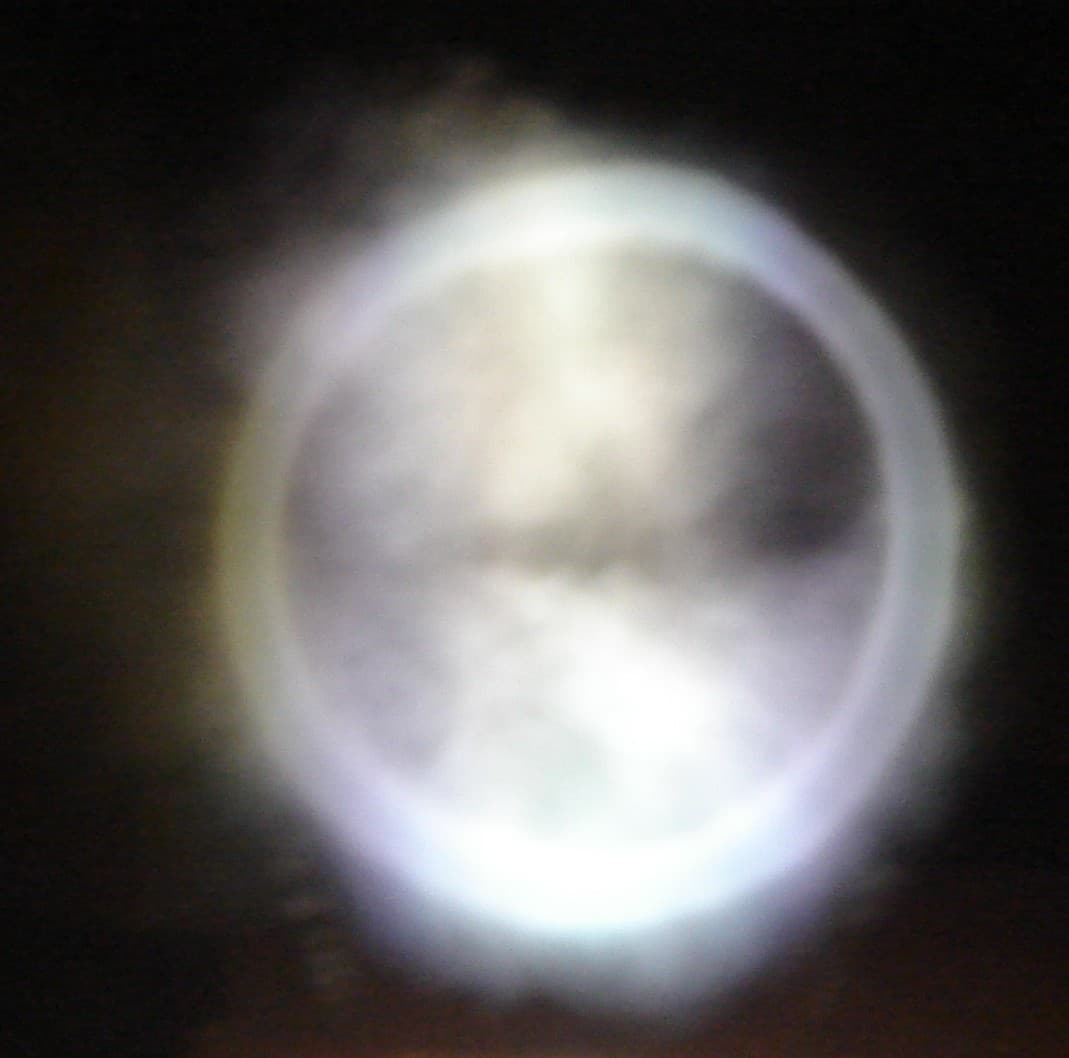
Photographs, illustrations and video: The primary source linked below reproduces the six witness photographs and the separate comparison series. The local photograph on this page instead shows a smoke ring produced at Bonn University in 2006, credited to Traitor under CC BY-SA 3.0. It illustrates a ring's appearance, not the 1957 event or a replication of the military demonstration. The surviving case material reviewed here is photographic; no verified contemporary motion-picture source is attached. Later online narration cannot replace the original sequence or resolve its provenance.
Assessment and archival value: The best-supported reading is the Condon team's smoke-vortex identification, with incomplete reconstruction of the precise demonstration and photographic chain. An unresolved detail is not positive evidence of an exotic vehicle. This case belongs in an archive because the sequence permits comparison between a striking visual impression, an on-site investigation and a later critique. The B grade refers to the documentary record's quality, not an extraterrestrial probability. Keeping the original and comparison photographs distinct is essential to understanding both the explanation and its limits.
Related checks and records
- McMinnville: another photographic investigation
- Blue Book and official report classifications
- Michigan 1966: the scope of the swamp-gas explanation
Compare the witness reports, misattributed photograph, Air Force statement and Ford's demand for an inquiry.
- Compare flight, satellite and weather records
Timeline
- Six photographs are taken at Fort Belvoir; the exact day is unknown.
- Prints reach NICAP in spring; McDonald learns of them later that year.
- Hartmann interviews the photographer by telephone.
- The base visit links the ring to military demonstration smoke.
- The Colorado study presents the smoke-vortex identification in Case 50.
- Druffel, Wood and Kelson revisit the explanation in a paper about the Heflin photographs.
Fort Belvoir photograph questions
Was the Fort Belvoir ring a solid UFO?
The witness thought it looked substantial, but the photographs do not establish a solid vehicle. The Condon investigation identified a smoke vortex using site testimony and comparison images.
Was there a nuclear explosion at Fort Belvoir?
The explanation concerns a non-nuclear training demonstration that simulated an explosion's appearance, not an atomic detonation at the base.
Where can I see the original photographs?
Follow the Case 50 source for plates 32–37. Plates 38–40 are a separate comparison demonstration. The Bonn photo displayed here is an explanatory example from 2006, not either historical series.
Sources
- [1] ResearchCondon Case 50: investigation and original photo sequencesUniversity of Colorado / William K. Hartmann; Project 1947 archive
- [2] Research2000 reanalysis: Fort Belvoir discussion within the Heflin studyAnn Druffel, Robert M. Wood and Eric Kelson / Journal of Scientific Exploration
- [3] ArchiveBonn smoke-ring comparison photograph and licenceTraitor / Wikimedia Commons