
Spain / 1976 / DISPUTED
1976 Talavera Air Base UFO incident
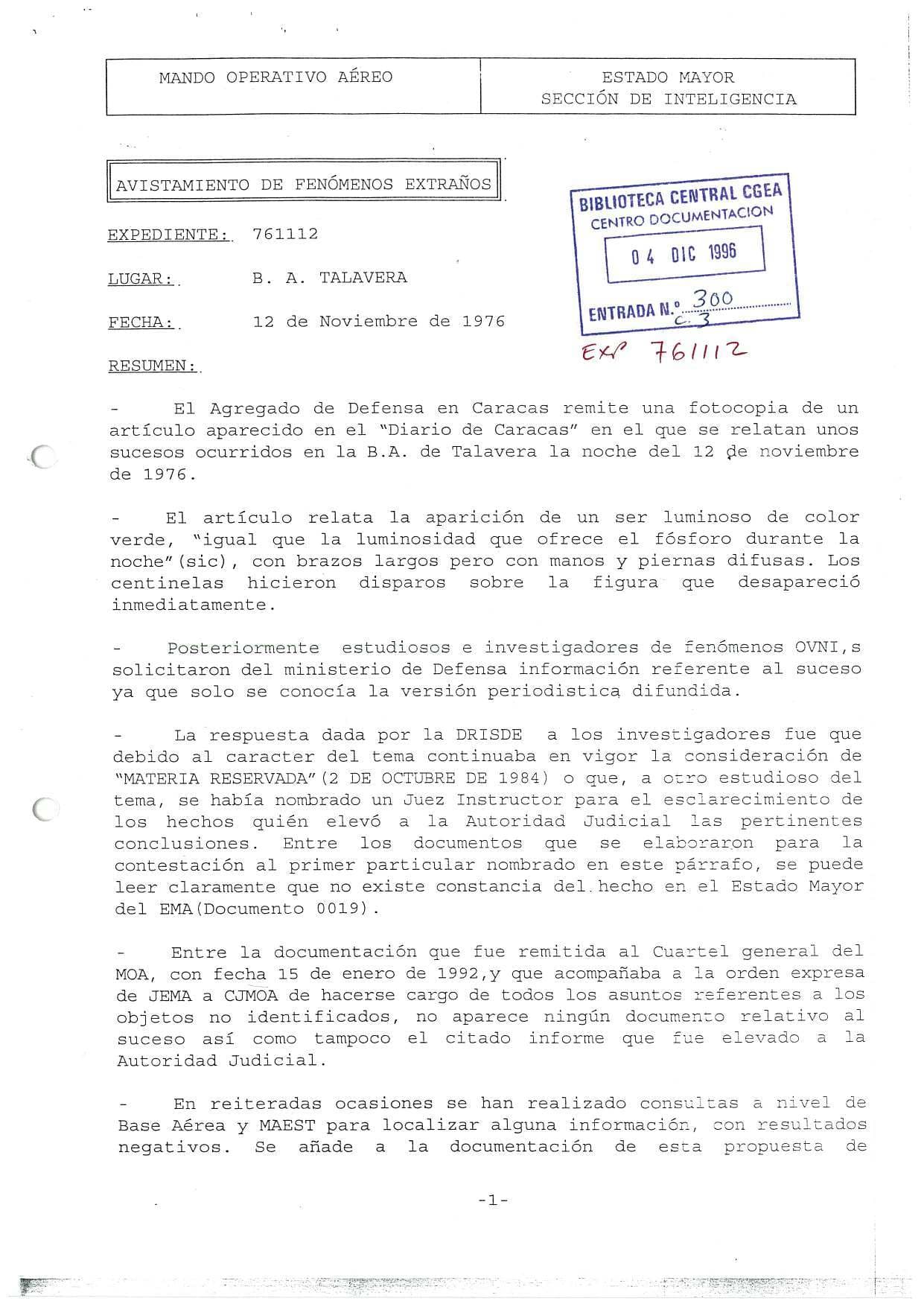
According to a report published after the event, three Spanish Air Force sentries at Talavera la Real Air Base encountered unusual sounds, a brief light and a luminous humanoid-like figure at about 1:45 a.m. on 12 November 1976; shots were allegedly fired. Spain's official 28-page public file does not contain the original guard statements or investigation report. Its 1996 summary says the story entered military files through a photocopy of a newspaper article and that repeated archive searches failed to locate the original report. No authenticated event photograph, video, radar record, physical trace, medical record or ballistic document is public. The archive confirms institutional handling of the allegation, not the reported figure or an extraordinary cause.
This case is disputed. The archive preserves the claims while separating evidence from interpretation.
- Documentation
- High documentation
- Primary location
- Talavera la Real Air Base, Badajoz
- Source base
- 7 linked records
- Research use
- Comparison case
What the public record supports
- Confirmed archive
- Spain's Virtual Defence Library preserves a genuine 28-page military compilation, declassified on 26 November 1996.[1][2][3]
- Reported encounter
- A later press account says three airmen heard unusual sounds, saw a brief light and encountered a luminous humanoid-like form; gunfire was alleged.[2][5]
- Missing primary record
- The public file contains no original guard statement or investigation report; its own summary says repeated searches failed to locate them.[1][2]
- Media and evidence boundary
- No authenticated event photograph, original video, radar record, physical trace, medical chart or ballistic record is public.[2]
What the archive's own case card records
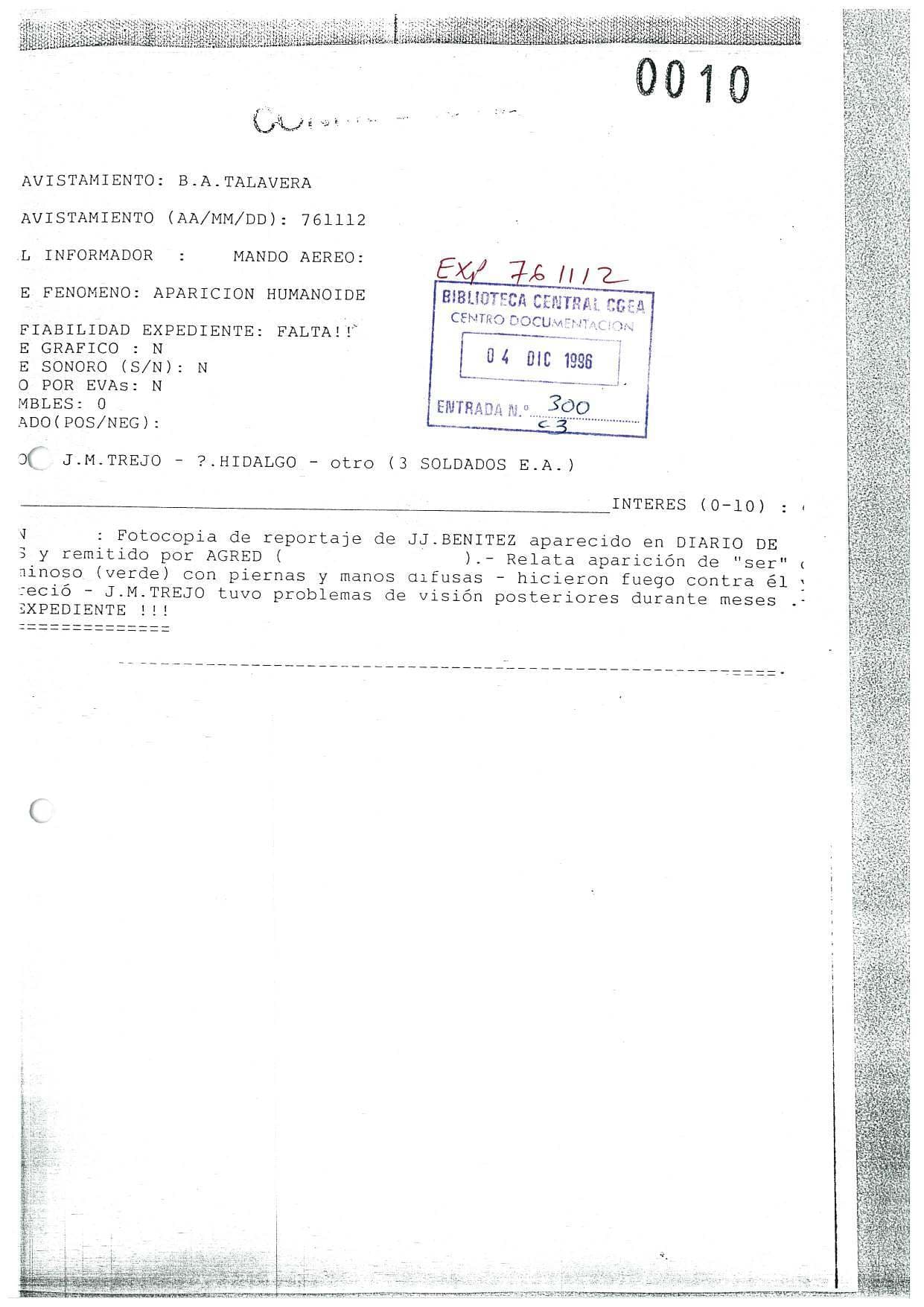
Case dossier
Talavera la Real Air Base lies near Badajoz in Extremadura. Spain's Air and Space Force says the installation opened in 1953 and received the F-5B in 1970, serving as an advanced fighter and attack training base. That operational setting explains why a report by armed sentries would have been a security matter, but it does not establish what produced the reported disturbance.
The detailed encounter is known through J. J. Benitez's later account, subsequently copied into the military compilation. It says airmen Jose Maria Trejo and Juan Carrizosa Lujan were on guard near the fuel area, about 60 metres apart, at roughly 1:45 a.m. They reportedly heard a piercing, radio-like whistle or interference and saw a flare-like light for approximately 15 to 20 seconds.
The published story says a third guard, Jose Hidalgo, arrived with a dog after the alarm. The men allegedly heard movement or breaking branches in a eucalyptus area. The dog was said to have moved forward, staggered and whimpered. These details are part of the reported narrative; no kennel record, veterinary document, contemporary photograph or signed statement in the released file independently verifies them.
Benitez's account attributes the central sighting to Trejo: a luminous green, roughly three-metre humanoid-like form with long arms and indistinct hands and feet. Trejo allegedly collapsed, while the other guards reportedly fired bursts toward the figure. The same narrative says the figure disappeared and no visible bullet impacts or diagnostic traces were recovered. The released archive contains no event photograph, weapon log or ballistic examination confirming this sequence.
Later versions say Trejo received medical care and experienced visual or neurological effects. No public medical chart, named clinician's report or contemporaneous diagnostic record accompanies the released file. The absence does not prove that Trejo received no care, but it prevents later health claims from functioning as verified physiological evidence of the encounter.
The public chain begins after the alleged encounter. A 1996 intelligence summary says the file's source was a photocopy of a J. J. Benitez report in the Venezuelan newspaper Diario de Caracas. The account also appeared in Flying Saucer Review in 1978. This publication history preserves the story, but it means the detailed narrative reaches readers through journalism rather than through the missing original guard statements.
Correspondence from 1984 to 1994 exposes the archival gap. A 1985 reply said an investigating officer had reportedly been appointed and sent conclusions to judicial authority, yet the report was not attached. Other replies record searches at the base and in Air Staff files that found no event record. A date written as 12 December in one letter was itself queried as a likely error; the catalogue and later case card use 12 November.
The Air Force prepared a later case card and declassified the compilation on 26 November 1996. The card identifies three Air Force witnesses but marks file reliability as missing and records no graphic, sound or other evidence. Declassification means the material no longer required secrecy. It confirms that an allegation and an administrative trail existed; it is not an official endorsement of the humanoid account.
Timeline
- The later press account places the sentry alarm and reported humanoid encounter at about 1:45 a.m.
- J. J. Benitez published the detailed story; a photocopy later entered the military compilation.
- Flying Saucer Review reproduced the encounter narrative in volume 23, number 5.
- A public enquiry prompted military correspondence and searches for the original file.
- A reply referred to an investigating officer and judicial conclusions, but supplied no report; other offices still could not locate it.
- Another search at Talavera and in Air Staff archives found no original incident record.
- A summary and case card recorded the allegation, three airmen and the absence of graphic, sound or other evidence.
- The Spanish Air Force declassified the 28-page administrative compilation.
- The Virtual Defence Library published the catalogue, scan and open-licence metadata online.
Frequently asked questions
What happened at Talavera Air Base in 1976?
A later report says three sentries experienced unusual sounds, a brief light and a luminous humanoid-like figure, followed by alleged gunfire. The original statements and investigation report are not in the public file.
Did the Spanish military confirm a humanoid?
No. The military archive confirms that an allegation was collected and later declassified. Its summary identifies a newspaper photocopy as the source and records that the original report could not be found.
Are there photographs or videos of the encounter?
No authenticated event photograph or original video is known. The images on this page are official archive pages, not photographs of the reported figure or craft.
Why is there an official file if the original report is missing?
Military offices later assembled press material, public enquiries, correspondence, a case card and declassification paperwork. That administrative compilation survived even though searches did not recover the original investigation.
Were shots fired at the reported figure?
The later account says bursts were fired, but the released file contains no weapon log, spent-ammunition record, impact documentation or ballistic report that independently confirms it.
What is the best explanation for the Talavera incident?
The record cannot select one cause. Intruder, animal, light, interference, fatigue, stress and night-time misperception remain possible. Missing first-hand evidence prevents a confident reconstruction.
Why does the case belong in the archive?
It is a useful example of how an official declassified file can authenticate the history and administrative handling of a claim without confirming the extraordinary event described in it.
Sources
- [1] Official fileOfficial Talavera Air Base UFO file catalogueBiblioteca Virtual de Defensa
- [2] Official fileDigitized 28-page Talavera Air Base fileBiblioteca Central del Ejército del Aire y del Espacio
- [3] ArchiveTalavera file metadata and CC BY 4.0 licenceBiblioteca Virtual de Defensa
- [4] Official fileAla 23 and Talavera la Real Air BaseSpanish Air and Space Force
- [5] ArchiveThe Man of Talavera Air BaseFlying Saucer Review / IAPSOP archive
- [6] ResearchTalavera la Real 1976 case reviewUAP Codex
- [7] ResearchComparison of later Talavera encounter versionsPodcast UFO
The main image is page 2 of Spain's official 28-page compilation: a 1996 intelligence summary stating that the source was a newspaper photocopy and that repeated searches did not locate the original incident report. It is an archival document, not a photograph of the reported humanoid or an event image. No authenticated original event photo or video is known.