
Spain / 1976 / DISPUTED
1976 Canary Islands UFO incident
At 21:27 UTC on 22 June 1976, the Spanish Navy corvette Atrevida recorded a yellow-blue light and a transparent electric-blue halo while sailing south of Fuerteventura. Reports from Gran Canaria and other islands described related lights and expanding forms. The Air Force investigating judge concluded on 16 July that the main phenomenon had occurred but that its nature was unknown; he also said the doctor and taxi driver's account of a nearby sphere with two figures lacked conclusive support. In 2001, researchers writing in Spain's Revista de Aeronáutica y Astronáutica linked the display to two U.S. Navy Poseidon C-3 tests. A modern aerospace catalog lists two USS Von Steuben launches on the same date, although its displayed times do not exactly match the Spanish observation. The missile-plume explanation is therefore strongly supported, not the 1976 file's own conclusion, and none of the records establishes an extraterrestrial craft.
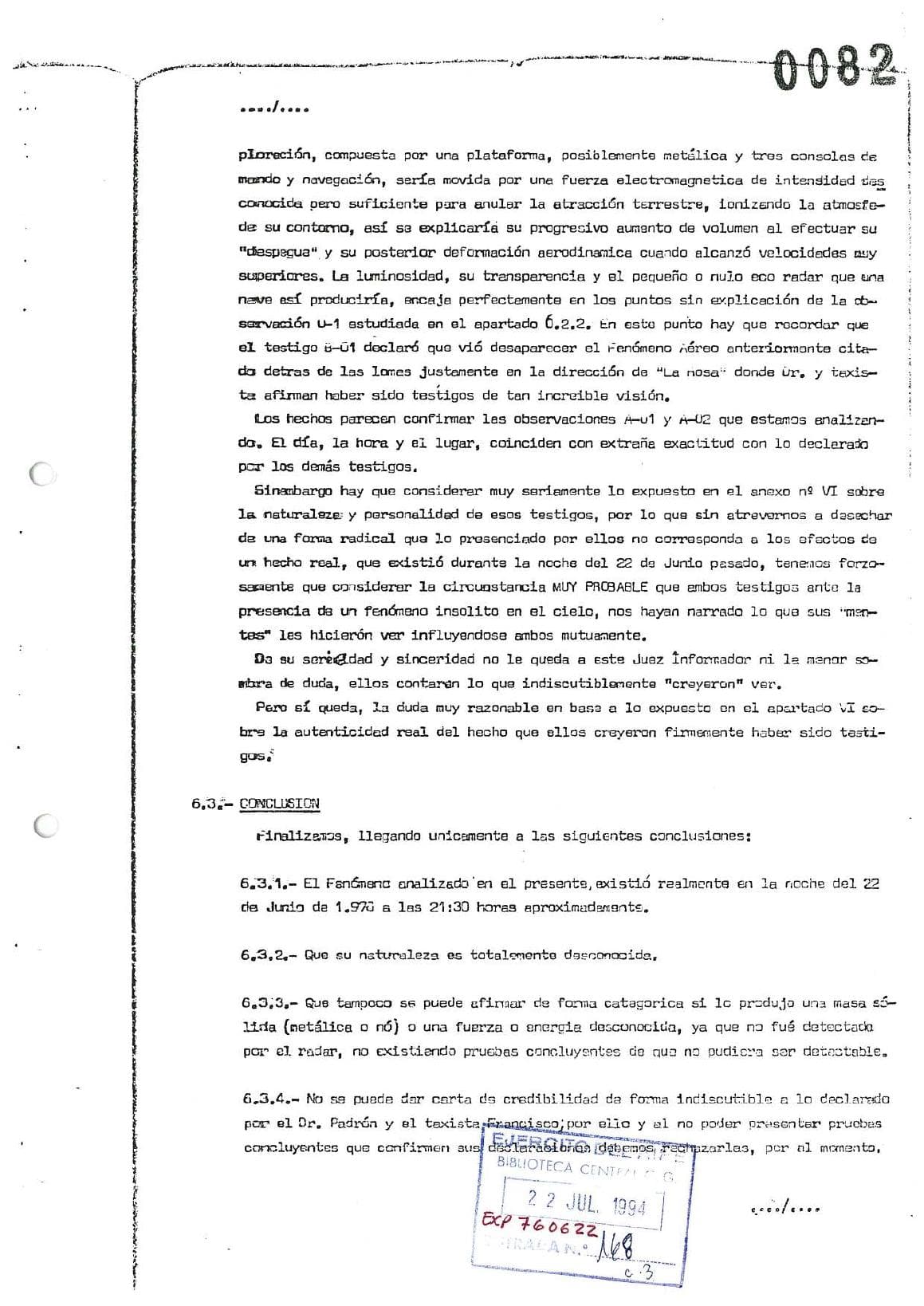
This case is disputed. The archive preserves the claims while separating evidence from interpretation.
- Documentation
- High documentation
- Primary location
- Canary Islands
- Source base
- 5 linked records
- Research use
- Comparison case
What the Canary Islands file establishes
- Confirmed event
- A naval crew and witnesses across several islands reported a large luminous display on 22 June 1976.[1]
- Official conclusion
- The 1976 judge classified the main display as a real but unidentified aerial phenomenon, not an extraterrestrial craft.[1]
- Separate testimony
- The doctor and taxi driver's sphere-and-figures account lacked conclusive corroboration even in the official file.[1][4]
Case dossier
The Atrevida record: The corvette was about three nautical miles south of Punta Lantailla, Fuerteventura, when its commander first saw a white light resembling an aircraft lamp. The investigating report says it became yellow-orange, rose to roughly 25–30 degrees, and generated a vast transparent blue arc whose stars remained visible through it. A central light divided, one part climbing in an irregular spiral while the halo faded over more than twenty minutes. These angles, dimensions and movements are crew estimates preserved in an official report, not radar tracks. The ship carried surface radar only and recorded no nearby echo.
A broad observation, not one close craft: The file groups testimony from Gran Canaria, Fuerteventura, Tenerife and La Palma, plus ships at sea. Witnesses differed on color, duration, direction and apparent motion, but many described a rising focus, spiral or separated lights followed by a large translucent halo. A sergeant at Pozo de las Nieves reported a red circular form rising from behind Tenerife; Agaete witnesses described related lights. Simultaneous reports over a wide area establish a conspicuous sky display, while making a small nearby object less likely and distance estimates highly uncertain.
The doctor and taxi-driver account is a separate claim: Near Las Rosas, physician Francisco Julio Padrón León and the taxi driver transporting him said they saw a transparent sphere near the road with two very tall red-clad figures inside. The judge labeled this Observation O-2 and analyzed it apart from the wide-area display. He wrote that they probably narrated what their minds, influenced by each other, made them see during a real unusual sky event; he did not accuse them of conscious invention, but found serious doubt about the event's objective authenticity and no conclusive proof. The file therefore preserves sincere testimony, not an official finding that occupants or a landed craft existed.
Photographs and drawings need provenance: The expediente contains witness sketches, sequence diagrams and a copy of a luminous photograph. Its own photographic history says an unknown foreign tourist left the image through a Maspalomas hotel route; the negative and photographer were not recovered, and the exact day, time and place could not be established. The file associated it with earlier report 01/76 after witnesses recognized a phase of the display. This makes the photograph relevant but weakly sourced. No motion picture, calibrated optical record or radar plot of the phenomenon appears in the reviewed file.
What the 1976 inquiry actually concluded: On 16 July, the investigating judge wrote that the phenomenon existed at about 21:30, that its nature was totally unknown, and that the evidence did not establish whether a solid mass or unknown energy caused it. He summarized it as a fenómeno aéreo no identificado, not as an extraterrestrial vehicle. His analysis rejected aircraft, missile, aurora and meteor alternatives using the information then available. The missile rejection rested partly on no known island launch base and no submarine detected by surface radar—premises that do not test a distant submerged ballistic-missile launch and its high-altitude exhaust cloud.
Why Poseidon is now the leading explanation: Ballester Olmos and Campo Pérez published a reconstruction in the March 2001 Revista de Aeronáutica y Astronáutica, a professional Spanish Air Force periodical. They compared the Canary reports with missile-test morphology and a launch chronology, concluding that two Poseidon exhaust displays caused the 22 June event. Jonathan McDowell's current GCASO catalog independently lists two Poseidon C-3 launches by USS Von Steuben on that date at 20:16 and 20:17 UTC. Those displayed times are about seventy minutes before Atrevida's 21:27 UTC entry; the 2001 authors argued that the older compilation was one hour wrong. The date, paired-launch sequence, platform and plume behavior are a strong convergence, but the open catalog alone is not exact minute-by-minute proof.
How later media changed the case: Contemporary newspapers foregrounded the doctor, alleged figures, a supposed landing and damaged onions, although the official report treated the wide-area display and close-encounter narrative separately. Later television retellings often rejoined them. RTVC Noticias' 2026 fiftieth-anniversary video is reliable regional retrospective coverage, not footage recorded in 1976. The most careful present classification is disputed historically but probably explained for the main sky display: testimony and a military inquiry are real, the close encounter is unverified, and a non-human origin is unsupported.
Related video
Timeline
- GCASO lists two USS Von Steuben Poseidon C-3 test launches. The 2001 Spanish analysis says the older launch compilation was one hour early, so the displayed times require caution.
- The Atrevida crew begins its recorded observation south of Fuerteventura; a bright focus develops into a large transparent blue halo.
- Observers on Gran Canaria and elsewhere report related rising, spiral and expanding lights; the doctor and taxi driver separately report a nearby sphere with two figures.
- The Air Force investigating judge signs his report: the main phenomenon occurred but remained unidentified; the close-encounter claim lacks conclusive proof.
- The file is declassified under JEMA order 2866; the Defence catalog now distributes the digital copy under CC BY 4.0.
- Revista de Aeronáutica y Astronáutica publishes the Ballester Olmos–Campo Pérez Poseidon reconstruction.
- RTVC Noticias publishes a fiftieth-anniversary regional retrospective; it is later reporting, not original event footage.
Questions about the 1976 Canary Islands incident
What happened over the Canary Islands on 22 June 1976?
A bright source rose and separated while a huge translucent blue halo expanded and persisted. A Spanish naval crew and observers across several islands reported it.
Did the Spanish military conclude it was extraterrestrial?
No. The 1976 report called the main display an unidentified aerial phenomenon of unknown nature. That describes non-identification, not extraterrestrial origin.
Were two occupants officially confirmed?
No. The judge said the doctor and taxi driver probably believed what they described, but found serious doubt about objective authenticity and no conclusive proof.
Why are Poseidon missiles the leading explanation?
A launch catalog records two tests by USS Von Steuben that day, and the reported rising, splitting, spiral and expanding translucent cloud matches a high-altitude twilight exhaust display. Exact public-time reconciliation remains incomplete.
Is there an original photograph or video?
The file contains a photograph copy with no recovered negative, photographer or exact date/time/place, plus witness drawings. No original motion footage is established. RTVC's video is a 2026 retrospective.
Sources
- [1] Official fileSpanish Air Force expediente 760622Biblioteca Virtual de Defensa / Mando Operativo Aéreo
- [2] ResearchThe Canary Islands UFOs were Poseidon missilesRevista de Aeronáutica y Astronáutica / Ministerio de Defensa
- [3] Reference databaseGCASO launch record for USS Von SteubenJonathan C. McDowell / General Catalog of Artificial Space Objects
- [4] ResearchTwo red giants riding a missileNaukas / Ricardo Campo Pérez
- [5] News reportFifty years since the alleged Gran Canaria UFO sightingInformativosTvc / RTVC Noticias
The hero image is a licensed official conclusion page, not a photograph of the phenomenon. The linked RTVC video is later reporting from 2026, not original footage.