
Spain / 1979 / DISPUTED
Manises UFO incident
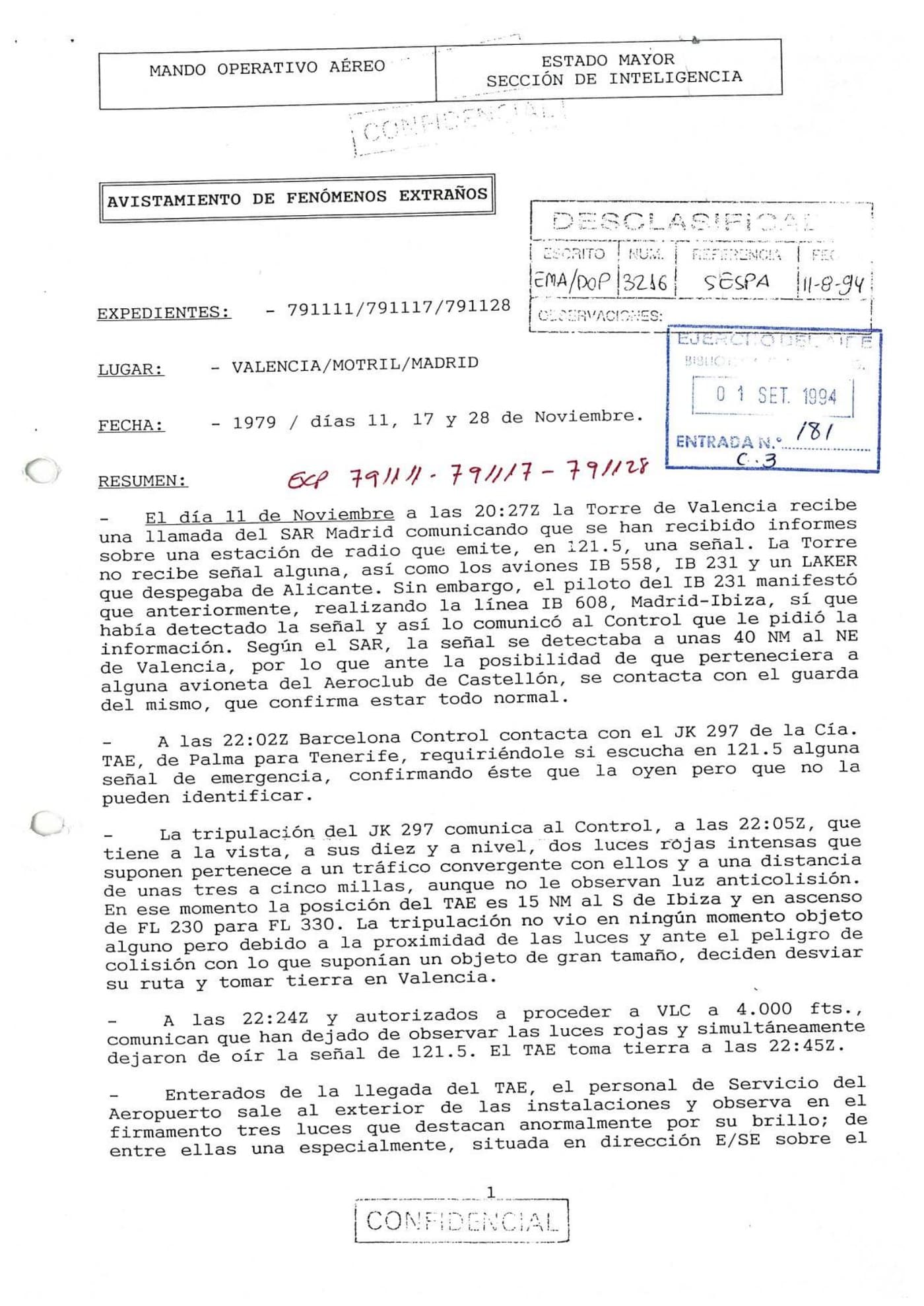
At 22:05 UTC on 11 November 1979, the crew of TAE Caravelle JK297, climbing south of Ibiza, reported two intense steady red lights near its level and apparently converging. The crew saw lights, not a resolved craft, and diverted to Valencia; it lost sight of them at 22:24 and landed at 22:45. Airport personnel then watched other bright, colour-changing lights. An F-1 from Albacete was scrambled and pursued lights without closing them. The declassified Spanish Air Force file is unusually valuable because its investigating judge separated the airliner, airport and later low-altitude observations. It records no unknown-object contact on the fighter, Pegaso, Barcelona or Valencia radars, and the fighter camera failed. The judge considered reflection in ice crystals, celestial objects with atmospheric scintillation, and uncontrolled traffic, but found the data insufficient to accept or reject any hypothesis categorically. Later refinery-flare and astronomical reconstructions are relevant conventional proposals, not the official conclusion. The event is therefore well documented as an operational aviation response but disputed as a single unexplained object.
This case is disputed. The archive preserves the claims while separating evidence from interpretation.
- Documentation
- High documentation
- Primary location
- Ibiza–Valencia air corridor and Manises Airport
- Source base
- 6 linked records
- Research use
- Comparison case
What the declassified record establishes
- Airliner report
- JK297 reported two intense steady red lights at 22:05 UTC and diverted to Valencia; the crew did not resolve a craft behind them.[1]
- Radar boundary
- The official inquiry found no unknown-object contact on the fighter, Pegaso, Barcelona or Valencia radars.[1]
- Military response
- One F-1 was scrambled from Albacete. It reported lights and interference but produced no radar return or photograph.[1]
- Official conclusion
- The judge separated three observation phases and said the information could not categorically accept or reject any hypothesis.[1]
Declassified chronology and radar boundary
Case dossier
The official chronology begins before the visual report. At 20:27 UTC, Valencia tower received a call from Madrid search and rescue about an unidentified transmission on the emergency frequency 121.5 MHz. Aircraft queried at Valencia did not then hear it, although the JK297 crew later said it had heard the signal earlier while operating flight IB608 from Madrid to Ibiza. At 22:02 Barcelona Control asked JK297, now flying Palma–Tenerife, to monitor 121.5; the crew heard the transmission but could not identify it. The file treats this as a radio anomaly. Temporal overlap with the lights is not evidence that one source produced both.
At 22: 05, about 15 nautical miles south of Ibiza and climbing from flight level 230 toward 330, the crew reported two very bright red lights at roughly the ten-o'clock position and near its altitude. Early estimates in the file range from about three to five miles to roughly ten miles; a later newspaper interview offered still closer and larger impressions. These are cockpit judgments made at night without a resolved outline or measured range. Concerned about collision with what seemed a large object, the commander turned toward Valencia. The lights remained to the left until the crew lost them at 22:24 while descending toward the airport.
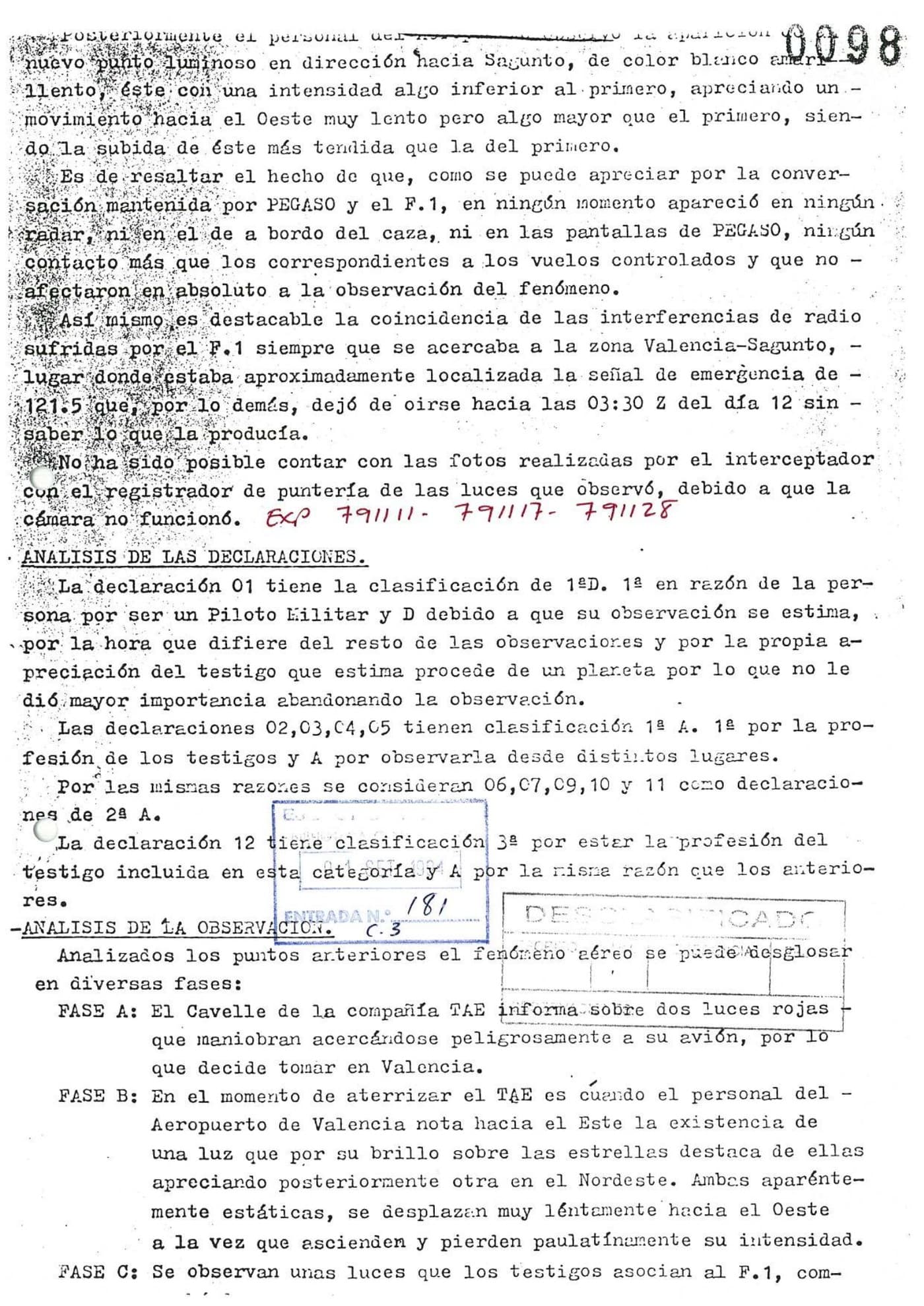
JK297 landed at 22: 45. Personnel outside Manises then described three unusually bright sky lights; the strongest lay east-southeast, about 20 degrees above the horizon, and appeared to flash green, red and white. The file says their later motion followed the firmament, a feature compatible with celestial sources. Two controllers also used binoculars to report navigation-like lights moving south between El Saler and La Albufera at an estimated 2,500–3,000 feet. Their estimate was visual, and those lights were not the F-1, whose reported position was then north of Calles. No radar track independently fixed the low-altitude traffic.
An F-1 from Albacete contacted the Pegaso control centre at 23:42 and was guided during the search. The pilot reported lights and radio interference but could not appreciably reduce the distance; he ended the mission at 00:57. The judge found that an apparent multiple-target report at Pegaso resulted from the discriminator display and hurried communication: operators were following JK297, not a second unknown track. The fighter radar, Pegaso, Barcelona Control and Valencia ground-controlled approach recorded no unknown-object contact. The camera was inoperative, so the sortie yielded neither a radar return nor photograph of the reported source.
The investigating judge divided the evidence into phases rather than assuming one object. For the airliner lights he discussed a reflection of the aircraft's own navigation light in ice crystals and unidentified traffic, while noting missing tests and observations. For the airport lights he regarded a celestial body—probably a planet, distorted and coloured by atmospheric scintillation—as an acceptable but not proven hypothesis. The low moving lights could have been uncontrolled aircraft or helicopters. His 28 November report says the information was insufficient to accept or reject any hypothesis categorically. A conditional passage about a single unknown craft or energy applies only if all phases were one phenomenon; it is speculation, not a finding.
Contemporary El País reporting establishes how quickly the episode became public, but also shows why press claims require checking. Its 13 November account spoke of radar detection and four Phantoms; the official file instead documents one F-1 and no unknown radar track. A 16 November interview preserves the commander's attributed impressions, not calibrated measurements. A 2000 skeptical reconstruction, summarized favourably in El Escéptico, attributed major phases to refinery flares, stars and misinterpretation. That later proposal is useful because it tests ordinary light sources, but the review does not itself publish the complete primary flare logs, geometry and meteorological chain needed to make it dispositive. The defensible result remains B / DISPUTED: multiple documented reports and a real diversion/intercept, bounded by absent radar corroboration, separated observation phases and unresolved conventional alternatives.
Timeline
- Valencia tower is alerted to an unidentified 121.5 MHz transmission.
- JK297 reports two intense red lights south of Ibiza and turns toward Valencia.
- The crew loses sight of the red lights while descending; the 121.5 signal also ceases.
- JK297 lands at Valencia; airport personnel continue observing other lights.
- The scrambled F-1 contacts Pegaso and begins the guided search.
- The F-1 ends its mission without an unknown radar return or photograph.
- The investigating judge reports insufficient data for a categorical hypothesis.
- JEMA order 3216 declassifies the compiled file.
Manises incident questions
Why did JK297 divert?
The crew feared collision after seeing two intense red lights apparently converge near its altitude. It chose Valencia and landed safely.
Did radar track a UFO?
No unknown-object radar track appears in the inquiry. Pegaso's apparent multiple targets were explained as display and communication confusion while tracking JK297.
How many fighters were involved?
The official file documents one Spanish Air Force F-1 from Albacete. Early newspaper claims of four Phantoms or two interceptors are not supported by that record.
Were all the lights one object?
That was not established. The judge explicitly separated the airliner lights, sky lights seen from Manises and low navigation-like lights.
Did officials identify an extraterrestrial craft?
No. The judge found the evidence insufficient for any categorical hypothesis. A conditional exotic possibility in the report is not an official finding.
Are refinery flares the proven answer?
No. They are part of a later conventional reconstruction. The reviewed summary does not supply a complete primary-source chain sufficient to make that reconstruction the official or definitive solution.
Sources
- [1] Official fileSpanish Air Force declassified file: Valencia, Motril and Madrid, November 1979Biblioteca Virtual de Defensa
- [2] Official fileOfficial METS metadata and CC BY 4.0 digital-copy rightsBiblioteca Virtual de Defensa
- [3] News reportUn ‘ovni’ forzó el aterrizaje de un Caravelle en ManisesEl País
- [4] News reportEncuesta oficial sobre el aterrizaje forzoso de ManisesEl País
- [5] News reportEl último piloto español ‘asaltado’ por un ovni cuenta su experienciaEl País
- [6] ResearchReview of El expediente ManisesEl Escéptico / ARP-SAPC
Both displayed images are localized pages from the declassified Spanish Air Force file under CC BY 4.0. They are archival documents, not event photographs, radar plots or depictions of the lights. No Sóller photograph, newspaper image or documentary frame is presented because event relevance, custody or reuse rights were not adequately established.