
United Kingdom / 1957 / DISPUTED
1957 Milton Torres UFO intercept
On 20 May 1957, USAF pilot Milton Torres said he flew an F-86D from RAF Manston to intercept a target tracked by ground radar over the North Sea. In a statement written decades later, he said an authenticated order told him to fire all 24 rockets and that his airborne radar briefly locked the target, but he never saw it. Another pilot later remembered the mission while disputing important details. The surviving public files preserve these retrospective accounts, not contemporaneous radar plots, controller recordings or a complete 1957 mission file.
This case is disputed. The archive preserves the claims while separating evidence from interpretation.
- Documentation
- High documentation
- Primary location
- RAF Manston, East Anglia and the North Sea
- Source base
- 8 linked records
- Research use
- Comparison case
What the record supports
- Confirmed archive fact
- DEFE 24/1931 preserves Torres's later written account, and The National Archives identifies the F-86D incident in its 2008 guide.[1][2]
- Reported mission
- Torres said he received an authenticated order to fire 24 rockets after an airborne radar lock, but he never saw the target and did not fire.[1][8]
- Corroboration limit
- Roberson remembered an armed radar mission but disputed the launch sequence, loading location, number of returns and sustained lock.[5]
- Missing primary record
- No raw radar track, controller recording, authenticated fire order, aircraft log or complete contemporary mission file is public.[1][3][4]
- Media boundary
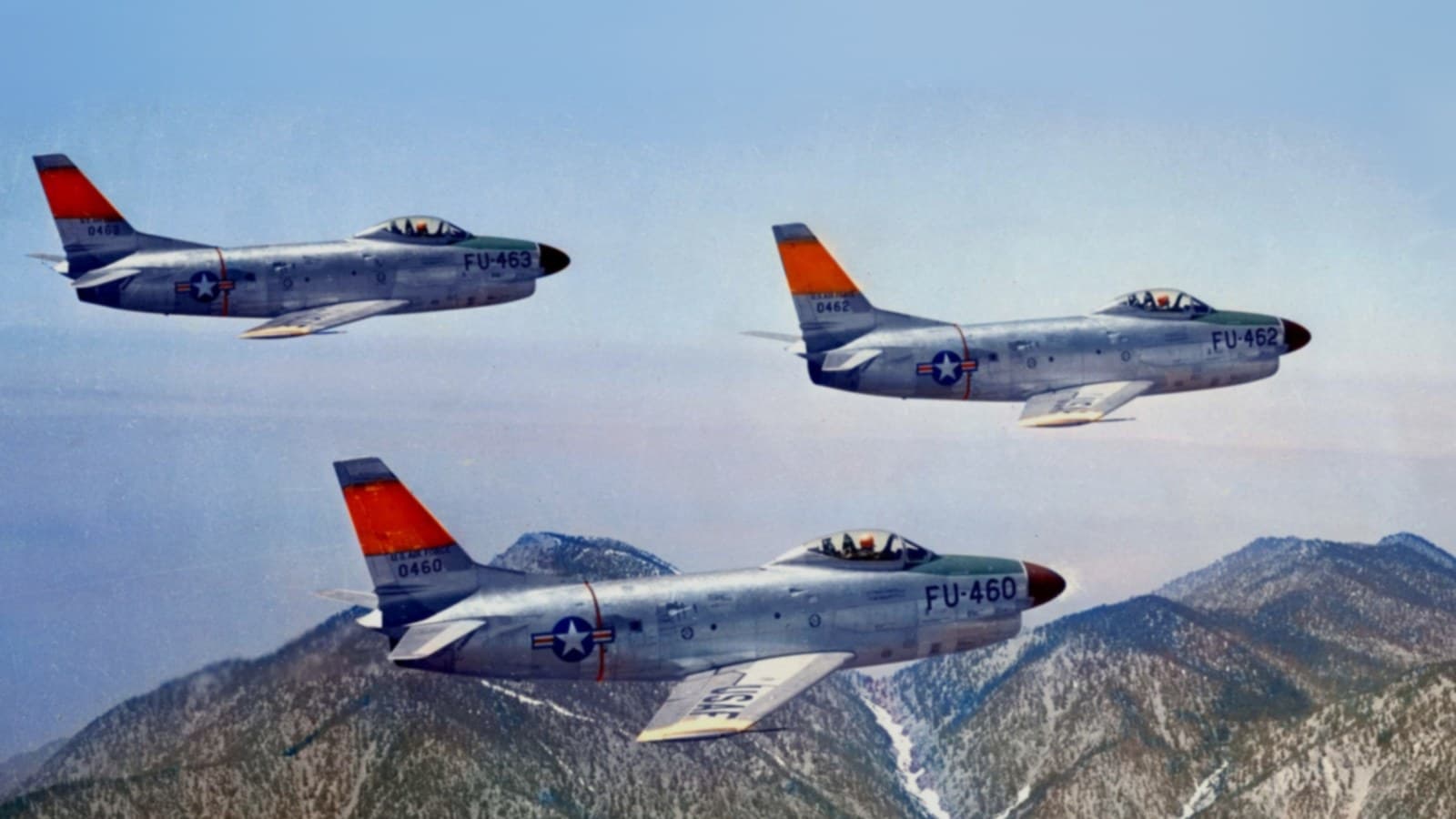
- The F-86D image shows the aircraft type only. No authenticated event photograph, radar-scope image, audio or original video has been located.[8]
Case dossier
Torres's later statement places the event on 20 May 1957 during a night of instrument-weather flying. He described serving with a U.S. Air Force F-86D interceptor unit at RAF Manston in Kent. The F-86D was an all-weather interceptor whose Hughes fire-control system combined radar with a retractable tray of 24 unguided 2.75-inch rockets. That technical configuration is independently documented; whether every detail of the reported mission occurred as later remembered is a separate question.
According to Torres, ground control ordered two aircraft into the air and directed him east over the North Sea. He recalled climbing in full afterburner to about 32,000 feet while controllers described a very large return that could remain nearly stationary. He said the instruction changed from interception to an authenticated order to fire a full salvo. Torres selected all 24 rockets but still had no visual contact through cloud and darkness.
Torres wrote that his onboard radar acquired a strong lock at roughly 15 miles. Before he reached firing range, the return moved away, broke the lock and disappeared from both his display and the ground-control picture. He did not launch a rocket. Because no visual identification was made, the central event is a reported radar interception rather than a radar-visual encounter, and later claims about the target's physical size or acceleration depend on the missing sensor record.
Dave Roberson, who later identified himself as the other pilot, remembered a radar-directed armed mission but not the same sequence. He thought they were already on a training flight, landed at RAF Bentwaters to load live rockets and then relaunched. He recalled several returns, no visual sighting and no sustained lock, although Torres told him he had locked one. The overlap supports that a sortie was remembered by two named pilots; the differences weaken any minute-by-minute reconstruction.
The most detailed public version entered the archive long after 1957. Torres's written account appears on pages 259 to 263 of Ministry of Defence file DEFE 24/1931, a file series catalogued as public correspondence from 1986 to 1992. Related correspondence also appears in DEFE 24/1942. These records show that the claim was submitted to and retained by the Ministry; they are not a contemporaneous operations log, weapons authorization form or radar transcript.
The National Archives explains that, until 1967, Ministry of Defence policy called for UFO files to be destroyed after five years. That policy makes loss of early material plausible, but it does not prove that a particular Torres mission file once existed or was destroyed. This review located no raw radar plot, controller recording, authenticated fire order, aircraft log, maintenance record or contemporaneous witness statement capable of testing the later performance claims.
The October 2008 release made the account newsworthy because it joined a named fighter pilot, an alleged weapons order and Cold War air-defence secrecy. Those elements justify preserving the case, but the archive supports a narrower conclusion than many headlines: Torres and Roberson later described a radar-directed mission, while the target, its motion and the exact command chain cannot be independently reconstructed from the surviving public record.
Timeline
- Torres later dates the radar-directed F-86D mission to this night.
- He says ground control directed him over the North Sea and issued an authenticated full-salvo order.
- Torres reports a radar lock at about 15 miles, followed by the return's disappearance; no rocket is fired and no visual contact occurs.
- Torres later says he was debriefed and ordered not to discuss the event; no contemporaneous debrief record is public.
- Torres's written narrative and related correspondence enter Ministry of Defence public-correspondence files.
- The National Archives release includes DEFE 24/1931 and identifies the East Anglia F-86D incident in its highlights guide.
- The Guardian and Reuters report Torres's account during coverage of the file release.
- The archive review separates the retrospective testimony from the missing contemporaneous operational record.
Milton Torres intercept questions
What happened in the Milton Torres UFO intercept?
Torres later said ground control sent his F-86D toward a large radar return on 20 May 1957 and authorized a full rocket salvo. He reported a brief airborne-radar lock, no visual contact and no firing before the return disappeared.
Was Milton Torres really ordered to fire rockets?
That is Torres's documented later claim. The F-86D could carry 24 rockets, but no contemporaneous recording, authenticated order form, weapons log or controller transcript has been located publicly to verify the command independently.
Did Torres see the UFO?
No. His account says cloud and darkness prevented visual contact. The case therefore depends on reported radar information and later testimony, not a pilot's visual description of an object.
What do the UK National Archives records prove?
They prove that Torres's account and related correspondence were retained in government files and released in 2008. The relevant series is later public correspondence, not a complete 1957 operations file, so archival custody does not verify every mission detail.
Was the incident a Palladium radar-spoofing test?
That remains speculative. Public CIA history documents Palladium from 1960 onward, three years after the Torres date. It shows that radar deception later existed but supplies no record tying the program to this mission.
Is there a photo or video of the 1957 event?
No authenticated event image, radar-scope photograph, audio or original film has been located. The page image is a public-domain F-86D aircraft-type photograph and does not show Torres's aircraft, the target or the mission.
What is the most careful conclusion?
Two named pilots later remembered a radar-related armed sortie, but their details conflict and the primary operational record is absent. The target remains unidentified in the surviving account, but the evidence does not establish an extraordinary craft or verified combat engagement.
Sources
- [1] ArchiveDEFE 24/1931: Milton Torres retrospective account, pages 259-263UK Ministry of Defence / The National Archives scan via The Black Vault
- [2] Official fileOctober 2008 UFO files highlights guideThe National Archives
- [3] Official fileUFO records research guideThe National Archives
- [4] Official fileAugust 2009 UFO files research guideThe National Archives
- [5] ResearchUSAF F-86D at Manston ordered to fire at UFO, 20 May 1957History of Manston Airfield
- [6] News reportUS pilot was ordered to shoot down UFOThe Guardian
- [7] News reportUS pilot was ordered to shoot down UFOReuters / ABC News Australia
- [8] Official fileNorth American F-86D Sabre fact sheetNational Museum of the U.S. Air Force
No authenticated image, audio or original video of the 1957 mission has been located. The F-86D photograph identifies the aircraft type only; the records discussed are later testimony and archival correspondence.