
Brazil / 1982 / DISPUTED
1982 VASP Flight 169 UFO Sighting
On February 8, 1982, VASP Flight 169 reported a bright light while flying toward Rio de Janeiro. Brazil's national archive preserves exchanges between crews and air traffic control, including a controller's report of a nearby radar point. Another crew suggested Venus. These records establish a real aviation report, not the identity or performance of an extraordinary craft. Later astronomical analysis favors Venus and possible refraction, but the original radar data and atmospheric measurements needed to test every detail are not supplied by the cited record.
This case is disputed. The archive preserves the claims while separating evidence from interpretation.
- Documentation
- High documentation
- Primary location
- Belo Horizonte to Rio de Janeiro
- Source base
- 4 linked records
- Research use
- Comparison case
What the VASP records establish
- Date and route
- 8 February 1982, toward Rio de Janeiro. The map marks Belo Horizonte approximately as a route reference, not the target's location.[1][2]
- Documented exchange
- A controller reported a point about eight miles away; the transcript alone cannot identify it or match it securely to the light.[1]
Case dossier
A flight report, not a fixed observation site: the February 9 issue of O Imparcial describes a VASP service from Fortaleza to São Paulo with a stop at Galeão, Rio de Janeiro. It names the captain as Gerson Brito; later analysis uses Gerson Maciel de Britto. The official February 8 transcript places the aircraft near and south of Belo Horizonte, continuing toward Rio. These route references do not establish the light's coordinates. Brasília was the control center, not necessarily the location of the reported object.
What the crew and passengers described: VP 169 reported a light at its nine-o'clock position, changing among orange, red and white. O Imparcial recorded the captain's interpretation of a disc, but passenger Cilezia Paes Del Rosso described a bright, largely static appearance after his announcement. These are descriptions from different viewpoints, not measured dimensions. The same newspaper quoted Cardinal Aloisio Lorscheider saying that he did not look. He should not be counted as an eyewitness, and the aircraft's passenger total cannot become a verified witness count.
The radar point that must not be omitted: the Arquivo Nacional file initially records control reporting no traffic in the indicated direction. At the printed time 0718 on February 8, however, the controller says a point is appearing at the VASP aircraft's nine-o'clock position, about eight miles away and following its movement. Saying that radar never registered anything would misrepresent this transcript. Equally, a controller's description is not the original radar plot. Without the returns and system assessment, it does not establish that this point and the visible light were one physical target.
Other aircraft did not give a unanimous answer: the February 8 exchanges include QD 177 and AR 169. AR 169 initially reports restricted visibility through cloud, then suggests Venus; QD 177 reports the luminosity and counters by referring to Brasília's radar reception. The radio conversation connects these observations, but also prompts the crews to look in a particular direction. It documents disagreement rather than independent confirmation of an exotic craft. The time standard is not explicit in the scanned heading, so its printed times are not silently converted to local time here.
Three dates inside one official file: CINDACTA's June 3, 1982 covering letter accompanies transcripts for February 8, 9 and 10. On February 9, a flight again using VP 169 is allowed to turn toward a light; the conversation discusses Venus and no radar echo. A call sign does not prove the same crew, and this maneuver must not be inserted into Britto's previous-day report. A February 10 QD 035 report gives an elevation estimate of 10–15 degrees. That estimate likewise belongs to its own observation, not automatically to February 8.
Venus, refraction and the limits of a reconstruction: astronomer Luiz Augusto L. da Silva's 2022 analysis favors Venus, possibly distorted by atmospheric refraction. This offers a conventional explanation for a conspicuous distant light, but a proposed mirage is not a measured atmospheric profile. His categorical account of what the other crews concluded is stronger than the archived exchange warrants. The original transcript therefore takes precedence on who said what. A plausible astronomical explanation and an unresolved radar statement can coexist without establishing an extraordinary aircraft.
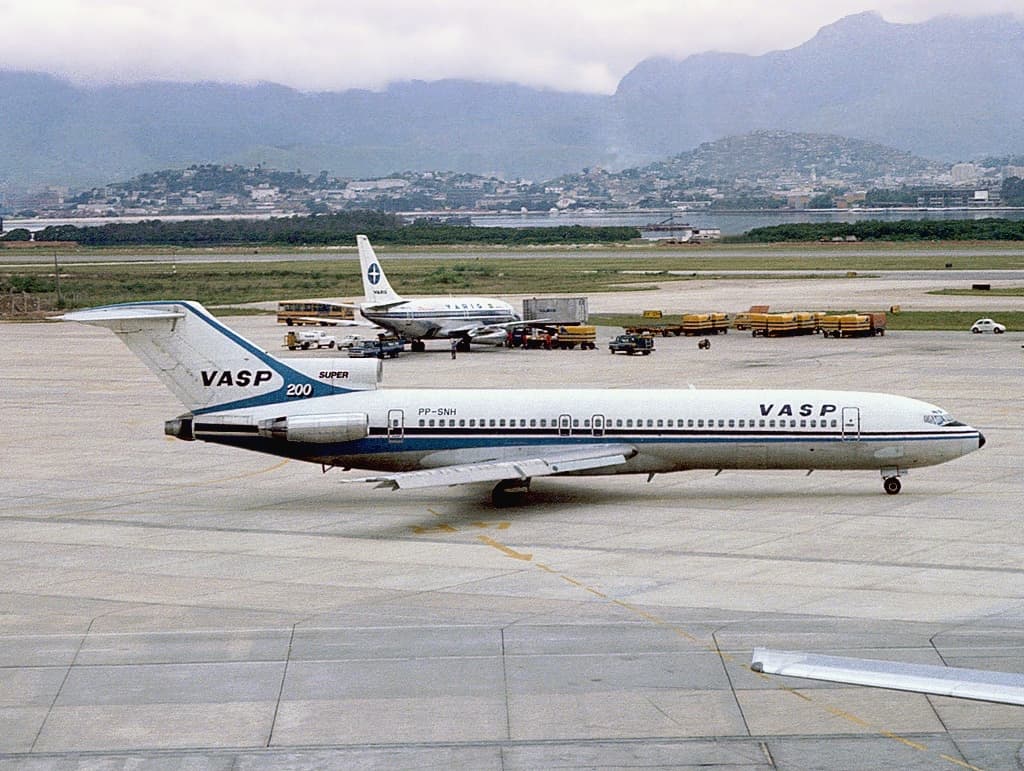
The photographs are a separate evidence question: da Silva attributes a series of passenger photographs to Lígia Auxiliadora Rodrigues and interprets the bright features in negatives 13–15 as navigation-light reflections on nearby clouds, not resolved images of the distant target. That is his analysis of supplied copies, not a new inspection of the original negatives here. Credit and permission to view are not commercial republication rights, so the analysis is linked without copying those photographs. The local image shows a different VASP Boeing 727, PP-SNH, photographed in November 1984; it is airline and aircraft-type context, not the incident aircraft PP-SNG or a UFO photograph.
Why VASP 169 belongs in the archive: official communications, next-day reporting and later technical interpretation allow the claims to be compared rather than merely repeated. Their strongest common conclusion is that an unusual light generated serious reports and disagreement. No cited material establishes its physical dimensions, extraordinary acceleration or nonhuman origin. The case remains disputed at the identification level, while its documentary history is substantial. It should also remain separate from Brazil's military aircraft and radar reports of May 1986, which involve different dates, crews and records.
Related checks and records
Timeline
- VP 169 and other crews discuss a bright light with control; the transcript includes both a radar-point statement and a Venus suggestion.
- O Imparcial publishes pilot and passenger accounts. Separately, a new VP 169 radio exchange describes a turn toward a light.
- QD 035 reports a light with an estimated elevation of 10–15 degrees; this is a separate observation.
- CINDACTA's covering letter forwards the three dates' communication transcripts in the file now held by Arquivo Nacional.
- Luiz Augusto L. da Silva publishes his retrospective Venus/refraction analysis and discussion of passenger photographs.
VASP 169 questions
Did radar confirm an alien aircraft?
No. The official transcript includes a radar-point report, but no cited raw dataset proves that point was the observed light or an extraordinary craft.
Was the VASP 169 light Venus?
Venus is a substantive conventional explanation, suggested in the contemporary exchange and developed by da Silva. It is not a verified explanation of every radar and photographic detail; the refraction reconstruction lacks measured atmospheric confirmation in the cited record.
Did everyone aboard see the object?
No verified all-passenger witness count is established. The next-day newspaper quotes Aloisio Lorscheider saying he did not look, while another passenger describes the light after the announcement.
Is there original UFO video here?
No authenticated original sighting video is embedded. The linked analysis discusses passenger photographs; the displayed aircraft photograph is later context, not a sighting frame.
Sources
- [1] Official fileCINDACTA: communications of 8–10 February 1982, national archive fileCINDACTA / Arquivo Nacional, BR DFANBSB ARX.0.0.217
- [2] News reportO Imparcial, 9 February 1982: pilot and passenger interviews (pp. 1, 6)O Imparcial / Biblioteca Digital UNESP
- [3] ResearchLuiz Augusto L. da Silva: 2022 Venus analysis and photograph interpretationLuiz Augusto L. da Silva / Rede Omega Centauri
- [4] ArchiveVASP aircraft context photograph and CC BY-SA licencePedro Aragão / Wikimedia Commons