
Brazil / 1977 / DISPUTED
Operation Saucer: Brazil's Colares UFO Investigation
Operation Saucer (Operacao Prato) was a 1977 Brazilian Air Force investigation into reports of unusual lights and alleged injuries around Colares, Para. Surviving records confirm an official inquiry, witness interviews, field observations, and photographs, but the public file is incomplete and does not identify an extraordinary craft. This dossier keeps military records, testimony, and later folklore separate.
This case is disputed. The archive preserves the claims while separating evidence from interpretation.
- Documentation
- High documentation
- Primary location
- Colares, Para
- Source base
- 8 linked records
- Research use
- Comparison case
What the surviving record supports
- Confirmed record
- I COMAR conducted a field inquiry and preserved interviews, observation forms, reports and photographs from coastal Pará.[1][2][3]
- Archive scale
- The principal public register contains 130 numbered observations dated from September 1977 through November 1978.[1][5]
- Medical boundary
- Symptoms and treatment were reported, but public files do not establish a measured exposure, shared cause or exotic mechanism.[2][5]
- Media boundary
- An event-period archive photograph survives; later documentaries and television programs are retrospective, not original sighting footage.[1][7][8]
- Open question
- The causes of the whole report wave and the completeness of every material alleged in later accounts remain unresolved.[4]
Case dossier
Reports intensified in coastal Pará during the second half of 1977, especially around Colares, Vigia, Santo Antônio do Tauá and nearby islands. Residents described luminous objects or beams moving over rivers and settlements, while newspapers popularized the label chupa-chupa. The First Regional Air Command, known as I COMAR, sent personnel to collect accounts and observe the area under the inquiry later called Operação Prato.
Witness accounts varied in shape, color, movement and distance. Some residents also described heat, weakness, dizziness, superficial burns or small marks after an encounter with a light. These are recorded claims, not a single medically verified syndrome. The reports nevertheless affected daily life: later archival and academic accounts describe fear, nighttime gatherings and changing routines in the communities involved.
The surviving record is more substantial than a later legend alone. National Archives file BR DFANBSB ARX.0.0.184 contains 130 numbered observation records covering September 1977 through November 1978. The forms organize location, date, time, direction, color, apparent form, movement, estimated altitude and distance, observers and attachments. Other preserved material includes maps, sketches, interviews, press clippings and photographs.
The military record also shows why the case cannot be reduced to one interpretation. A preserved mission account says a team reached Colares on 24 October 1977 and interviewed residents. An entry from 26 October treated one observed light as a probable meteor, while the team and helicopter crew reported a different light on 1 November. The archive therefore contains both unresolved descriptions and observations assigned plausible ordinary causes.
Medical material requires the same separation. A physician told the team that she had treated four people and described weakness, headache, dizziness, tremor, first-degree burns and small perforation-like marks. The public record preserves her report, but it does not provide controlled testing, a measured exposure, an established mechanism or evidence that all symptoms shared one cause. Claims of blood extraction or exotic radiation go beyond what these documents demonstrate.
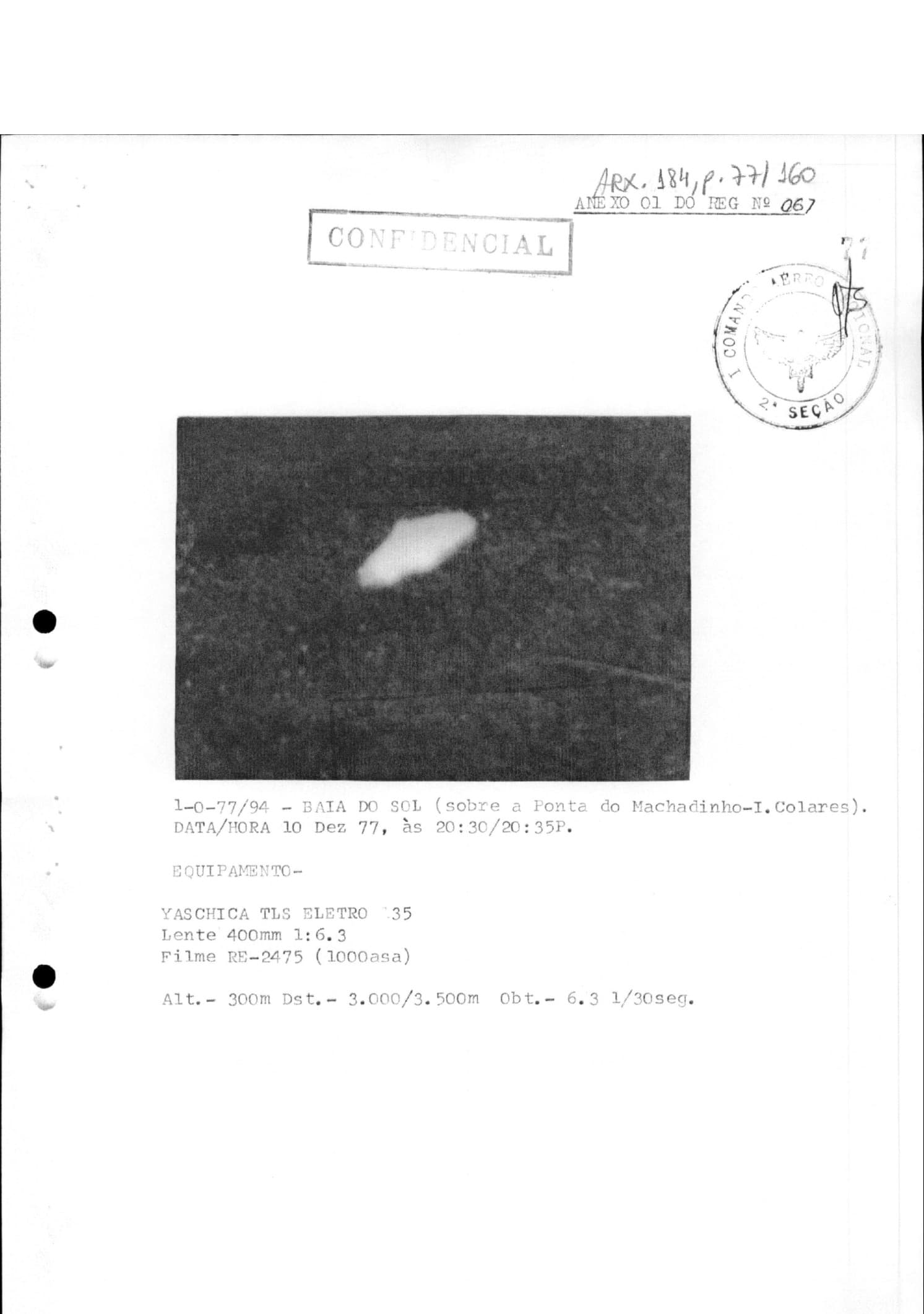
Observation register 067 provides a concrete example of the photographic evidence. Its annex records a photograph made at Baía do Sol on 10 December 1977 with a 400 mm lens and high-speed film, together with estimated altitude and distance. The scan shows an elongated bright exposure against a dark field. Provenance is unusually clear for a UFO photograph, but the single image cannot independently establish the subject's size, range, motion or identity.
Brazil's National Archives now provides public access to transferred Air Force UFO holdings. Access disputes remain part of the story: a 2023 information-review decision records the Air Force position that all UFO documentation it held from 1952 to 2022, including Operation Saucer material, had been transferred, and that additional requested information was not in its custody. That statement does not prove that every item ever alleged in later accounts exists or survives publicly.
Later interviews, television programs and documentaries made Operation Saucer one of Brazil's best-known UFO narratives. They are useful for studying memory and media history, but later testimony, reconstruction and dramatic narration must not be merged with the 1977 files. The case belongs in the archive because an official field inquiry and a large primary record survive, while the causes of the full report wave and the most dramatic injury claims remain disputed.
Related video
Timeline
- The surviving I COMAR observation register begins recording reports from coastal Pará.
- A military team reached Colares, established local contact and interviewed residents according to the preserved mission account.
- One observation entered in the mission material was assessed as a probable meteor.
- Team members and a helicopter crew recorded an observation of a light whose identity was not established in the public file.
- A mission report summarized interviews, field observations and medical claims collected around Colares.
- Observation register 067 documented a photograph made at Baía do Sol between about 20:30 and 20:35.
- The preserved 130-entry observation register reaches its final dated records.
- An I COMAR intelligence note, preserved in file ARX.0.0.322, discussed the public circulation of Operation Saucer material.
- A federal information-review decision addressed access to Air Force UFO records transferred to the National Archives.
- A further review decision recorded the Air Force statement that all UFO documentation in its custody, including Operation Saucer material, had been transferred to the National Archives.
Frequently asked questions
What was Operation Saucer?
Operation Saucer, or Operação Prato, was a 1977 Brazilian Air Force field inquiry into reports of unusual lights and alleged effects around Colares and other coastal Pará communities.
Did the Brazilian Air Force investigate the Colares reports?
Yes. National Archives files preserve observation registers, mission material, interviews, maps, sketches and photographs produced through I COMAR.
Did Operation Saucer confirm extraterrestrial craft?
No. The surviving public documents confirm an inquiry and unresolved observations, not an official finding of extraterrestrial or non-human technology.
Were people injured by the reported lights?
Residents and a physician reported symptoms and treatment. Public records do not provide controlled measurements or demonstrate that an unusual aerial source caused the symptoms.
Are there original Operation Saucer photographs?
Yes. The archive includes event-period photographs, including the annex to observation register 067. Its provenance is documented, but the image alone does not identify the bright exposure.
Is the TV Brasil documentary original footage?
No. It is a later documentary containing reporting, interviews and retrospective framing, not a recording of a 1977 observation.
What is the most careful conclusion?
A substantial official investigation and social report wave are documented. The reports probably had mixed causes, and the public evidence does not support one extraordinary explanation for all of them.
Sources
- [1] Official fileI COMAR UFO observation register, ARX.0.0.184Arquivo Nacional do Brasil
- [2] Official fileOperation Saucer mission material, ARX.0.0.322Arquivo Nacional do Brasil
- [3] Official fileBrazilian National Archives collection overviewArquivo Nacional do Brasil
- [4] Official fileCMRI Decision 205/2023 on access to Operation Saucer recordsCasa Civil da Presidência da República
- [5] ResearchUnknown etiology symptomatology: testimonies from Operation SaucerANPUH-SP 2024
- [6] Official fileOperation Saucer in the Brazilian National Archives collectionImprensa Nacional
- [7] News reportTV Brasil retrospective documentary: Chupa Chupa, the story that came from the skyTV Brasil
- [8] News reportLinha Direta Mistério retrospective on Operation SaucerMemória Globo
This is page 77 of Brazilian National Archives file BR DFANBSB ARX.0.0.184, the annex to observation register 067. It preserves a photograph made at Baía do Sol on 10 December 1977. The scan documents a bright exposure and camera notes; it does not independently establish a craft, size, distance or origin.