
Peru / 1980 / UNRESOLVED
La Joya UFO incident
The public record supports a narrow conclusion: a Peruvian Air Force response to a round, hovering object was reported to the U.S. defense attaché in 1980, including an Su-22 intercept and claimed gunfire without visible damage. It does not settle when the event occurred or what was targeted. The June 1980 message dates two sightings to 9–10 May and calls the shooting account third-party information; retired pilot Óscar Santa María Huertas later dated his flight to 11 April and supplied the familiar details of 64 rounds, repeated climbs and a close view. No contemporaneous Peruvian report, radar plot, gun-camera film, ammunition log or statement from the claimed mass of ground witnesses is public in the reviewed set. A stratospheric balloon is a plausible but unproven explanation. The case remains unresolved because an operational report exists while the geometry, chronology and physical target cannot be reconstructed from primary records.
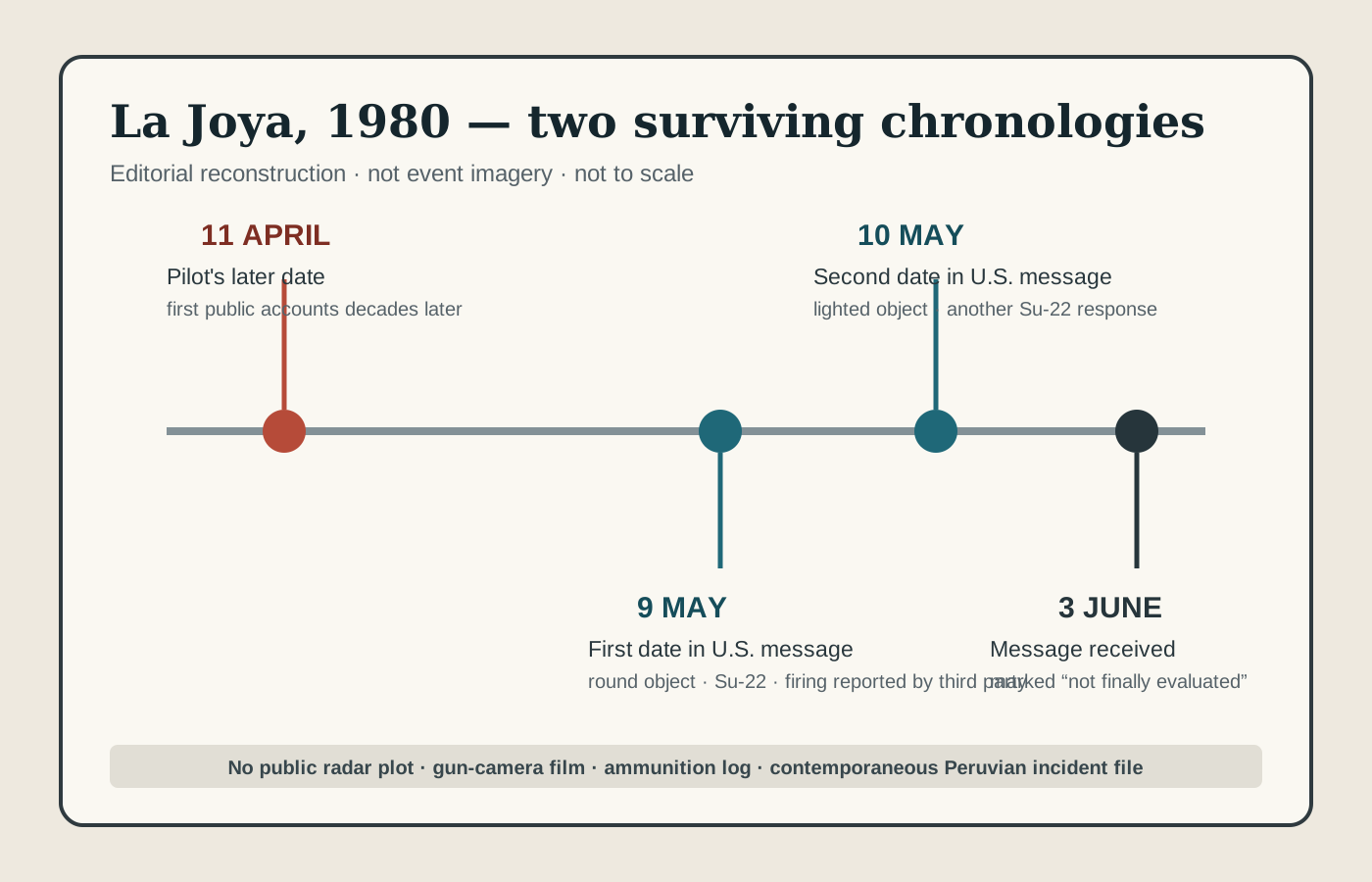
This case remains unresolved in the public record, with credibility grade B.
- Documentation
- High documentation
- Primary location
- Mariano Melgar Air Base, La Joya, Arequipa
- Source base
- 6 linked records
- Research use
- Comparison case
What the surviving record supports
Case dossier
The earliest public document is not a Peruvian incident report. On 2 June 1980 the U.S. Defense Attaché Office in Lima sent Intelligence Report 6 876 0146 80, received by the Joint Chiefs message center on 3 June. Its heading warns that the information was not finally evaluated. The named source category was a Peruvian Air Force officer who had observed the event and could hear discussions about it; however, the passage about a pilot firing at close range is explicitly attributed to a third party. The message therefore confirms that the story circulated through military channels, not that U.S. investigators witnessed or technically verified the engagement.
That message describes two occasions near Mariano Melgar Air Base at La Joya: a morning event on 9 May and a lighted object on the evening of 10 May. On the first, officers in formation reportedly saw a round object hovering; an Su-22 was scrambled, fired at close range without apparent damage and was then outrun. On the second, another Su-22 allegedly failed to catch a lighted vehicle. The reporting officer added only that other sources had discussed the sightings, that 'some vehicle' apparently had been seen and that its origin remained unknown. The message gives no time, aircraft serial, pilot name, ammunition count, radar return, altitude, range, photograph or instrument attachment.
Santa María's later first-person account is much more detailed and follows a different calendar. In interviews published from 2008 through 2023 he said the event occurred at 07:15 on 11 April, while about 1,800 people were beginning work. He said the object looked like a balloon roughly five kilometres away and about 600 metres above the end of the runway. He identified himself as the alert pilot, said he was ordered to destroy a possible spy device, and recalled firing 64 explosive 30 mm rounds from two cannon. These figures are testimony: no public contemporaneous log independently fixes them.
He described a 22- to 28-minute pursuit in which the object climbed whenever he prepared another attack. In the 2023 El Comercio interview he said he climbed above 19,000 metres, broke off when the low-fuel warning appeared and passed within about 100 metres. He described an opaque whitish dome over a broad metallic circular base, with no visible windows, rivets or propulsion. Distance, size, speed and altitude in a featureless sky are difficult visual estimates, especially from a fast moving aircraft. The claim that shells hit or were 'absorbed' is not established: in the 2008 transcript Santa María specifically said he could not resolve that, only that he aimed directly and saw no explosion or damage.
A balloon explanation has a real evidentiary lead but no completed identification. StratoCat lists double-probe electric-field balloons launched from Cachoeira Paulista, Brazil, on 3 and 9 April 1980; the latter flight is recorded as eleven hours. A later technical reconstruction argues that high-altitude easterly-to-westerly winds and visual parallax could make a distant balloon appear low, evade fire and climb as the aircraft changed position. Yet the catalog does not track the 9 April balloon to Peru, and its recorded instrument flight ended long before 11 April. The reconstruction proposes that the envelope may have continued after payload separation, but no recovery record or trajectory closes that chain. It is a testable conventional hypothesis, not a solved identification.
Timeline
- A documented electric-field balloon launches from Cachoeira Paulista; its cataloged instrument flight lasts 11 hours. A later reconstruction proposes, but does not prove, a connection.
- Date later given by Santa María for his La Joya flight; it is not the date in the U.S. message.
- First sighting date in the U.S. report: round hovering object, Su-22 intercept and third-party gunfire claim.
- Second sighting date in the U.S. report: a lighted object allegedly outruns another Su-22.
- The Joint Chiefs message center receives the attaché report, marked not finally evaluated.
- Santa María says the Peruvian Air Force authorized public discussion and requested his written statement; that statement is not public in the reviewed corpus.
- El Comercio publishes a direct retrospective interview, including the 19,000-metre and roughly 100-metre estimates.
La Joya incident questions
Did the La Joya incident really occur?
A military response was reported through U.S. intelligence channels in 1980. The exact date, number of events and detailed flight sequence remain disputed.
Did Santa María fire 64 rounds?
He consistently said so in later interviews. The contemporary U.S. message reports gunfire but gives no round count and says that detail came through a third party.
Was the object tracked on radar?
No public radar plot has been located. Later claims about radar cannot substitute for a released sensor record.
Could it have been a stratospheric balloon?
Possibly. A 9 April Brazilian launch and high-altitude westward winds make the idea testable, while missing trajectory and recovery data prevent a definitive match.
Why is the case still unresolved?
The intercept report is credible enough to preserve, but conflicting dates and missing contemporaneous Peruvian and sensor records prevent reconstruction of the physical target.
Sources
- [1] Official fileUFO Sighted in Peru — IR 6 876 0146 80 (FOIA transcription)Defense Intelligence Agency release / NICAP archive
- [2] News reportOvnis en Perú: habla el ex piloto FAP que persiguió un objeto sobre ArequipaEl Comercio Perú
- [3] ArchiveEl OVNI y el piloto de ataque — entrevista a Óscar Santa María HuertasRuta de Ovnis transcript / Investigación Ovni en Perú
- [4] Reference databaseStratospheric balloons launched in 1980StratoCat
- [5] ResearchCombate a 20.000 metrosGluon con Leche
- [6] Research‘Unexplained’ Cases—Only If You Ignore All ExplanationsSkeptical Inquirer
The displayed image is an original record-timeline reconstruction made for this archive. It is not an event photograph, Su-22 image, radar plot or official document scan. No rights-clear, custody-sound event image or video was established.