
Brazil / 1986 / UNRESOLVED
Brazil Night of the UFOs
The best-supported core of Brazil's 1986 'Night of the UFOs' is an air-defense response, not a resolved identity. Controllers reported multiple radar plots around São José dos Campos and Anápolis; five fighters were launched, and contemporary officials publicly acknowledged the operation. Individual records do not describe one uniform encounter: some pilots saw lights, some obtained radar contact, and others saw nothing despite ground vectors. A 2 June command report characterized the phenomena as apparently solid and responsive, but the public archive does not include calibrated raw radar data sufficient to independently test every speed, size or maneuver later attributed to the targets.
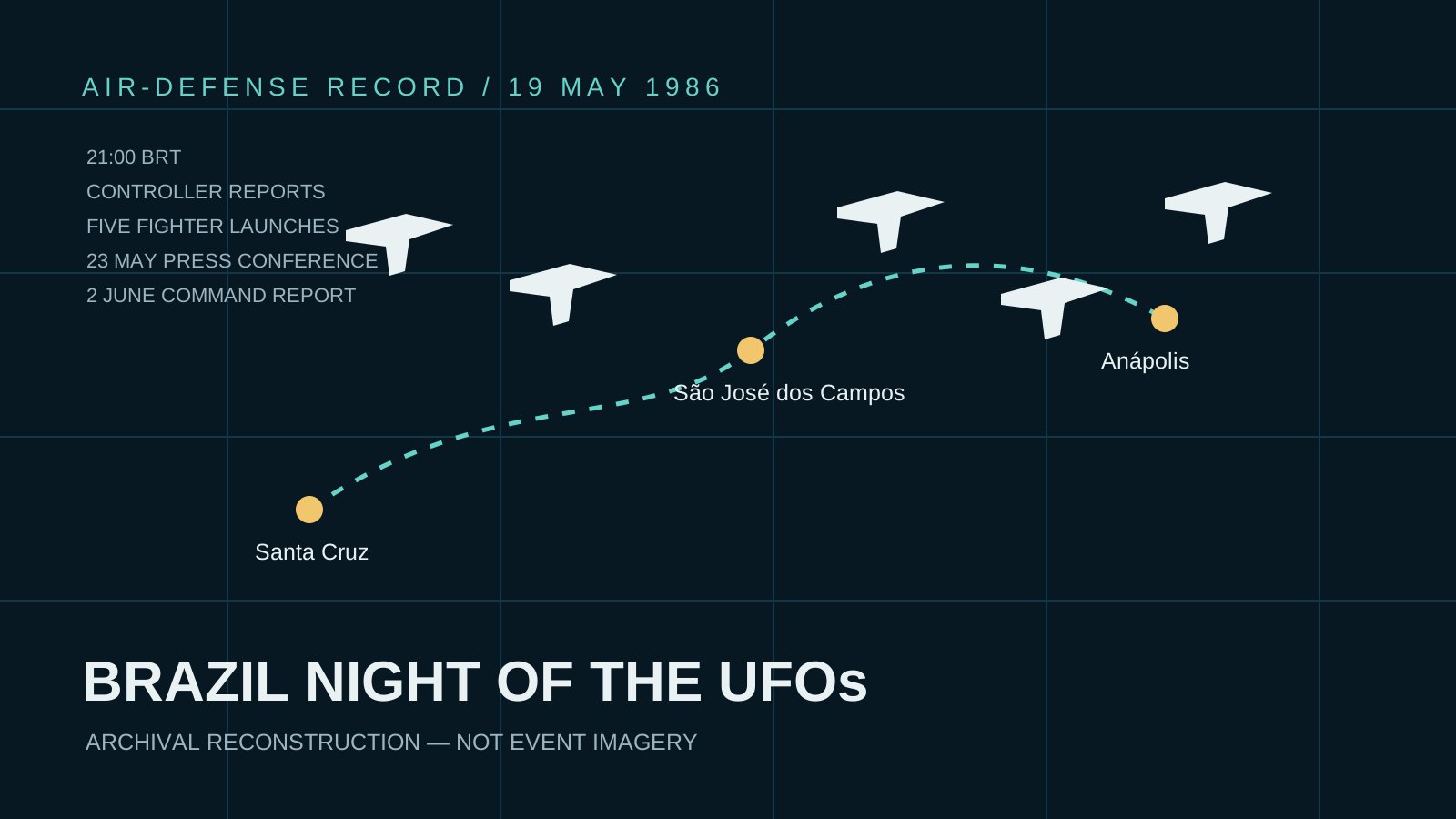
This case remains unresolved in the public record, with credibility grade B.
- Documentation
- High documentation
- Primary location
- São Paulo, Rio de Janeiro, Minas Gerais and Goiás
- Source base
- 8 linked records
- Research use
- Comparison case
What the 1986 record establishes
- Confirmed operation
- Five fighters launched from Santa Cruz and Anápolis after controllers reported unidentified returns.[1][2][5]
- Different encounters
- Pilot reports range from visual plus radar contact to no visual contact despite ground vectors.[3][4][5]
- Official boundary
- Officials said there was no technical explanation; they did not identify extraterrestrial craft.[1][8]
Case dossier
The alert developed across separate sectors. Near São José dos Campos, air-traffic and air-defense personnel reported unidentified radar returns while the Xingu aircraft carrying Ozires Silva approached the city. Around Anápolis, the record begins after midnight in UTC: an alert was ordered at about 01:20Z on 20 May and the first Mirage, call sign Jaguar 116, departed at 01:48Z. These timestamps belong to the same Brazilian evening operation; they do not establish that every plot in São Paulo, Rio de Janeiro, Minas Gerais and Goiás was the same object.
The Santa Cruz pilots' signed reports preserve an important contrast. First Lieutenant Kleber Caldas Marinho described a pulsing white, green and red light, a ground-radar correlation, and one airborne-radar contact at roughly 10–12 nautical miles. Captain Márcio Brisolla Jordão wrote that ground control repeatedly placed contacts near his F-5, yet he obtained no visual contact with them; later he saw a red light toward the sea, which control confirmed, but could not approach it. Their statements are pilot observations, not instrument printouts, and they should not be merged.
The Anápolis packet records multiple changing plots and three Mirage launches. Ground operators wrote that Jaguar 116 was vectored toward an eight-nautical-mile return and that the plots appeared to merge, while Jaguars 98 and 107 did not see any object. The packet also contains crew reports, but its surviving public form is a five-page administrative scan rather than a complete sensor archive. It verifies that controllers acted on displays and crews were launched; it does not by itself validate every later numerical claim about speed or diameter.
On 23 May, Aeronautics Minister Octávio Júlio Moreira Lima held a press conference with pilots and controllers. He acknowledged five fighter launches and said there was then no technical explanation, while promising investigation. The National Archives identifies a 2 June occurrence report signed by Brigadier José Pessoa Cavalcanti de Albuquerque. Its often-quoted conclusion judged the phenomena solid and suggestive of intelligence because they maintained distance and formation. That is the command's contemporary assessment, not proof of occupants, extraterrestrial technology or one cause for every return.
Release history changed access, not the event itself. The Air Force transferred UFO records to the National Archives after Brazil's access-to-information regime, and in October 2015 the archive made sixteen audio files available, including eight recordings involving pilots, controllers and the defense system from 19 May. The releases allow the operation and differing reports to be studied. They do not supply a complete synchronized radar dataset, verified event photographs or physical material, so the case remains unresolved at the identification level rather than confirmed extraordinary craft.
Related checks and records
- VASP 169: Venus and the disputed radar point
Read the 1982 radio exchange before combining different crews, dates and explanations.
Timeline
- Controllers near São José dos Campos report unidentified radar returns as Ozires Silva's Xingu approaches.
- F-5 fighters launch from Santa Cruz; the signed pilot reports record visual/radar contact for one sortie and no visual contact with vectored plots for another.
- Mirage Jaguar 116 launches from Anápolis after the local alert; Jaguars 98 and 107 follow.
- Minister Moreira Lima publicly confirms five fighter launches and says no technical explanation is then available.
- The two surviving Santa Cruz pilot reports are signed, preserving their differing observations.
- The Air Defense Command occurrence report is dated and signed; it assesses the phenomena as apparently solid and responsive.
- The National Archives releases sixteen audio files from the UFO collection, including eight recordings tied to the 19 May operation.
Brazil Night of the UFOs questions
What happened during Brazil's Night of the UFOs?
Controllers reported unidentified returns on 19 May 1986 and five fighters launched. Crews reported differing visual and radar experiences without identifying the targets.
Did all five pilots see UFOs?
No. The records include visual and radar contact, partial contact, and sorties with no visual sighting despite controller vectors.
What did the Brazilian Air Force conclude?
The 2 June report assessed the phenomena as apparently solid and responsive, while the minister said no technical explanation was available. Neither statement identified extraterrestrial origin.
Were there 21 separate craft?
Officials used the number 21 for reported objects or returns, but the released records do not establish 21 continuous, independently tracked physical craft.
Are there original photos or video?
No authenticated event image was located. The strongest public media are official documents and released communications audio; later television images are reconstructions or reporting context.
Does the case prove extraterrestrial visitors?
No. It proves an unresolved air-defense incident and a substantial official record. Origin, number of physical objects and claimed extreme performance remain uncertain.
Sources
- [1] Official fileOfficial UFO Night in BrazilGovernment of Brazil
- [2] Official fileNational Archives: Official UFO NightArquivo Nacional
- [3] Official fileKleber Caldas Marinho pilot reportArquivo Nacional / Brazilian Air Force
- [4] Official fileMárcio Brisolla Jordão pilot reportArquivo Nacional / Brazilian Air Force
- [5] Official fileAnápolis air-defense alert reportsArquivo Nacional / Brazilian Air Force
- [6] ArchiveContemporary press clippings, May–June 1986Arquivo Nacional / Folha de S.Paulo
- [7] Official fileNational Archives release of 1986 audio recordingsArquivo Nacional
- [8] Official fileIdentification of the 2 June occurrence reportArquivo Nacional
The hero is an original archival reconstruction created for this case from verified dates, sectors and aircraft types. It is not an event photograph, radar screen, video frame or depiction of target shape. No authenticated event image was located; the existing YouTube thumbnail is rejected because it is later programme artwork with no clear reuse license.