
Earth orbit / 1991 / DISPUTED
1991 STS-48 UFO Video
The STS-48 UFO debate concerns lights, a flash and apparent direction changes in shuttle video attributed to September 15, 1991. Jack Kasher argued against a nearby-ice model; James Oberg proposed debris accelerated by a shuttle thruster plume. Neither screen motion nor disagreement supplies the missing target distance. NASA's mission report documents Discovery's operations, but the passages examined do not identify those points or match a particular firing to the disputed flash. The recording is not a measured demonstration of extraordinary spacecraft performance.
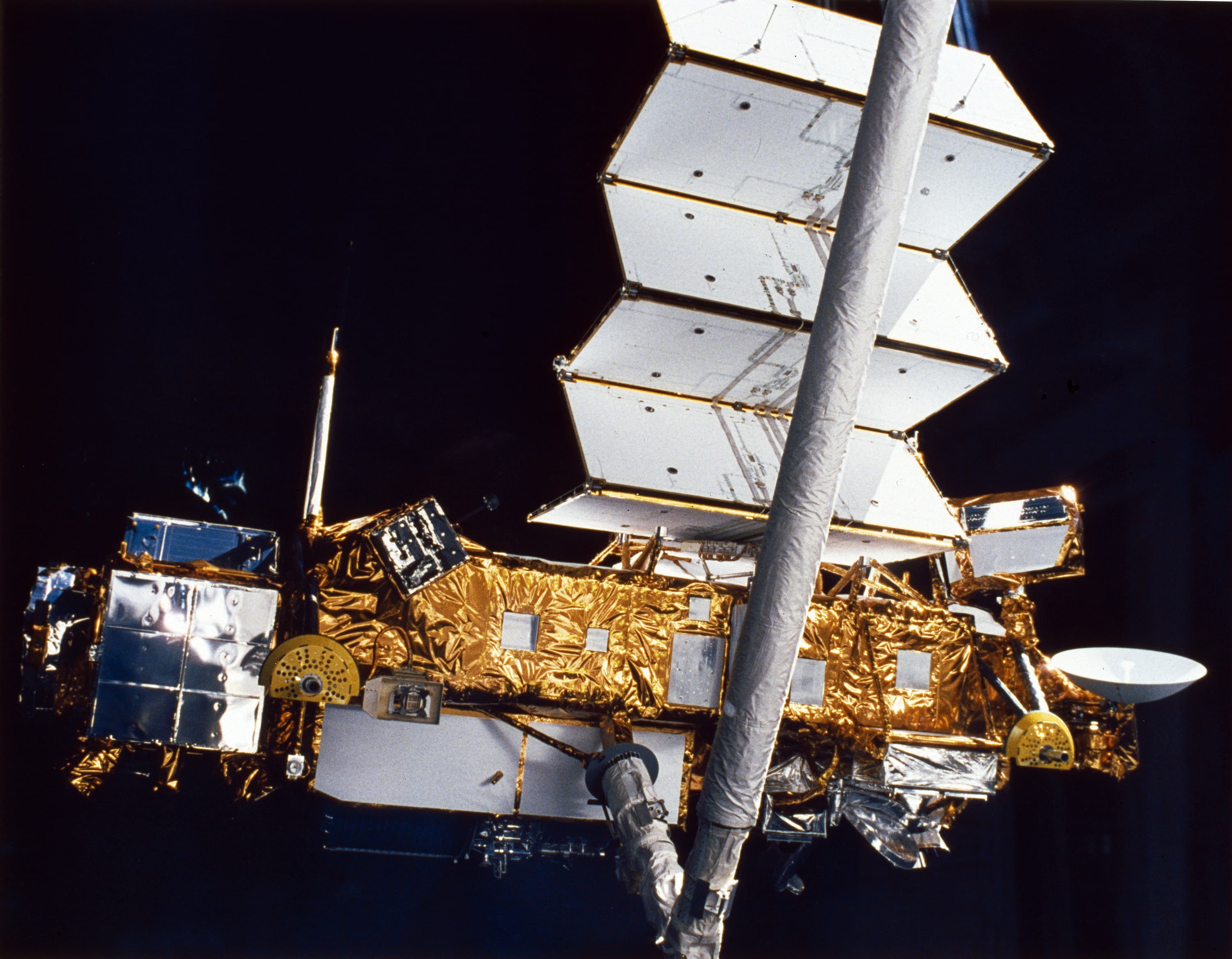
This case is disputed. The archive preserves the claims while separating evidence from interpretation.
- Documentation
- High documentation
- Primary location
- Earth orbit
- Source base
- 5 linked records
- Research use
- Comparison case
What the records establish
- Timing
- September 15, 20:30–20:45 GMT is Kasher's attribution, not a master-tape match.[2]
Case dossier
The disputed sequence: Discovery flew STS-48 from September 12 to 18, 1991. Kasher assigns the contested recording to September 15, 20:30–20:45 GMT. His analysis describes a bright point near Earth's limb, a flash, altered apparent tracks and subsequent streaks. That interval is an analyst's attribution, not a timecode independently matched here to a NASA master recording. The dispute is principally about interpreting camera images, not a separately documented crew encounter with a structured vehicle. Individual lights should not be counted as independently identified craft.
Three events, not one: NASA's October 1991 mission report places release of the Upper Atmosphere Research Satellite (UARS) at September 15, 04:23:08 GMT, or September 14, 23:23:08 CDT. It separately records a seven-second avoidance maneuver at September 16, 01:31:04 GMT for a spent rocket body from the Cosmos 955 launch. Neither is the later-September-15 interval assigned to the lights. The genuine avoidance maneuver cannot authenticate the disputed flash as that burn, and a photograph of UARS is not a photograph of the unknown points.
Kasher's argument and its limits: the 1994 MUFON proceedings analysis tracks screen positions, differentiates them and fits curves. Five arguments concern an apparent pause, back-projected tracks, expected particle speeds, a delay and rescaled geometry. These test a particular near-shuttle ice model. They are not five independent observations or direct measurements of distance. Kasher acknowledges unknown range before presenting distance-dependent accelerations. The available transcription omits supporting appendices, including the original NASA correspondence. Rejecting one model would not establish the paper's ice-or-spacecraft choice as exhaustive.
A physical alternative: in his June 28, 1992 article, Oberg describes shuttle-generated particles illuminated against space and accelerated by a thruster plume. He distinguishes atmospheric airglow from the solid-Earth edge and interprets a subsequent streak as expelled material affected by imaging. This earlier article precedes the 1994 proceedings and is not a point-by-point reply to that text. It is an authored explanation, not a NASA final finding. Its generic pulse descriptions do not supply an event-matched firing log, calibrated range or an independently reproduced identification of every point.
What the operational record adds: the mission report documents normal attitude-control activity and leakage in water-dump equipment. Neither passage demonstrates the origin of a particular bright point. A listed television-camera fault is likewise not a verified explanation of this sequence. NASA's report and the two analytical authors are different documentary lines, but Kasher and Oberg are interpreting substantially the same pictures, not supplying independent cameras. Original recording provenance, camera response, simultaneous telemetry and target range are necessary to test a precise reconstruction; missing inputs must not be replaced by certainty.
Assessment and archive value: nearby debris influenced by shuttle operations is a physical explanation that deserves testing; the published dispute does not demonstrate exotic propulsion or deliberate avoidance. Unknown identity is not positive evidence of an extraordinary craft. The case belongs here because its dated mission record and contrasting analyses show how assumptions about distance change a video's interpretation. The local UARS photograph supplies mission context only. The NASA highlights catalog is an official viewing lead, not an authenticated copy of the disputed moment. No precise ground location is assigned to this orbital recording.
Related checks and records
Timeline
- Discovery launches STS-48.
- 04:23:08 GMT: UARS release; the disputed lights are attributed by Kasher to the later 20:30–20:45 GMT interval.
- 01:31:04 GMT: a separate seven-second debris-avoidance maneuver.
- Oberg publishes his early debris/plume explanation.
- Kasher's five-argument analysis appears in the MUFON proceedings.
STS-48 questions
Did NASA confirm alien spacecraft?
No such confirmation appears in the checked mission report. Published interpretations are not an official identification.
Could the points be nearby debris?
That is Oberg's physical explanation. The available record does not independently identify each particle or reproduce a precise firing-to-video match.
Is the UARS image the UFO video?
No. It shows a known satellite during the same mission, not the disputed light points. The events and their times must remain separate.
Sources
- [1] Official fileNASA mission report: UARS release, avoidance and systemsRobert W. Fricke / NASA, October 1991
- [2] ResearchKasher's 1994 video analysis: available main text, appendices omittedJack Kasher / MUFON proceedings, NICAP transcription
- [3] ResearchOberg's June 1992 debris and thruster explanationJames Oberg / Debunker, June 28, 1992
- [4] Official fileNASA highlights catalog: mission context, not a verified event matchNASA / NTRS 19960000168
- [5] Official fileNASA/MSFC UARS photograph: mission context onlyNASA / Marshall Space Flight Center