
Earth orbit / 1965 / DISPUTED
1965 Gemini IV UFO Sighting
James McDivitt reported a white cylindrical object with a projection during Gemini IV, dated June 4, 1965 in Franklin Roach's investigation. McDivitt could not establish its distance or size. He rejected the familiar published pictures as images of his object and later favored spacecraft debris. His earlier account of a hazy photograph differs from his 1999 statement that nothing appeared in the pictures. The case is a documented astronaut report, not an authenticated photograph or identification of an alien spacecraft.
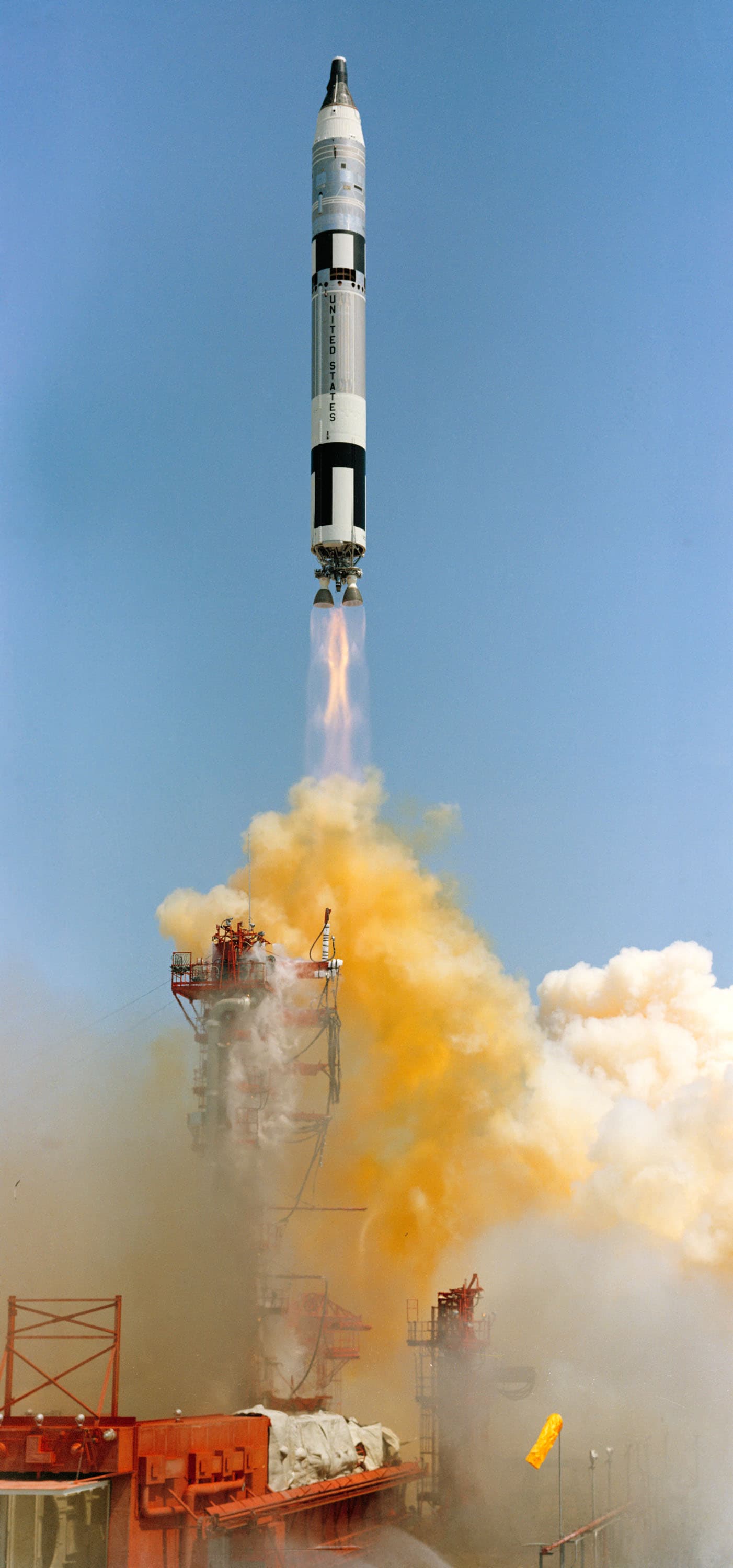
This case is disputed. The archive preserves the claims while separating evidence from interpretation.
- Documentation
- High documentation
- Primary location
- Earth orbit
- Source base
- 4 linked records
- Research use
- Comparison case
Observation versus identification
- Observer
- McDivitt described the object; White was asleep in the 1999 account.[1]
Case dossier
The observation: Roach's Condon Report chapter records a cylinder with an antenna-like extension on June 4, 1965. His October 3, 1967 interview places Gemini IV in free drift over the Pacific, with sunlight on a dirty window eventually obstructing the view. McDivitt thought avoidance might be necessary but could not determine range. The report's 3:00 CST notation is not independently matched here to a dated original sighting log. June 4 is not the June 3 launch date, and the separate bright-light report at mission elapsed 50:58:03 must not be folded into this encounter.
The astronaut's later account: in NASA's June 29, 1999 oral history, McDivitt said Ed White was asleep. The spacecraft was tumbling with equipment switched off to conserve power. He described a white can-like form with a pencil-like projection, switched on equipment in case he needed to maneuver and grabbed cameras. Rotation carried the object out of view; he did not find it again. These are relative-shape descriptions, not measurements of a beverage-can-sized object. His concern about collision is not evidence that the object approached deliberately or performed an evasive maneuver.
The photographs disagree: Roach's account says McDivitt later recognized a hazy image of what he saw. In 1999 McDivitt instead said nothing showed up when he reviewed the photographs, suggesting hurried, out-of-focus exposures. Both accounts reject the familiar released pictures as the observed cylinder. In the later interview he attributed those images to reflections of window bolts through multiple panes. That is his retrospective explanation, not a reproduced optical test. It is inaccurate either to advertise the famous picture as verified evidence or to erase the earlier report that a hazy image existed.
Competing conventional identities: in Roach's interview McDivitt favored an unmanned satellite but questioned the suggested Pegasus identification. Roach's comparison placed Pegasus B roughly 2,000 kilometres away and argued that its apparent size was too small to resolve the reported structure. That tests one proposed candidate, not every possible nearby fragment. By 1999 McDivitt favored ice or Mylar from his own spacecraft. Neither account supplies a recovered object or a reliable measured distance. Changing interpretations across decades should be reported explicitly rather than combined into a conclusive satellite identification or an exotic craft.
Official mission context: NASA's June 1965 technical report, section 7.1.2.9, describes window contamination, difficult daytime star viewing and brightly illuminated vented particles. These observations explain why orbital viewing needs care; they do not label a particular particle as McDivitt's cylinder. A timeline entry near thirty hours concerns playback and must not be substituted for the camera-exposure time. NASA's 1999 preservation of the interview records an astronaut's recollection, not institutional endorsement of an extraterrestrial interpretation. The Condon chapter is an independently authored assessment of the same witness, not a second eyewitness confirmation.
Assessment: the strongest established fact is that McDivitt described an object he could not identify at the time. Unknown distance leaves physical size and motion uncertain; the photographic disagreement limits retrospective verification. His later debris interpretation deserves attention without becoming recovered-material proof. The archive preserves the report because the primary interview and independent investigation permit those distinctions to be checked. No precise ground point is plotted for this orbital observation. The launch photograph is authentic mission context from the previous day, not the reported object or its location.
Related checks and records
Timeline
- Gemini IV launches; the local photograph shows this mission context.
- Date assigned to the cylinder report by Roach; precise exposure time unresolved.
- Roach interviews McDivitt for the university investigation.
- NASA oral history records the later debris and photograph account.
Gemini IV questions
Did McDivitt claim to see aliens?
His checked accounts do not establish that. In 1999 he favored ice or Mylar from the spacecraft and rejected an extraordinary interpretation.
Is there a verified photograph of the object?
No authenticated event image is supplied here. Roach records a hazy image claim, while the later interview says nothing appeared; both reject the famous released pictures.
Was it Pegasus B?
That identification was questioned by McDivitt and Roach. Rejecting one distant satellite candidate does not establish an extraterrestrial object or exclude nearby debris.
Sources
- [1] Official fileMcDivitt's NASA interview, pp.45–47NASA Johnson Space Center Oral History Project
- [2] ResearchRoach: Condon Report astronaut observations, pp.306–308Franklin E. Roach / University of Colorado / Project1947 copy
- [3] Official fileNASA June 1965 mission report: visual conditions and timelineNASA / MSC-G-R-65-3
- [4] Official fileNASA launch photograph: context, not the unknown objectNASA Johnson Space Center