
Earth orbit / 1998 / DISPUTED
1998 STS-88 Black Knight Satellite Photographs
The famous Black Knight images are real STS-88 photographs, but they do not establish an ancient alien satellite. NASA catalogs frames STS088-724-66, 67 and 70 as space debris, photographed on December 11, 1998. Its mission summary records lost equipment, while Brian Dunning's later account identifies the photographed object as a thermal blanket. The checked primary records do not individually connect that identification to every frame. The defensible distinction is between a documented orbital photograph, a plausible lost-hardware explanation and unsupported claims about the object's age or origin.
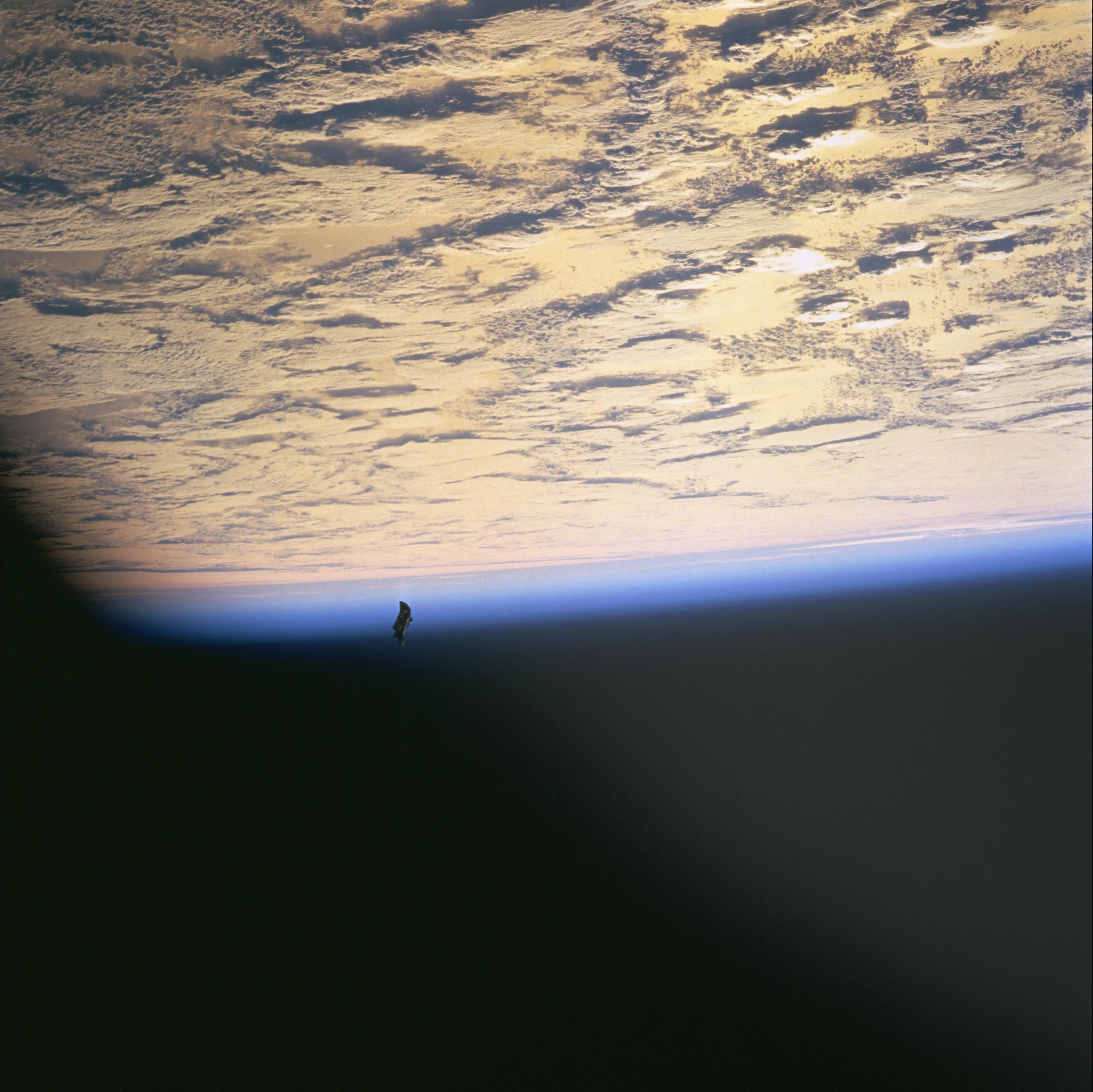
This case is disputed. The archive preserves the claims while separating evidence from interpretation.
- Documentation
- High documentation
- Primary location
- Earth orbit
- Source base
- 7 linked records
- Research use
- Comparison case
Photographic record and interpretation
Case dossier
The mission behind the pictures: Endeavour launched on December 4, 1998, to connect the American Unity module with the Russian Zarya module during the first International Space Station assembly mission. John Uri's NASA history dates the three spacewalks to December 7, 9 and 12, station entry to December 10, departure to December 13 and landing to December 15. This is a well-documented construction flight, not a mission dispatched to investigate Black Knight. The photograph dates must be checked separately from the dates of spacewalks and later publications.
What the original catalog says: NASA's Gateway to Astronaut Photography records frame 66 at December 11, 20:17:04 GMT, frame 67 at 20:17:20 and frame 70 at 20:18:44. All three list space debris among their features and have no descriptive image caption. Frame 66 records a Hasselblad camera, 250 mm focal length and high-oblique view. These are cataloged photographic observations, not a witness statement identifying an alien vehicle. Multiple frames provide related views, not multiple independent observers or instruments. The intact first image shows a small irregular dark object against Earth's cloud-covered limb.
The lost-hardware explanation: NASA's mission summary says construction items floated away, including a slidewire carrier, worksite interface socket, retractable tether and trunnion pin cover. It does not match that list item by item to these photographs. In his 2013 Skeptoid article, Brian Dunning identifies the pictured object as a lost thermal blanket and corrects an earlier account that placed its discovery in the initial post-launch inspection. This is a named secondary interpretation consistent with actual equipment losses, not a primary log establishing the precise loss date, astronaut or photo sequence. The missing match should remain explicit rather than become a falsely exact identification.
What the images cannot measure: the catalog's spacecraft nadir for frame 66 is 28.2 degrees south, 9.4 degrees east, with a shuttle altitude of 214 nautical miles, about 396 kilometres. Nadir is the point below the spacecraft, not the photographed object's position or distance. The photo-center fields are blank. Neither the silhouette nor the shuttle altitude supplies the object's physical dimensions, orbital lifetime or age. A changing outline across photographs is not by itself evidence of manoeuvring or transforming machinery. Without a target trajectory and range, a close piece of debris cannot be scaled as a distant spacecraft.
Photograph versus legend: Dunning describes a modern narrative joining earlier radio and satellite stories to the STS-88 images. Those proposed historical connections are not measurements contained in the NASA photo records. In particular, the familiar claim of a 13,000-year-old craft cannot be dated from these images. An unexplained detail in a photograph would not establish that larger story. The archive treats this as a discrete 1998 photographic case, not proof that unrelated reports across a century describe one object. Identifying the image file is firmer than identifying everything later claimed about it.
How to examine the record: compare the full frame, identifier, catalog time and adjacent images before trusting a cropped or relabelled version. The linked NASA mission summary documents ordinary hardware losses; the secondary analysis supplies a proposed identity with a remaining provenance gap. NASA's history also recommends a crew-narrated mission video published by the International Astronautical Federation. Its intact player is included as assembly-flight context, not as a verified recording of this object's release. The case belongs in the archive because it lets readers test a striking claim against accessible original photography without confusing authenticity with extraordinary interpretation.
Related video
Related checks and records
Timeline
- Endeavour launches the first ISS assembly flight.
- First spacewalk; this date does not identify the cover-loss time.
- NASA catalogs frames 66, 67 and 70 at 20:17:04, 20:17:20 and 20:18:44 GMT.
- Endeavour returns to Earth.
- Date of Dunning's Skeptoid article; the current text includes subsequent corrections.
Black Knight photograph questions
Are the Black Knight photographs real?
The STS-88 frames have NASA catalog records and downloadable originals. That authenticates the photographic source, not an extraterrestrial identity.
Was it a thermal blanket?
That is Dunning's explanation, consistent with NASA's account of lost hardware. The checked photo records call it debris but do not supply a complete item-to-frame identification chain.
Does the video show the object being lost?
The linked IAF programme is mission context recommended by NASA. No release sequence has been verified as the origin of these exact photographs.
Sources
- [1] Official fileNASA original photograph 66 and catalog metadataNASA / Johnson Space Center
- [2] Official fileNASA adjacent photograph 67NASA / Johnson Space Center
- [3] Official fileNASA later photograph 70 in the sequenceNASA / Johnson Space Center
- [4] Official fileNASA mission summary: assembly and equipment lossesNASA
- [5] Official fileNASA mission history and crew-video referenceJohn Uri / NASA, 2018-12-04
- [6] ResearchDunning's secondary explanation, with correctionsBrian Dunning / Skeptoid, 2013-06-04
- [7] ResearchIAF mission video linked by NASA: context, not a verified object releaseInternational Astronautical Federation