
Earth orbit / 1973 / DISPUTED
1973 Skylab 3 Red Object Observation
Skylab 3 astronauts reported a bright reddish object through the wardroom window in September 1973. NASA recorded changing brightness and disappearance shortly after the station entered darkness, but no confirmed identity. Four photographic frame numbers exist, with inconsistent descriptions in the NASA index. A later analysis dates the sighting September 20 and proposes a large object; that size depends on unverified exposure timing, optics and distance assumptions. The record supports an unusual observation, not a measured giant spacecraft or established extraterrestrial origin.
This case is disputed. The archive preserves the claims while separating evidence from interpretation.
- Documentation
- High documentation
- Primary location
- Earth orbit
- Source base
- 4 linked records
- Research use
- Comparison case
Records and measurement limits
Case dossier
What was reported: Alan Bean, Owen Garriott and Jack Lousma formed Skylab 3, the second crewed visit, from July 28 to September 25, 1973. Section 10.5 of NASA's January 1974 mission report describes a reddish object seen through the wardroom window, apparently brighter than Jupiter. It remained near the same part of the window for about ten minutes, shifting at most 0.17–0.35 radian. This is apparent angular movement, not a measured diameter or travel distance. The report says it was not seen again; it does not name a confirmed satellite.
Date and witness differences: NASA places the observation about ten days before return, without an exact day. Bruce Maccabee and Brad Sparks instead assign September 20, revolution 1863, roughly 16:35–16:45 GMT using a later orbital reconstruction. That is five days before return, not independent agreement on the date. Their reproduced Bean diary says twenty minutes or more, while the debriefing says five to ten. Their reproduced ground call puts the object into sunset first; the later account and NASA report put its disappearance after Skylab. The original audio is not supplied to settle these discrepancies.
Brightness is not a range measurement: NASA records roughly ten-second brightness variations of perhaps plus or minus thirty percent, leading the crew to infer rotation. No rotating shape was resolved. The reported five-to-ten-second delay after the station entered darkness prompted an estimated distance of perhaps 55–90 kilometres. That estimate assumes a relation between reflected sunlight, shadow entry and geometry; it is not radar ranging. The red hue and brightness support the description of a light, not the composition, propulsion or origin of a craft.
Four frames, two descriptions: Underwood and Holland's November 1973 NASA photographic index lists SL3-118-2138 through 2141, magazine CX-35 frames 7–10, with Nikon, SO-368 film and a 55/300 mm lens column. Page 41 calls them an unmanned satellite; page 245 calls the same frames blank. Neither label identifies a specific object. The neighboring laser-experiment pictures and following Lake Erie view are not extra UFO frames. Maccabee and Sparks associate the four frames with Garriott's observation, but the index alone does not establish the structure seen in a privately processed enlargement.
Why the large-size claim is conditional: Maccabee and Sparks argue that the fourth image represents real structure and reject several photographic-artifact explanations. Their 110-metre result assumes a 300 mm lens, a distance derived from shadow timing and an exposure shortly before Skylab entered darkness. They explicitly acknowledge that last timing assumption is unsupported. Their reasoning for the lens depends on continuity with an earlier laser experiment, not verified metadata for each exposure. Changing these inputs changes the size inference. This is an external analytical claim, not NASA measuring a 110-metre vehicle.
Mission context and explanations: a sunlit artificial object or debris is a conventional class of explanation; identifying a particular object requires more than a bright point and a timing estimate. The external authors conclude ordinary satellites cannot fit their reconstructed geometry, but that conclusion inherits the assumptions above. NASA also describes washer-like images on a solar-experiment television display and recognizable venting particles in the same section. Those are separate observations, not simultaneous confirmation of this red object or proof that it was one of those particles.
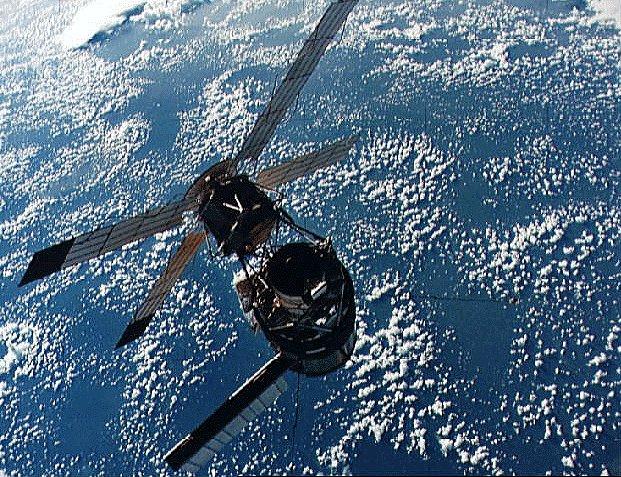
Careful assessment: the mission report establishes that an unusual light was recorded, and the index supplies traceable photographic identifiers. Neither settles the object's identity. Exact timing, photographic structure and physical scale remain disputed. The archive retains the case because primary records and a separately authored analysis allow readers to distinguish observation from calculation. The station photograph is NASA mission context, not the red object. An orbital report with uncertain timing cannot responsibly be represented by a precise ground marker.
Related checks and records
Timeline
- Skylab 3 begins the second crewed visit.
- Red-object report; September 20 is the later analysts' assigned date, not an exact day confirmed by the mission report.
- The crew returns to Earth.
- NASA photographic index lists the four frames with inconsistent descriptions.
- NASA's second-visit mission report records the red-light observation.
Skylab 3 questions
Did NASA identify the red object?
The checked mission section records observations and estimates, not a confirmed satellite identity or an extraterrestrial conclusion.
Are there four photographs?
The NASA index lists four relevant identifiers, SL3-118-2138 through 2141, with contradictory descriptions. Private enlargements require separate provenance and rights checks.
Does the case prove a giant UFO?
No. The large-size inference depends on uncertain distance, lens and photograph timing. An unidentified light and a conditional calculation do not establish a giant craft.
Sources
- [1] Official fileNASA mission report, section 10.5: visual observationsNASA / Mission Evaluation Team, January 1974
- [2] Official fileUnderwood and Holland: NASA photographic index, pp.41 and 245NASA / NASA-TM-X-69780, November 1973
- [3] ResearchMaccabee and Sparks: independent photograph analysis and its assumptionsBruce Maccabee and Brad Sparks / NICAP copy
- [4] Official fileNASA station photograph: mission context onlyNASA / HEASARC