
Chile / 2010 / DISPUTED
El Bosque Air Base video case
The best-supported event date is 5 November 2010, when a contemporary aviation observer documented the Chilean Air Force command-change ceremony and its flying display at El Bosque. Later CEFAA material is internally inconsistent: its opening text says 24 June, a diagram says 5 November, and Chilean news reports repeated 4 November. Nobody publicly reported seeing the disputed marks during the display; they were noticed in video review. CEFAA published preliminary claims that more than one camera showed a solid, sunlit, very fast object, while explicitly saying no final opinion yet existed. The public set does not include the camera-original files, synchronized timecode, metadata, measured range or a final institutional report. A nearby insect—or in some frames a bird—can create a large angular displacement and motion blur without extraordinary linear speed. The case remains C / DISPUTED: official study existed, but official involvement is not confirmation of an anomalous craft.
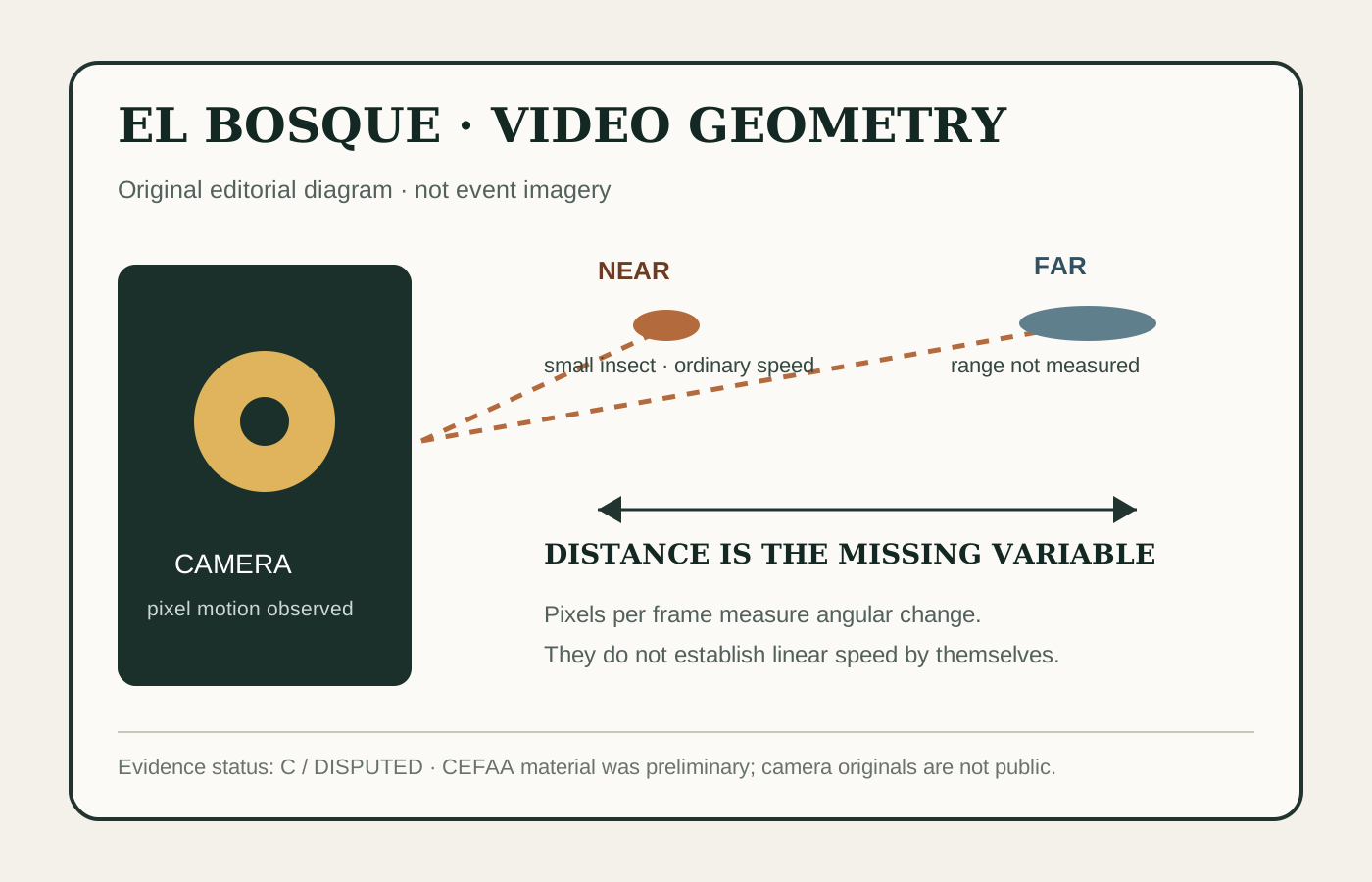
This case is disputed. The archive preserves the claims while separating evidence from interpretation.
- Documentation
- High documentation
- Primary location
- El Bosque Air Base, Santiago
- Source base
- 8 linked records
- Research use
- Comparison case
What the public record supports
- Activity date
- A same-day aviation record supports 5 November 2010; later case sources conflict with 4 November and an erroneous 24 June.[3][4]
- Observation boundary
- The marks were found in replay; no public live sighting by the crowd or pilots is established.[2][4]
- Official boundary
- CEFAA studied the clips but its surviving page calls the work preliminary and says no final opinion existed.[1][2]
- Speed boundary
- No public range or synchronized originals support converting pixel motion into extraordinary linear speed.[2][5]
- Leading explanation
- A near-camera insect and motion blur best fit the record; birds may explain some marks, but originals are needed for specific identification.[5]
Case dossier
The ceremony and conflicting dates
The ceremony, not 5 November as a sighting claim, is the firm anchor. A same-day aviation blog recorded President Sebastián Piñera, Defence Minister Jaime Ravinet, outgoing commander Ricardo Ortega and incoming commander Jorge Rojas Ávila at El Bosque, with a large flying sequence beginning shortly before 11:00. This contemporaneous account is stronger for the activity date than later UFO retellings. It does not mention an unusual object. The case should therefore say that footage was made on 5 November while preserving the 4 November and erroneous 24 June conflicts in the source history. [3] · [2] · [7]
Marks found during replay
The unusual content was not a mass visual sighting. Accounts published in 2012 said spectators aimed cameras at formations including Halcones aerobatic aircraft and fighters, but the fast marks were found only when recordings were replayed. CEFAA assembled or reviewed several clips said to come from different positions. That establishes a multi-recording research set, not automatically one physical object tracked across synchronized cameras: no public package supplies camera clocks, frame-accurate synchronization, lens data, original codecs or a triangulated path. [2] · [7]
What CEFAA called preliminary
The surviving CEFAA presentation deserves exact wording. It says an adviser considered the image a solid object reflecting sunlight and moving at a speed beyond known craft, and that international analysts confirmed the national conclusions. In the same opening page it calls the published material a preliminary investigation still under analysis and says no final opinion existed. Later press attributed much stronger speed figures and exclusions to director Ricardo Bermúdez. Those are reported analysis claims dependent on assumed range; they are not measured flight performance, a released final DGAC finding or proof of non-human technology. [2] · [4]
Publication and original-file custody
The public provenance chain begins late. Ricardo Bermúdez presented the case at a UFO conference in the United States in February 2012; Cooperativa reported it in Chile on 12 March, and international news and reposted clips followed. The reviewed record does not establish when CEFAA first obtained every file, who held each camera original, or whether the online compilations preserve original resolution and timing. The archive therefore links reporting and analysis pages but does not embed a platform repost or label it original event footage. [4] · [6]
A published NARCAP study
A case-specific NARCAP report does exist: Richard Haines’s International Air Safety Report 5, dated 21 June 2012. The currently hosted PDF has 57 pages and describes work under the CEFAA–NARCAP collaboration. Haines judged that two cameras probably recorded the same mark once. His conclusion favoured an anomaly over insects but explicitly left the insect hypothesis unanswered. This corrects the archive’s earlier statement that no NARCAP report had been located. No equivalent El Bosque IPACO report was established in this review. Neither a researcher’s inference nor a collaborative agreement is a final DGAC identification. [7] PDF pp. 1–2, 19, 48
Camera positions and missing settings
The report supplies useful details without eliminating the uncertainties. Camera locations were reconstructed on 21 March 2012; the operators had moved during the display, so their separation was approximate. Appendix 1 lists 14 video files at 640 × 480 pixels, including overlapping clips; this is not 14 independent camera views. Appendix 2 estimates hyperfocal distances while acknowledging that exact focal lengths and aperture settings were unknown. These conditions matter when apparent sharpness is used to reject a nearby object. A sharp-looking compressed mark is not by itself a measured distance to the aircraft. [7] PDF pp. 4–6, 51–52
Why the analysts disagreed
Leslie Kean’s November 2012 account quotes Bruce Maccabee reaching the opposite conclusion for the Halcones sequences he examined: he could not match the same object in both recordings at the same time, so he favoured small nearby insects. His full report was not recovered from the unavailable author site in this review; this account is attributed to Kean, not presented as a fresh audit of his calculations. She also reported that CEFAA no longer possessed five of the seven initially discussed videos and that Bermúdez described the case as set aside but unresolved in September. Her visits and quoted correspondence are reporting, not a signed final agency decision. [8]
The foreground-insect explanation
The conventional explanation turns on geometry, not ridicule. Linear speed cannot be calculated without distance. A small insect close to the lens can cross many pixels in a few frames, appear out of focus or elongated by exposure, and seem to pass the aircraft although it is nowhere near them. A bird farther away can also blur, but shape, wingbeat and scale require the original frames to test. A 2012 Skeptical Inquirer review compared the marks with insects and cited other El Bosque air-show footage containing similar fly-like transits in different directions. That is a strong competing explanation, not a laboratory identification of every mark. [5]
What would resolve the disagreement
The disagreement is testable in principle: independent analysts would need the same complete files, a reproducible alignment of the recordings, calibrated camera geometry and a justified correspondence between individual marks. More short reposts cannot substitute for those inputs. The existing published analysis should be read and challenged on its assumptions rather than described as absent. The surviving material documents a real ceremony and a real investigation, but leaves the identity and distance of the small marks disputed; neither an extraterrestrial craft nor a single identified insect species follows from it. [7] · [8]
Related checks and records
Timeline
- A contemporary aviation observer documents the command-change ceremony and flying display at El Bosque.
- Fast marks are noticed during video review; no public live visual report is established.
- Ricardo Bermúdez presents the case at a UFO conference in Phoenix, Arizona.
- Cooperativa reports the presentation in Chile and attributes the activity to 4 November.
- International news coverage and copied video compilations spread; the camera-original chain remains unpublished.
- Skeptical Inquirer publishes an insect-based critique and points to similar fly-like transits in other footage.
- SEFAA identifies itself as the DGAC section formerly called CEFAA; no final El Bosque determination is listed in its resolved cases from 2018 onward.
El Bosque video questions
When was the El Bosque footage recorded?
The strongest contemporaneous record supports 5 November 2010. Later sources conflict, so the date history is disclosed rather than silently harmonized.
Did CEFAA confirm an anomalous craft?
No final confirmation is public. Its surviving text presents strong preliminary interpretations but explicitly says analysis continued and no final opinion existed.
Were there seven confirmed views of one object?
Several clips were reportedly collected, but the public record lacks synchronization and calibration needed to prove the same nearby or distant object appears in each.
Could the marks be insects or birds?
Yes. Insects close to a lens can produce the apparent speed and blur without extraordinary motion; birds remain possible in some frames. Original files are required for a frame-specific identification.
Is there a NARCAP or IPACO report on this case?
Yes: NARCAP publishes Haines’s 2012 IR-5 report. It favours an anomalous interpretation but leaves the insect hypothesis open; no equivalent case-specific IPACO report was established here.
Sources
- [1] Official fileSEFAA — Chilean anomalous aerial phenomena sectionDirección General de Aeronáutica Civil de Chile
- [2] Official fileCaso El Bosque — preliminary CEFAA presentationCEFAA / La Nación Chile archive on SlideShare
- [3] ArchiveAircraft at the 2010 FACH command-change ceremonyVirtualiners
- [4] News reportRetired general presents El Bosque video caseCooperativa.cl
- [5] Research‘Fly’ing Saucer VideoSkeptical Inquirer, July/August 2012
- [6] News reportThis Newest UFO Video Out of Chile Is Creating a BuzzBusiness Insider
- [7] ResearchThe El Bosque Video Case — NARCAP IR-5 (2012)Richard F. Haines / NARCAP
- [8] News reportTwo reports on El Bosque reach conflicting resultsLeslie Kean / HuffPost Contributor, 15 November 2012
The displayed image is an original editorial diagram of the record and geometry problem. It is not an event frame, official CEFAA slide or reconstruction of the object. No rights-clear camera original was selected.