
Israel / 2011 / DISPUTED
2011 Jerusalem Dome of the Rock UFO videos
The Jerusalem videos document a viral claim, not a verified aerial event. Contemporary reports agree that clips circulating in early February 2011 appeared to show a bright light descending, hovering and then rising rapidly above the Dome of the Rock. They do not establish who recorded every angle, whether the camera operators were independent, or where the original files and metadata were kept. Early reporting by NPR and The Jerusalem Post treated fabrication as the leading explanation, while Live Science described visual and editing anomalies. Multiple uploaded angles therefore strengthen the history of the online story, but do not supply independent corroboration without authenticated originals.
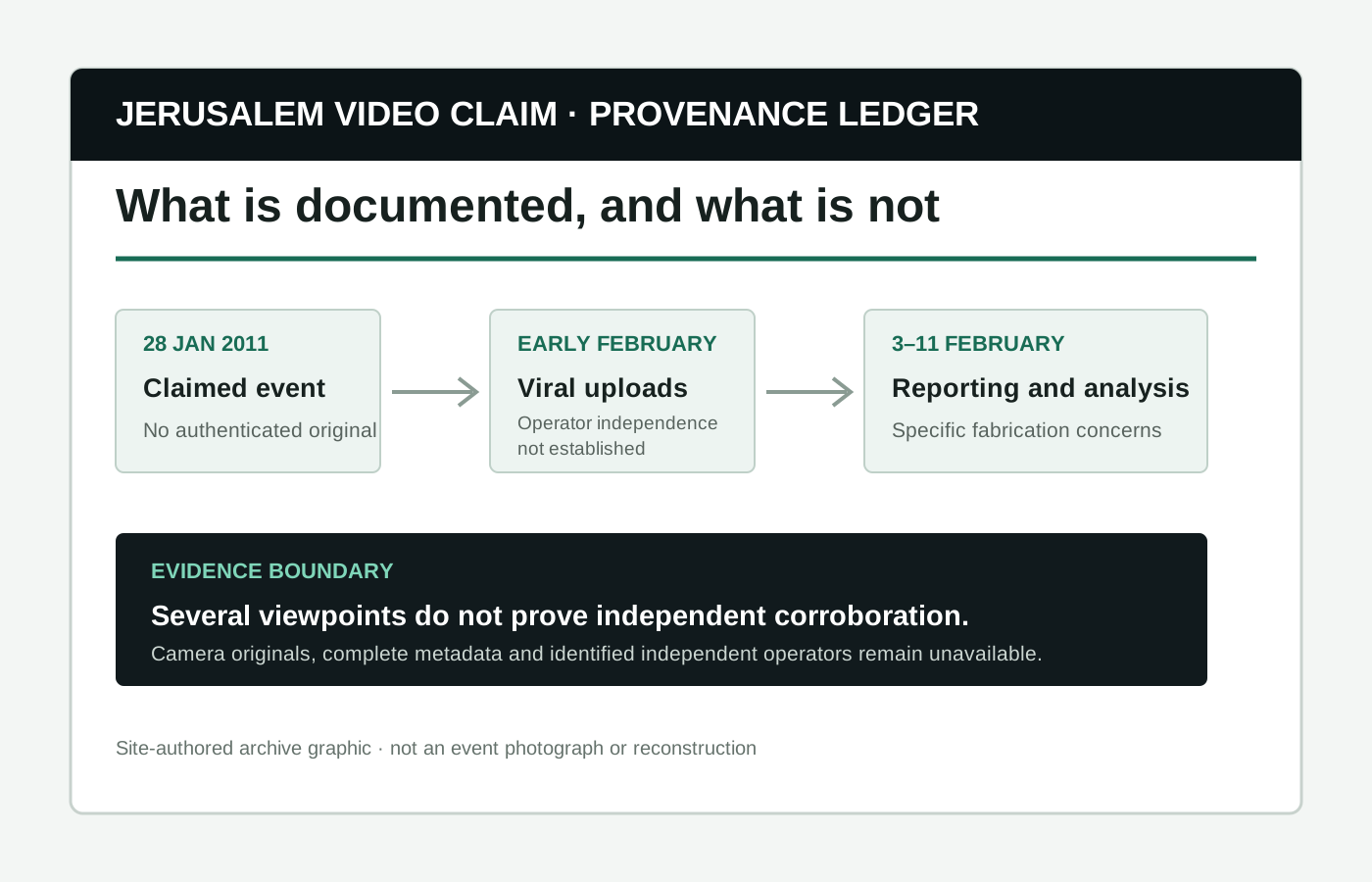
This case is disputed. The archive preserves the claims while separating evidence from interpretation.
- Documentation
- High documentation
- Primary location
- Jerusalem
- Source base
- 6 linked records
- Research use
- Comparison case
What the public record supports
- Confirmed record
- Several clips and contemporary news reports circulated in early February 2011.[1][4]
- Unverified claim
- No reviewed source authenticates an aerial object over the shrine on 28 January.[1][2][3]
- Provenance gap
- Camera originals, complete metadata and independent operator identities are missing.[1][3]
Case dossier
The claim over the Dome
The claim concerns the night of 28 January 2011. Videos uploaded to YouTube appeared to show a luminous point descending toward the Dome of the Rock, pausing above the shrine and then accelerating upward after a flash. The exact capture times, camera settings and original recording devices were not published with a complete evidence package. [1] · [3]
How news outlets carried the clips
The iconic location helped the clips travel quickly. CBS News reported the footage on 3 February and published a video segment; NPR followed on 4 February. Those reports document that the story was circulating and what viewers were shown. They do not authenticate the event, identify every uploader or establish an official investigation. [1] · [4] · [5]
NPR’s sources and the reporting chain
Wright Bryan’s NPR post of 4 February is a short account of circulating material, not an interview with a camera operator. It credits the Sydney Morning Herald for the claimed 28 January date and points readers to the Vancouver Sun for versions of the footage. Those links explain how the story travelled between publications. They do not add two separately authenticated observation records, and NPR’s suggestion that a hoax was probable is a judgment on the claim rather than the result of a published examination of camera files. [1]
Multiple angles without verified independence
The phrase 'multiple angles' is often used as if it settles authenticity. It does not. Independent corroboration requires identified observers, demonstrably separate recording chains, original files and compatible time-and-location data. The public clips did not provide that package, so their apparent agreement can also be consistent with coordinated staging or derivative editing. [1] · [3]
The contemporary objections
Skeptical analysis appeared almost immediately. The Jerusalem Post called the encounters fabricated. Live Science emphasized anonymous provenance, the absence of expected illumination on the shrine and a claimed repeating edge pattern associated with an editing effect. These are reported analyses rather than access to a complete forensic archive, but they materially weaken the extraordinary reading. [2] · [3]
The origin of the mirrored-edge analysis
Robert Sheaffer’s 7 February blog post identifies the basis of his editing claim: a demonstration posted by HOAXKiller1, which he dates to 5 February. He describes repeated scenery at frame borders and interprets it as mirrored tiles used to fill edges during artificial camera shake. The blog is the analyst’s own explanation of that argument, not a laboratory report on an original recording. Live Science subsequently quotes Sheaffer, so its repetition of this particular claim is not a second independent image examination. The inference of fabrication should remain attributed to the analysis. [6] · [3]
Different clips require separate checks
Sheaffer distinguishes the early distant view from a close-up with an American voice, commonly called the Mississippi version. He says the latter used a known still photograph as its background. That is a different objection from the mirrored-edge argument. His post therefore supplies reasons to keep the versions separate, rather than treating every clip as the same evidentiary item. Neither a demonstrated problem in one version nor apparent agreement between edited copies establishes the origin and authenticity of all the others. [6]
Why brightness does not supply a distance
Benjamin Radford’s Live Science article also questions the lack of visible illumination on the dome despite a recorded claim of intense brightness. This is a qualitative criticism, not calibrated photometry. Its approximate size estimate assumes a relationship between the light and the building that the available files do not independently establish. This archive therefore does not convert apparent position above the dome into a measured altitude, physical size or speed. [3]
No confirming official finding located
No public record reviewed for this archive contains a police, aviation, defense or site-authority finding that an unidentified craft was present. Absence of such a finding does not by itself disprove a light in the sky; it means the viral clips cannot borrow official authority they never received. [1] · [2] · [3]
The archive’s assessment
The case belongs in the archive because it is a compact lesson in digital provenance. A spectacular image, an important landmark and several uploads can create a strong impression while leaving the basic evidentiary questions unanswered. The current assessment is D / DISPUTED: the circulation is real, but the alleged aerial event is not authenticated and fabrication remains the best-supported explanation in the reviewed record. [1] · [3] · [6]
Contemporary news coverage
CBS News presented the circulating claim on 3 February 2011. This is reporting context, not independent verification.
Related video
Related checks and records
Timeline
- The circulating clips claim to record a light above the Dome of the Rock.
- CBS News reports the viral footage and publishes a news video segment.
- NPR summarizes the claim and says a hoax is the probable explanation.
- The Jerusalem Post publishes 'Close encounters of the fabricated kind.'
- Live Science details provenance and editing concerns, including a claimed repeating edge pattern.
Questions about the Jerusalem videos
Did a UFO hover over the Dome of the Rock in 2011?
The videos make that claim, but the reviewed record does not authenticate the event or an unidentified craft.
Do multiple camera angles prove the videos are real?
No. Independence, original files, metadata and identifiable operators must also be established.
Why are the clips widely considered a hoax?
Anonymous provenance and reported lighting and editing anomalies led contemporary outlets to favor fabrication.
Was there an official investigation?
No case-specific official finding confirming an unidentified craft was located in the reviewed public record.
Is the CBS News video original sighting footage?
No. It is a contemporary news segment presenting circulating clips and is labeled as reporting context.
Sources
- [1] News reportNPR: a UFO over Jerusalem?NPR
- [2] News reportClose encounters of the fabricated kindThe Jerusalem Post
- [3] ResearchJerusalem UFO: provenance and editing analysisLive Science
- [4] News reportCBS News report on the viral Jerusalem clipsCBS News
- [5] News reportCBS News video reportCBS News / YouTube
- [6] ResearchSheaffer’s mirrored-edge analysisRobert Sheaffer / Bad UFOs
The hero is a site-authored provenance graphic. The related CBS News video is reporting about circulating clips, not authenticated original sighting footage.