
United Kingdom / 1979 / DISPUTED
Robert Taylor incident
The Robert Taylor incident has a documented date, place, named reporter and police response, but its extraordinary interpretation rests on one person's account. Taylor returned home muddy, grazed and with torn trousers after reporting unconsciousness in Dechmont Woods. Police visited the clearing and treated the injuries as a possible common assault; later reporting describes ground impressions and forensic inspection of the trousers. Those actions establish that officers investigated an unexplained injury report, not that police verified a craft or nonhuman attacker. No other person saw the reported object, and the original police file, forensic report and medical notes are not available in the public material reviewed here. Neurological illness, misperception and human-made ground marks remain plausible but unproved explanations. The case therefore remains C / DISPUTED.
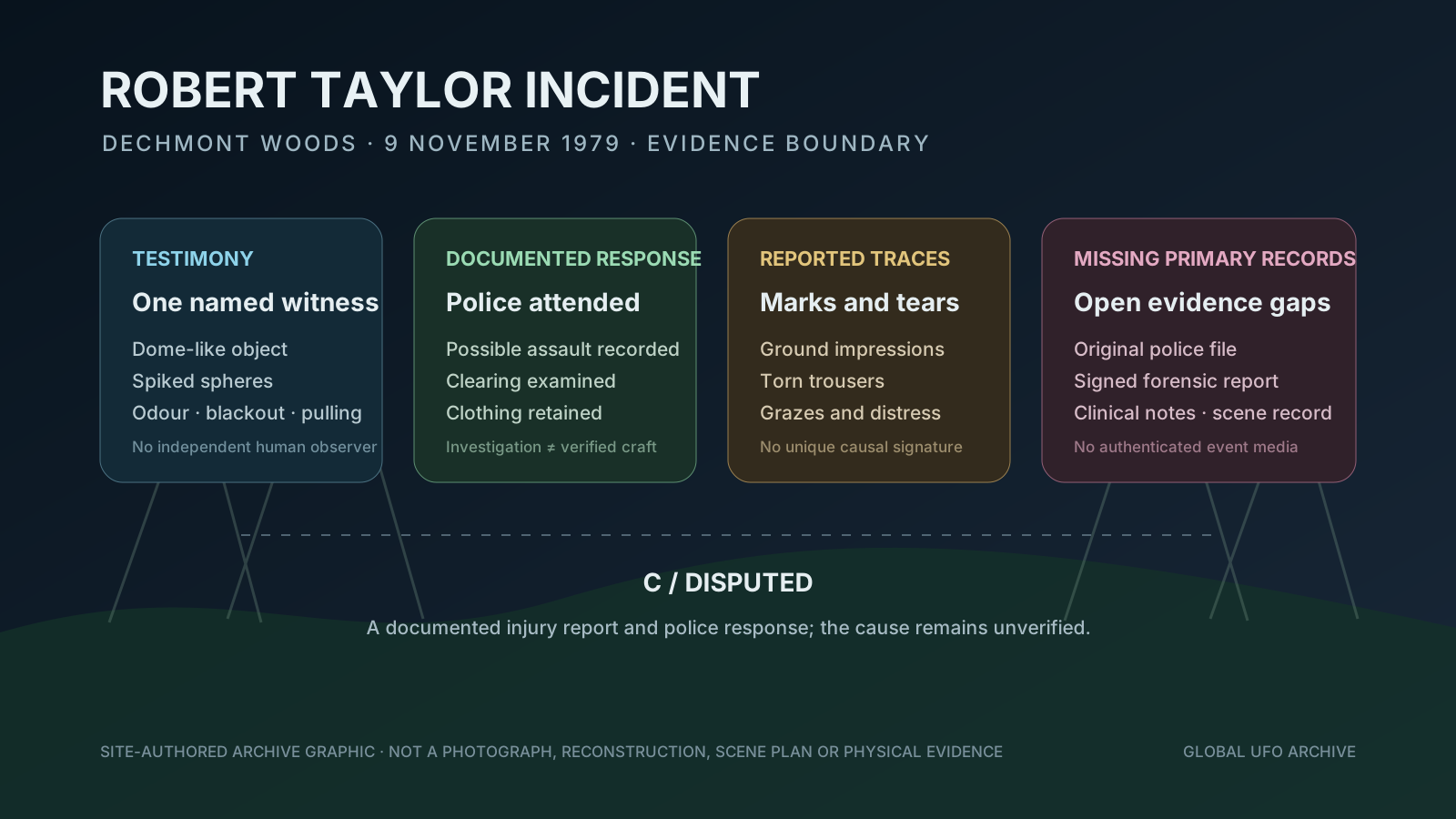
This case is disputed. The archive preserves the claims while separating evidence from interpretation.
- Documentation
- High documentation
- Primary location
- Dechmont Woods, Livingston, West Lothian, Scotland
- Source base
- 5 linked records
- Research use
- Comparison case
What the Robert Taylor record establishes
- Confirmed event
- Taylor returned injured on 9 November 1979 and police investigated his report and the clearing.[1][2]
- Witness limit
- Taylor was the only human witness to the reported object, spheres and attack.[2]
- Trace limit
- Tears and ground marks were reported, but no complete public forensic or scene record uniquely identifies their cause.[2][5]
- Medical limit
- A focal seizure could fit some symptoms, but the public record does not establish that diagnosis in Taylor.[4]
Case dossier
On Friday 9 November 1979, 61-year-old Robert Taylor was working for Livingston Development Corporation and inspecting woodland at Dechmont Law with his red setter, Lara. He parked his pickup and walked into a clearing. This employment, location and date are repeated in Police Scotland's disclosure-log entry, West Lothian's archive catalogue and later BBC reporting. Exact minute-by-minute times vary in retellings, so this dossier does not manufacture greater precision than the surviving public record supports.
Taylor later said a large, roughly spherical or dome-like object occupied the clearing. He described a dark, textured surface and smaller spiked spheres that moved toward him, caught his trousers and pulled. He reported an acrid smell, a choking sensation and then loss of consciousness. These vivid details belong to Taylor's statement and later interviews. Lara was present but provides no human corroboration, and no second person reported seeing the object, the smaller spheres or the alleged attack.
After regaining awareness, Taylor tried to leave in his pickup, drove it into soft ground and walked home. His wife Mary described him as muddy and dishevelled, with torn clothing; reports also describe grazes to his chin and thighs. A doctor and police were contacted. The condition in which others saw Taylor is corroborative of distress and injury, but it cannot establish what caused either. The public sources reviewed here do not reproduce the contemporaneous clinical notes or a diagnostic examination.
Officers accompanied Taylor and his supervisor Malcolm Drummond to the clearing. Later accounts describe two ladder-like impressions and a series of smaller holes in damp ground. Police compared the larger marks with forestry equipment and reportedly did not find a match. The trousers were retained for examination, with later summaries describing tears consistent with a forceful upward pull. Yet the original scene plan, photographs with measurement scales, casts, soil results and signed laboratory report have not been recovered in the accessible sources. The marks and tears are real reported observations with an incomplete chain of custody and no unique cause.
The administrative record is narrower than the folklore. Police Scotland's FOI page confirms disclosure 23-1429 was released on 28 May 2024 and links a response document, which this review did not open under the research constraint. The page itself does not reproduce the 1979 statements or forensic findings. West Lothian Council's catalogue lists an open Livingston Development Corporation file covering 1979–1991, but explicitly says it contains press cuttings and plaque press releases, not the corporation's internal investigation. Neither public listing warrants the slogan that police proved, solved or permanently maintain a unique UFO crime case.
A neurological episode has long been proposed because Taylor reported an unusual smell, altered awareness, weakness, headache and later confusion. Modern clinical literature confirms that focal seizures can involve smell, visual or experiential phenomena and impaired awareness. That makes a focal seizure a medically plausible framework, not a retrospective diagnosis: no public EEG, specialist assessment or recurrent seizure history establishes it in Taylor. A fall or struggle during altered awareness could account for some injuries, while it does not by itself explain when or how every ground mark was made.
The story developed a substantial cultural afterlife. Television reconstructed the event in 1980; Livingston Development Corporation later promoted a commemorative marker, and West Lothian now publishes a trail map and a stylized visitor handout. BBC Scotland revisited the case for its fortieth anniversary in 2019. These materials document remembrance and tourism, not additional witnesses or new physical evidence. With no authenticated event photograph or reliable original video available for reuse, this page uses a site-authored evidence-boundary graphic and labels it as neither reconstruction nor evidence.
Timeline
- Taylor reports the Dechmont Woods encounter and returns home injured; police and a doctor are contacted.
- Police visit the clearing and document reported ground marks; the trousers enter the evidentiary account.
- Scottish newspapers begin reporting the claim; subsequent cuttings expand the public narrative.
- Arthur C. Clarke's Mysterious World broadcasts a reconstruction and interviews, creating the best-known moving-image version.
- Livingston Development Corporation prepares publicity for a commemorative marker at the site.
- Robert Taylor dies aged 88, having continued to maintain his account.
- BBC Scotland publishes a fortieth-anniversary review separating the report from the police investigation.
- Police Scotland publishes FOI disclosure-log entry 23-1429; the attached response is not treated here as reviewed evidence.
Questions about the Robert Taylor incident
What happened to Robert Taylor in Dechmont Woods?
He said a dome-like object and two spiked spheres pulled at him before he lost consciousness. He returned home injured; that encounter description remains his testimony.
Did police investigate the incident?
Yes. Police responded as to a possible common assault, visited the clearing and handled reported traces. This does not mean police verified a UFO or nonhuman attacker.
Were the trousers and ground marks proof of a craft?
No. They are reported physical observations, but the accessible record lacks a complete forensic chain and any feature unique to an extraordinary craft.
Was Robert Taylor diagnosed with epilepsy?
Not in the public record reviewed here. A focal seizure is a later explanatory hypothesis because some reported symptoms overlap; it is not an established diagnosis.
Are there authentic photos or videos of the event?
No authenticated event image or original video was located. Television footage is later reconstruction or interview material.
Is this Britain's only criminally investigated UFO case?
That promotional superlative is not supported by the limited public listings. The defensible statement is that police recorded and investigated a possible assault connected to Taylor's report.
What is the best current conclusion?
Taylor's distress, injuries and the police response are historical; the cause and object remain unverified. C / DISPUTED is more accurate than either alien proof or a conclusively solved hoax.
Sources
- [1] Official file23-1429 - UFO sighting - Taylor / Livingston Incident, Dechmont Woods EncounterPolice Scotland
- [2] News reportThe UFO sighting investigated by the policeBBC Scotland News
- [3] ArchiveUFO Sighting by Bob Taylor of LDC in Dechmont Law Wood November 1979West Lothian Council Archives
- [4] ResearchDelusions, illusions and hallucinations in epilepsy: 1. Elementary phenomenaEpilepsy Research / PubMed
- [5] Official fileDechmont Law UFO visitor informationWest Lothian Council
Original site-authored evidence-boundary graphic. It is not a photograph, reconstruction, scene plan or physical evidence from the 1979 event.