
France / 1967 / DISPUTED
Cussac UFO encounter
The Cussac case is a documented report, not a documented craft. François Delpeuch, thirteen, and his nine-year-old sister Anne-Marie said that while tending cattle near Les Tuiles at about 10:30 on 29 August 1967 they saw four small dark figures beside a bright object that departed upward. La Montagne published their account three days later and reported that nearby adults heard nothing and no trace had been found. A 1978 GEPAN team re-interviewed the now-older witnesses and indirect adults, reconstructed the scene and treated their sincerity and the case’s strangeness favorably. Claims of a sulphurous smell, yellowed grass and an independently heard whistle depend mainly on those later investigative layers, not a public 1967 laboratory record or surviving gendarmerie file. Helicopter or military-activity explanations remain possible but unproven. The file therefore remains C / DISPUTED: historically important and sourceable, but evidentially dependent on testimony and retrospective reconstruction.
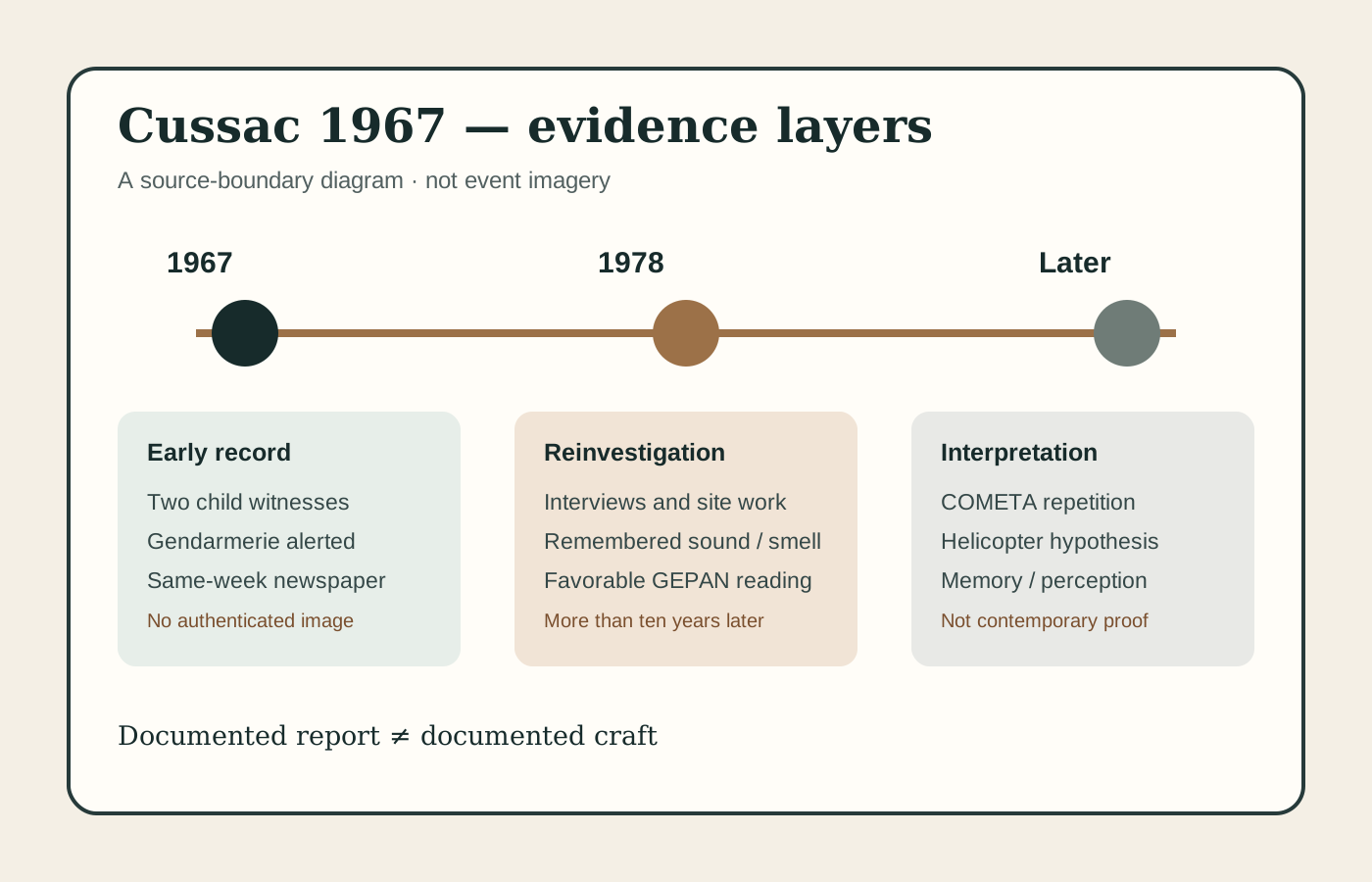
This case is disputed. The archive preserves the claims while separating evidence from interpretation.
- Documentation
- High documentation
- Primary location
- Les Tuiles, Cussac, Cantal
- Source base
- 7 linked records
- Research use
- Comparison case
What the record supports
- Event report
- Two children reported four small dark figures and a brilliant departing object on 29 August 1967.[1][2]
- Early record
- La Montagne published the account three days later and said no trace had been found.[1]
- Official boundary
- GEPAN investigated in 1978, more than ten years after the event; its own method document limits conclusions from old cases.[3][4]
Case dossier
The firm chronology begins on Tuesday, 29 August 1967. François and Anne-Marie were tending the family’s cattle at Les Tuiles, west of Cussac, when their dog reacted as a cow approached the field boundary. At roughly 10:30, François noticed small dark figures beyond a hedge and drew his sister’s attention to them. Their father, who was mayor of Cussac, contacted the gendarmerie after the frightened children returned. These are reported actions preserved by interviews and early press, not independently timed sensor events.
The earliest public version appeared in La Montagne on 1 September. It described four ‘dwarfs’ in black coveralls, facial hair, a dazzling object estimated at about four metres by two, the figures diving headfirst into it and one apparently coming back out before departure. Crucially, the article also said nearby people working in fields heard nothing and no trace had been found. Later accounts changed the geometry toward a sphere, added more precise motions and enlarged the physical-effects narrative. The early article is therefore an anchor, not a complete transcript of separate witness interviews.
Local gendarmes did visit, but the public provenance is incomplete. The original 1967 procès-verbal has not been located in the reviewed online record. The 1978 GEPAN report says a re-interviewed gendarme remembered a strongly sulphurous odour and a four-to-five-metre area of slightly yellowed grass. An earlier civilian GEPA investigation also attributed a sulphur smell to police. Because no contemporaneous sampling, photograph or laboratory result survives publicly, the smell and vegetation claims support a history of reported effects, not a verified landing trace.
The civilian GEPA inquiry published in 1968 and other specialist retellings fixed many details before the official CNES group existed. GEPAN was created only in 1977. Its four-person team visited Cussac in April 1978, more than ten years after the event, interviewed the siblings separately, used a theodolite and timed reconstructions, and spoke with indirect witnesses. One rural guard then recalled a whistle or droning sound from several hundred metres away. That late recollection conflicts with the earliest press statement that nearby adults heard nothing and cannot be treated as contemporary corroboration.
GEPAN’s internal assessment was favorable to the witnesses: the investigators considered them sincere, found the reported phenomenon unlike known categories available to them and regarded a piloted vehicle as fitting the collected description. That conclusion must be read beside GEPAN’s own public methodology brochure, which said its 1978 investigations of old cases allowed only limited conclusions because physical measurement and precise psychological or social reconstruction were no longer possible. Institutional attention and a strong investigator interpretation do not convert the report into confirmation of a craft or occupants.
The 1999 COMETA report later summarized Cussac under the heading ‘GEPAN/SEPRA inquiry’ and repeated the favorable reconstruction. COMETA was a private committee report hosted in GEIPAN’s document library, not a contemporaneous 1967 finding and not a new SEPRA field investigation. Its wording has often been repeated as ‘official confirmation,’ obscuring that the event account, 1978 review and 1999 advocacy document are separated by decades and have different evidential roles.
Conventional explanations do not produce a clean identification either. A helicopter with crew can resemble a rounded bright body and dark figures, and reported military activity made that hypothesis worth testing; however, no specific aircraft, crew, route or flight log has been tied to the field. Memory consolidation, interviewer influence and a brief unfamiliar stimulus can explain changing detail without accusing the children of fabrication. The responsible conclusion is narrower: two children made an early, striking report; later investigators added support and interpretation, but the surviving record cannot determine what physical stimulus, if any, generated it.
Timeline
- The children report the encounter while tending cattle at Les Tuiles; their father alerts the gendarmerie.
- Gendarmes visit the area according to later records; no surviving public 1967 file or laboratory result was located.
- La Montagne publishes the first known press account, including the absence of a found trace and silence of nearby adults.
- The civilian GEPA inquiry by Joël Mesnard and Claude Pavy is published in Phénomènes Spatiaux.
- CNES creates GEPAN; its scientific council selects old cases including Cussac for methodological reinvestigation.
- A four-person GEPAN team conducts interviews, site measurements and timed reconstructions at Cussac.
- The Cussac report is presented to the GEPAN scientific council as an old-case study, not a new event investigation.
- The private COMETA report republishes a favorable summary; later circulation often overstates it as contemporary official confirmation.
Questions about the Cussac encounter
What happened at Cussac in 1967?
Two children said they saw four small dark figures beside a bright object while tending cattle; the object reportedly rose and departed.
Did the gendarmerie confirm a landing trace?
Not in a surviving public 1967 record. Later sources attribute smell and yellowed grass to gendarmes, while the first newspaper said no trace was found.
Was Cussac officially confirmed by GEPAN or GEIPAN?
No. GEPAN made a favorable retrospective assessment in 1978, but its methodology limited conclusions from old cases. GEIPAN’s later document hosting is not confirmation.
Is there a photograph or video of the event?
No authenticated event image was located. Published drawings, diagrams and reenactments are later representations, not sighting evidence.
Could it have been a helicopter?
Possibly, but no specific flight is documented and some reported details fit poorly. The hypothesis remains an unverified conventional explanation.
Why is the case still disputed?
The report was early and repeatedly investigated, but it rests on child testimony, changing source layers and untested effects, with no surviving instrument record.
Sources
- [1] ArchiveFirst La Montagne account of the Cussac reportLa Montagne, 1 September 1967 (facsimile transcription)
- [2] Archive1968 GEPA investigation of CussacPhénomènes Spatiaux, June 1968 (archival transcription)
- [3] ResearchCritical review of the Cussac source recordRossoni, Deguillaume and Maillot, Les OVNI du CNES
- [4] Official fileGEPAN methodology and limits of old-case investigationsGEPAN / CNES
- [5] ResearchCOMETA’s later summary of the Cussac caseCOMETA (hosted by GEIPAN / CNES)
- [6] Official fileOfficial GEIPAN institutional historyGEIPAN / CNES
- [7] ResearchHistory of the Cussac debates and source publicationGrégory Gutierez
The hero image is a site-authored evidence-layer diagram. It is not an event image, witness drawing, official document scan or reconstruction of the alleged object.