
Japan / 1952 / UNRESOLVED
Haneda AFB Radar-Visual UFO Case
At 23:30 local time on 5 August 1952, Lloyd West and Walter Gutowski noticed a brilliant light northeast of Haneda Air Force Base. With Walter Jackson and George LaGasse, they watched it through 7×50 binoculars for about 50-60 minutes. Shiroi's CPS-1 radar later reported weak moving returns, and an F-94 crew reported a weak airborne-radar contact for about 90 seconds without seeing anything. Far East Air Forces report IR-35-52 and the Project Blue Book record card retained the case as unknown. The public file contains reports and a witness drawing, but no raw radar plots, scope film, photograph, or complete meteorological profile. A later University of Colorado analysis proposed Capella plus unusual optical effects for the light and anomalous radar propagation for the returns; that is a reasoned interpretation, not a demonstrated reconstruction.
This case remains unresolved in the public record, with credibility grade B.
- Documentation
- High documentation
- Primary location
- Haneda Air Force Base and northern Tokyo Bay
- Source base
- 5 linked records
- Research use
- Comparison case
What the Haneda file supports
- Date and witnesses
- The event began at 23:30 local time on 5 August 1952. The four tower observers were Lloyd West, Walter Gutowski, Walter Jackson, and George LaGasse.[1]
- Radar sequence
- Shiroi reported weak CPS-1 returns; the F-94B crew of Holder and Jones separately reported a weak APG-33 return for about 90 seconds and no visual target.[1]
- Official record
- IR-35-52 and the Blue Book record card retained unknown. That is an administrative identification outcome, not confirmation of extraordinary origin.[1]
- Later interpretation
- The Colorado report proposed a distorted image of Capella for the visual report and anomalous propagation for radar, but lacked complete weather data and did not demonstrate the exact mechanisms.[3][4]
- Media boundary
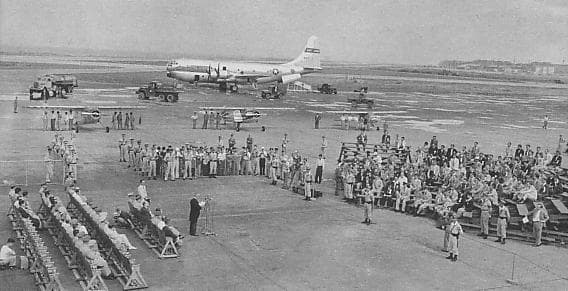
- No authenticated event image or video was found. The displayed July 1952 Haneda Airport photograph is location context, not sighting evidence.[1]
Case dossier
The event began before midnight, not merely in an unspecified month. West and Gutowski were crossing the ramp to begin the midnight tower shift when they saw the light at 23:30 local time. In the tower, Jackson and LaGasse joined them. IR-35-52 gives Haneda's coordinates as 35°33′N, 139°45′E and places the light to the northeast over the Tokyo Bay sector.
The four operators agreed on a circular, brilliant blue-white light. They reported a darker round area about four times its diameter, with a smaller light and two or three dim lights along the lower edge. They heard no sound and saw no rotation. The light faded eastward twice and returned. A lighted 30-gram ceiling balloon released at midnight looked much dimmer and yellower; this comparison rejected that particular appearance, but did not measure the unknown's distance or size.
Shiroi Site No. 4 of the 528th Aircraft Control and Warning Group first found three or four weak blips near the tower's bearing, but controller Lt. Rawlins could establish neither motion nor height. After Lt. Albert took duty at 23:45, the CPS-1 high beam tracked a weak target in right-hand orbits. Albert called its speeds rough estimates: 100-150 knots, occasional apparent hovering, and possibly 250-300 knots. Near 00:12 the return reportedly separated into three contacts. These were operator readings, not preserved plots.
An F-94B from Johnson Air Force Base, piloted by 1st Lt. Wesley R. Holder with 1st Lt. Aaron Jones operating the APG-33 radar, was ordered up around 23:55 and became airborne at 00:03 after a fuel-system delay. The crew saw no unknown object. When vectored toward a GCI contact, Jones reported a weak return at 6,000 yards, 10 degrees left and 10 degrees low. He maintained manual contact for about 90 seconds before it crossed the scope and disappeared during a right turn. The report says the set worked normally before and after the mission, but no scope record survives.
The file does not establish a clean one-object correlation. A C-54 pilot called the light a brilliant star. Tachikawa tower also reported a bright light, yet observers at Shiroi could not see it even when a radar target appeared within ten miles. The Colorado report later highlighted conflicting radar times and stated that the visual light persisted after the airborne return had vanished. The archive therefore uses the historical name while treating the visual, ground-radar, and airborne-radar channels separately.
Timeline
- West and Gutowski see the light while crossing the ramp; Jackson and LaGasse join the binocular observation from the tower.
- Lt. Albert takes over at Shiroi and reports a weak moving CPS-1 target after earlier blips yielded no definite movement or height.
- Johnson AFB orders Holder and Jones to scramble an F-94B; a fuel-system problem delays takeoff.
- The F-94B becomes airborne and searches over Tokyo Bay; its crew makes no visual contact.
- Shiroi reports three contacts; the F-94B then reports a weak airborne return for about 90 seconds. The file contains conflicting clock times.
- The Air Force analytical note says the radar nature cannot be plausibly explained without weather profiles; Ruppelt later presents the case as correlated, while the Colorado report proposes separate optical and radar causes.
Haneda AFB case questions
When did the Haneda AFB UFO case occur?
It began at 23:30 local time on 5 August 1952 and continued after midnight into 6 August.
Who saw the light at Haneda?
Tower operators Lloyd West, Walter Gutowski, Walter Jackson, and George LaGasse watched it. A C-54 pilot separately called it a brilliant star; the F-94 crew saw no unknown object.
Was the same object seen and tracked on radar?
The original investigators inferred correlation from bearing and timing, but the surviving file does not prove it. Shiroi could not see the light, the F-94 saw nothing, and later analysis identified timing and geometry inconsistencies.
What did Project Blue Book conclude?
The record card retained the case as unknown. This means the surviving investigation did not identify it; it does not mean extraterrestrial.
What is the leading conventional explanation?
A compound explanation: Capella distorted by unusual atmospheric optics for the visual light, and anomalous propagation for radar. It fits several limitations but was not demonstrated with complete Haneda weather data.
Is the Haneda photograph an image of the UFO?
No. It shows Haneda Airport on 1 July 1952 and is used only as historical airfield context.
Sources
- [1] Official fileProject Blue Book case file: Haneda AFB, Japan, August 1952U.S. Air Force / National Archives and Records Administration
- [2] ArchiveThe Report on Unidentified Flying Objects: Haneda discussionEdward J. Ruppelt / Project Gutenberg
- [3] ResearchScientific Study of Unidentified Flying Objects: Haneda analysisUniversity of Colorado / U.S. Air Force-sponsored study
- [4] ResearchScience in Default: Haneda case analysisJames E. McDonald / Princeton University archive
- [5] Official fileNational Archives guide to Project Blue Book recordsU.S. National Archives and Records Administration
The displayed image is a historical photograph of Haneda Airport dated 1 July 1952. It is location context, not a photograph of the reported light, a radar display, an official document, or a reconstruction. No authenticated event photograph or video was located.