
United States / 1986 / DISPUTED
Japan Airlines Flight 1628 UFO incident
Japan Air Lines cargo Flight 1628 was flying from Reykjavík to Anchorage when Captain Kenju Terauchi, First Officer Takanori Tamefuji, and Flight Engineer Yoshio Tsukuda reported unusual lights. Terauchi later described two luminous objects and a much larger dark “mothership”; the other crew members corroborated lights but not his detailed giant-craft description. Anchorage Center handled course and altitude changes, contacted the Elmendorf military radar center, and vectored nearby aircraft. The surviving FAA record contains interviews, radio transcripts, controller statements, radar printouts, and simulated displays. It also records failed confirmation by Fairbanks radar, United Flight 69, and a USAF C-130. FAA specialists attributed the retained dual radar target to a split return from the 747, while Philip Klass proposed ice-crystal/cloud effects and Jupiter for different visual phases. Those explanations are plausible but do not reproduce every reported detail; the careful conclusion is a documented aviation report with unresolved perceptions, not verified extraordinary technology.
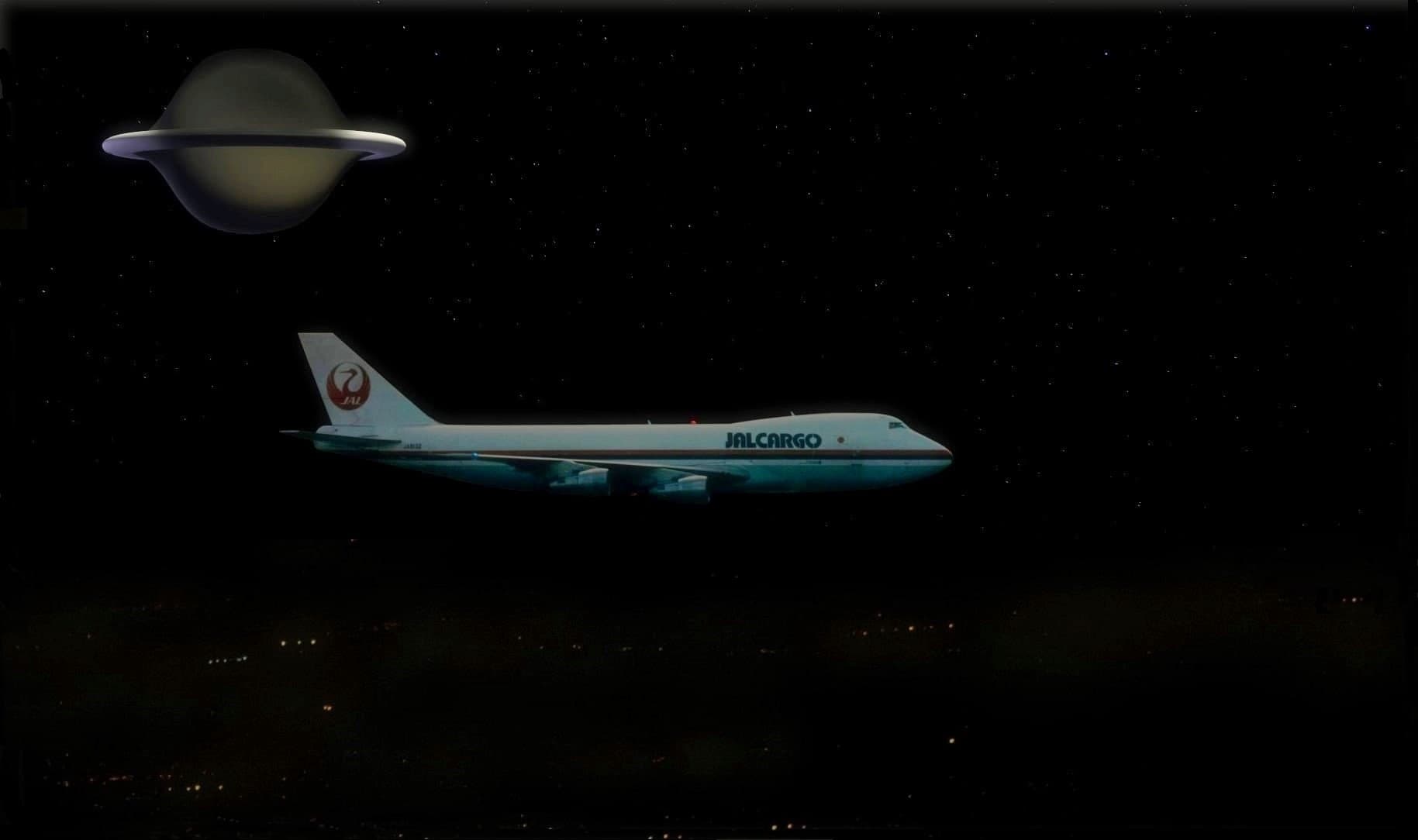
This case is disputed. The archive preserves the claims while separating evidence from interpretation.
- Documentation
- High documentation
- Primary location
- Fort Yukon to Fairbanks, Alaska airspace
- Source base
- 7 linked records
- Research use
- Comparison case
What the JAL 1628 record supports
- Confirmed record
- FAA files confirm a three-person cargo crew report, ATC handling, course and altitude changes, radar discussions, and nearby-aircraft checks on 17 November 1986.[1][2][3]
- Crew limit
- All three reported unusual lights. The immediate FAA notes say they saw no craft; Terauchi, not the other two, supplied the detailed giant “mothership” description.[2]
- Radar boundary
- Brief returns were discussed, but Fairbanks saw only JAL and the FAA technical review identified the retained dual target as a split return from the 747.[3][4]
- Conventional explanations
- Jupiter, moonlit ice-crystal clouds, weak weather-radar echoes, and split ground-radar returns plausibly explain different parts; no single reconstruction is proven.[4][6]
- Media boundary
- There is no authenticated event photograph or video. The hero image is a licensed 2018 reconstruction and John Callahan's later video is commentary, not event footage.[7]
Case dossier
The event unfolded during the Alaska evening of 17 November 1986, although FAA transcripts use 18 November UTC. JAL 1628, a Boeing 747 cargo flight from Reykjavík to Anchorage, was near Fort Yukon at flight level 350 when Terauchi asked Anchorage Center about traffic. At 02:19 UTC he reported white and yellow lights roughly one mile ahead at the same altitude. The controller knew of no aircraft there and treated the report as a possible traffic hazard.
The first post-flight FAA notes record a shared crew account of two changing sets of yellow, amber, and green lights. They also state that all three could see only lights and at no time a craft. Terauchi's later written and recorded accounts supplied the dramatic close luminous objects, perceived heat, and enormous dark walnut- or Saturn-shaped body. Tsukuda recalled the first lights for about ten minutes, could not describe an object's shape, and said the later faint light might have been a distant town. The crew therefore corroborates an unusual-light report, but not every element of the captain's “mothership” narrative.
The ATC record documents active but ambiguous sensor reporting. At 02:25 UTC Terauchi reported an onboard weather-radar return at 11 o'clock and eight miles. Anchorage Center briefly saw an uncertain primary return behind the 747. Elmendorf's Regional Operations Control Center then reported a primary-only return at ten o'clock and eight miles, lost it, later spoke of a “flight of two,” and soon lost the extra track again. Fairbanks Approach reported only JAL 1628. These statements are real contemporaneous records, but their changing bearings and short duration do not establish one target matching the cockpit report.
Anchorage Center approved descent from FL350 to FL310, a heading change, and a 360-degree turn. The transcript records Terauchi losing sight at 02:39, reacquiring a light at 02:44, and reporting no contact at 02:53. United Flight 69 was vectored near the route and saw the JAL 747 against the remaining light but no other traffic. A USAF C-130 also reported no object. These negative checks do not prove that the crew saw nothing, but they limit claims of a large persistent craft plainly accompanying the airliner.
Late-December wire reports turned the case into a “mothership” story, emphasizing Terauchi's size estimate and stating that radar had confirmed the object before the FAA technical review was public. Later retellings often merge every return, the captain's visual account, and former FAA official John Callahan's retrospective testimony into one continuous military-verified track. The contemporary FAA file is more cautious: it preserves intermittent and disputed indications, a completed air-safety inquiry, no authenticated event photograph, and no official finding of an extraordinary vehicle.
Timeline
- Terauchi asks Anchorage Center about traffic and reports white and yellow lights ahead; the controller has no known aircraft there.
- JAL reports an onboard weather-radar return; Anchorage and Elmendorf discuss brief primary returns, then lose them.
- Anchorage authorizes descent, course changes and a 360-degree turn. Fairbanks radar sees only JAL; Terauchi temporarily loses the reported traffic.
- Terauchi reports a light again. United Flight 69 sees the JAL aircraft but nothing else; JAL reports no further contact at 02:53 UTC.
- Anchorage ARTCC reports that its recorded radar data does not confirm traffic near JAL 1628.
- FAA releases its package, says it cannot confirm the event, attributes a second retained target to a split return, and closes the air-safety inquiry.
Japan Airlines Flight 1628 questions
What happened to Japan Airlines Flight 1628?
On 17 November 1986 its three-person cargo crew reported unusual lights over Alaska. Captain Terauchi later described a huge dark object, while FAA controllers managed the report as possible unknown traffic.
Did all three crew members see the mothership?
No. All three supported an unusual-light report, but the immediate FAA notes say they saw no craft. The detailed giant-object description came from Terauchi; Tsukuda remained uncertain about the later faint light.
Did FAA and military radar confirm a UFO?
They reported intermittent extra returns during the event, but Fairbanks saw only JAL, the extra tracks were quickly lost, and FAA specialists attributed the retained dual target to a split return from the 747.
What did the FAA conclude?
The FAA said it could not confirm the reported event, found no unreported aircraft safety hazard, explained its retained double target as a radar correlation effect, and closed the inquiry without deciding what every light was.
Could Jupiter or clouds explain the sighting?
They plausibly explain different phases: Jupiter was low in the later reported direction, while moonlit ice-crystal clouds could produce changing lights and weak weather-radar echoes. The compound scenario is not a proven full reconstruction.
Is there an authentic photo or radar video?
No authenticated event photograph or continuous radar video is public. The case image is a 2018 reconstruction, and later demonstration videos must not be presented as contemporaneous sensor evidence.
Sources
- [1] Official fileNational Archives: FAA records documenting Japan Airlines Flight 1628U.S. National Archives and Records Administration
- [2] Official fileFAA immediate post-flight crew interview notesFederal Aviation Administration / National Archives copy
- [3] Official fileAnchorage ARTCC chronology and radar-data findingAnchorage Air Route Traffic Control Center / FAA
- [4] Official fileFAA release and technical review of the JAL 1628 reportFederal Aviation Administration, Alaskan Region
- [5] News reportController confirms UFO sightingUnited Press International
- [6] ResearchFAA Data Sheds New Light on JAL Pilot's UFO ReportPhilip J. Klass / Skeptical Inquirer
- [7] ArchiveThe Vault Files: 1986 Alaska JAL Flight 1628The Black Vault
The displayed image is JMK's 2018 reconstruction, made from later descriptions and composited source elements. It is licensed visual context, not a photograph of the 1986 event, not an FAA radar display, and not independent evidence. No authenticated event photo or video was located.