
Japon / 1952 / NON RÉSOLU
Affaire UFO radar-visuelle de la base de Haneda
À 23 h 30 locale le 5 août 1952, Lloyd West et Walter Gutowski remarquèrent une lumière brillante au nord-est de la base de Haneda. Avec Walter Jackson et George LaGasse, ils l'observèrent aux jumelles 7×50 pendant environ 50-60 minutes. Le CPS-1 de Shiroi signala ensuite de faibles échos mobiles et l'équipage d'un F-94 un faible contact radar embarqué durant environ 90 secondes, sans rien voir. Le rapport IR-35-52 des Far East Air Forces et la fiche Project Blue Book conservèrent la mention unknown. Le dossier public contient rapports et dessin, mais ni tracés radar bruts, film d'écran, photo de l'événement ou profil météo complet. L'analyse ultérieure de l'Université du Colorado proposa Capella déformée optiquement et une propagation radar anormale : une interprétation argumentée, non une reconstruction démontrée.
Ce cas reste non résolu dans les archives publiques, avec une crédibilité de niveau B.
- Documentation
- Documentation élevée
- Lieu principal
- Haneda Air Force Base and northern Tokyo Bay
- Base documentaire
- 5 liens documentaires
- Usage de recherche
- Cas de comparaison
Ce qu'établit le dossier Haneda
- Date et témoins
- L'événement commença à 23 h 30 locale le 5 août 1952. Les quatre opérateurs étaient Lloyd West, Walter Gutowski, Walter Jackson et George LaGasse.[1]
- Séquence radar
- Shiroi signala de faibles échos CPS-1 ; Holder et Jones signalèrent séparément un faible écho APG-33 durant environ 90 secondes, sans cible visuelle.[1]
- Dossier officiel
- IR-35-52 et la fiche Blue Book conservèrent unknown : un résultat administratif, non une origine extraordinaire confirmée.[1]
- Interprétation ultérieure
- Le rapport Colorado proposa une image déformée de Capella et une propagation anormale, sans données météo complètes ni mécanisme exact démontré.[3][4]
- Limite média
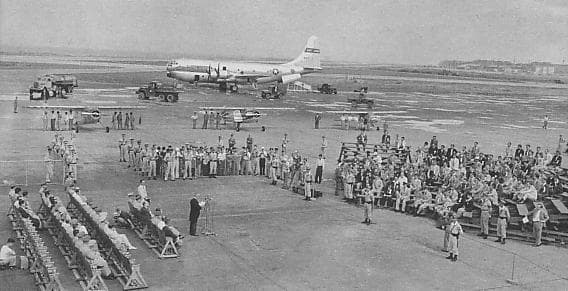
- Aucune image ou vidéo authentifiée n'a été trouvée. La photo de Haneda de juillet 1952 est un contexte de lieu, non une preuve d'observation.[1]
Dossier du cas
L'événement commença avant minuit. West et Gutowski traversaient l'aire de trafic pour leur quart de minuit lorsqu'ils virent la lumière à 23 h 30 ; Jackson et LaGasse les rejoignirent dans la tour. IR-35-52 situe Haneda à 35°33′ N, 139°45′ E et la lumière au nord-est, vers la baie de Tokyo.
Les quatre opérateurs décrivirent une lumière circulaire bleu-blanc, une zone sombre ronde environ quatre fois plus large, puis une petite lumière et deux ou trois faibles points sur le bord inférieur. Aucun son ni rotation. La lumière s'estompa deux fois vers l'est puis revint. Un ballon-plafond lumineux de 30 g lancé à minuit parut bien plus faible et jaune ; la comparaison écartait cette apparence précise, sans mesurer distance ou taille.
Le site no 4 du 528th Aircraft Control and Warning Group à Shiroi trouva d'abord trois ou quatre faibles échos, mais le Lt Rawlins ne put établir ni mouvement ni hauteur. Après la relève du Lt Albert à 23 h 45, le faisceau haut du CPS-1 suivit une faible cible en orbites à droite. Albert donna des estimations grossières : 100-150 nœuds, immobilité apparente occasionnelle et peut-être 250-300 nœuds. Vers 00 h 12, l'écho se serait divisé en trois. Ce sont des lectures, non des tracés conservés.
Un F-94B de Johnson AFB, piloté par le 1st Lt Wesley R. Holder avec le 1st Lt Aaron Jones au radar APG-33, reçut l'ordre vers 23 h 55 et décolla à 00 h 03 après un retard du système carburant. L'équipage ne vit aucun objet. Guidé vers un contact GCI, Jones signala un faible écho à 6 000 yards, 10° à gauche et 10° plus bas. Il le maintint manuellement environ 90 secondes avant sa disparition pendant un virage à droite. Le radar fonctionnait normalement avant et après, mais aucun écran enregistré ne subsiste.
Le dossier n'établit pas une corrélation nette avec un seul objet. Un pilote de C-54 parla d'une étoile brillante. La tour de Tachikawa signala aussi une lumière, mais personne à Shiroi ne la vit, même lorsqu'une cible radar semblait à moins de dix milles. Le rapport Colorado souligna ensuite les horaires incompatibles et la persistance visuelle après la disparition de l'écho embarqué. L'archive conserve donc le nom historique tout en séparant visuel, radar sol et radar embarqué.
Chronologie
- West et Gutowski voient la lumière sur l'aire de trafic ; Jackson et LaGasse rejoignent l'observation aux jumelles.
- Le Lt Albert prend la relève à Shiroi et signale une faible cible mobile CPS-1 après des échos sans mouvement ni hauteur définis.
- Johnson AFB ordonne le décollage du F-94B de Holder et Jones ; un problème carburant le retarde.
- Le F-94B décolle et recherche au-dessus de la baie ; aucun contact visuel.
- Shiroi signale trois contacts ; le F-94B rapporte ensuite un faible écho durant environ 90 secondes. Les heures du dossier se contredisent.
- La note Air Force dit que les cibles radar restent inexpliquées sans profils météo ; Ruppelt présente ensuite une corrélation, tandis que Colorado propose des causes optiques et radar séparées.
Questions sur l'affaire Haneda
Quand l'affaire de Haneda eut-elle lieu ?
Elle commença à 23 h 30 locale le 5 août 1952 et continua après minuit le 6.
Qui vit la lumière à Haneda ?
Lloyd West, Walter Gutowski, Walter Jackson et George LaGasse l'observèrent. Un pilote de C-54 parla d'une étoile brillante ; le F-94 ne vit rien d'inconnu.
Le même objet fut-il vu et suivi ?
Les enquêteurs l'inférèrent par direction et temps, mais le dossier ne le prouve pas. Shiroi et le F-94 ne virent rien, et l'analyse ultérieure releva des incohérences.
Que conclut Project Blue Book ?
La fiche conserva unknown : non identifié par l'enquête subsistante, pas extraterrestre.
Quelle est l'explication conventionnelle principale ?
Une explication composée : Capella déformée par l'atmosphère et propagation radar anormale. Elle répond à plusieurs limites sans être démontrée avec les données météo complètes de Haneda.
La photo de Haneda montre-t-elle l'UFO ?
Non. Elle montre l'aéroport le 1er juillet 1952 et sert uniquement de contexte historique.
Sources
- [1] officielDossier Project Blue Book : Haneda AFB, Japon, août 1952U.S. Air Force / National Archives and Records Administration
- [2] archiveThe Report on Unidentified Flying Objects : passage sur HanedaEdward J. Ruppelt / Project Gutenberg
- [3] rechercheScientific Study of Unidentified Flying Objects : analyse de HanedaUniversity of Colorado / U.S. Air Force-sponsored study
- [4] rechercheScience in Default : analyse du cas HanedaJames E. McDonald / Princeton University archive
- [5] officielGuide des Archives nationales sur Project Blue BookU.S. National Archives and Records Administration
L'image est une photo historique de l'aéroport datée du 1er juillet 1952. C'est un contexte de lieu, non la lumière, un écran radar, un document officiel ou une reconstruction. Aucune image authentifiée de l'événement n'a été trouvée.