
United States / 1947 / UNRESOLVED
Kenneth Arnold Sighting (1947)
Kenneth Arnold's 24 June 1947 flight is a well-documented report, not a documented craft. Arnold said that while detouring in his CallAir A-2 to search for a missing Marine transport, he watched nine reflective, apparently tailless objects pass Mount Rainier and continue toward Mount Adams. He timed part of the passage, then derived an extraordinary speed from estimated landmarks and distance. His July statement and drawing entered Army Air Forces files; newspapers transformed several saucer comparisons into the durable label “flying saucer.” No camera record, radar track, physical trace or second observer tied to Arnold's exact viewing geometry is public. A 1949 military review questioned his size and speed estimates and considered known aircraft plausible. The observation therefore remains unresolved at grade B: historically consequential and traceable, but incapable of proving an extraordinary or non-human vehicle.
This case remains unresolved in the public record, with credibility grade B.
- Documentation
- High documentation
- Primary location
- Mount Rainier, Washington
- Source base
- 6 linked records
- Research use
- Comparison case
What the record establishes
- Confirmed report
- Arnold submitted a signed account and drawings describing nine objects seen on 24 June 1947.[1][2]
- Estimated performance
- The famous 1,200 mph figure was derived from visual landmark and distance assumptions, not radar.[1][3]
- Media boundary
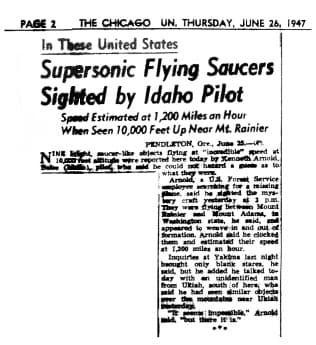
- No authenticated object image exists; the displayed file is a 26 June newspaper scan.[2][4][5]
Case dossier
The search detour: Arnold left Chehalis, Washington, at about 14:00 in a CallAir A-2, intending to refuel at Yakima on the way to Pendleton. He spent about an hour searching southwest of Mount Rainier for a missing Marine Corps C-46 and its reward. In his written statement he placed himself near Mineral at roughly 9,200 feet, in exceptionally clear and smooth air, with a DC-4 visible about fifteen miles behind and left. These details come from Arnold; the DC-4 crew is not recorded as a corroborating witness.
The observation: A bright reflection on Arnold's airplane drew his attention north of Mount Rainier. He reported nine objects in a diagonal, chain-like formation moving generally south-southeast. Against snow he thought their outlines lacked tails; as they banked, several flashed like mirrors, while edge-on they looked like thin dark lines. He estimated a range of twenty to twenty-five miles and described the formation as at least five miles long. Those range, size, altitude and shape judgments were unaided visual estimates, not measurements.
Timing and speed: Arnold wrote that his cockpit clock showed 14:59 when the first object passed Mount Rainier and that the formation covered his chosen Rainier-to-Adams interval in one minute forty-two seconds. He later checked the landmark distance after landing and derived roughly 1,200 miles per hour; later summaries sometimes used 1,700. The stopwatch-style observation is meaningful, but the result depends on the assumed path, range and landmark crossings. It is not a radar-measured groundspeed, and the 1949 military digest recorded Hynek's view that inconsistencies made subsonic known aircraft probable.
From Pendleton to “flying saucer”: Arnold spoke with pilots after landing, then reporters Bill Bequette and Nolan Skiff at the East Oregonian. Smithsonian's reconstruction says Skiff printed “saucer-like aircraft” on 25 June and Bequette's wire story used “nine bright saucer-like objects.” On 26 June the Chicago Sun headline read “Supersonic Flying Saucers Sighted by Idaho Pilot.” Arnold used saucer, disk and pie-pan comparisons in early accounts, while also comparing the motion to a saucer skipping on water. The record therefore supports rapid press compression, not the simple claim that Arnold never used shape language or that one identifiable reporter alone invented the phrase.
The surviving record: Arnold's multi-page July statement includes a plan and side-view sketch, says the objects seemed longer than wide and about one-twentieth as thick as their width, and admits their identity remained a mystery to him. NARA identifies a page from the report as Air Force-held material and explains that Blue Book collections mix observer reports, correspondence, clippings and later analysis. There is no authenticated sighting photograph or film. The familiar Chicago Sun image is a scan of press coverage, and the Arnold-with-airplane photograph used by Smithsonian is a later portrait, not an image of the objects.
Timeline
- Arnold departs Chehalis and detours to search for the missing Marine C-46.
- His clock reading marks the first reported object passing Mount Rainier; the full observation lasts about 2.5-3 minutes.
- After Yakima and Pendleton landings, Arnold discusses the sighting with pilots and local contacts.
- East Oregonian reporters record the first newspaper accounts using saucer comparisons.
- The Chicago Sun prints “Supersonic Flying Saucers Sighted by Idaho Pilot,” showing the phrase's rapid national spread.
- Arnold submits a detailed signed statement and drawings to Army Air Forces intelligence.
- A National Military Establishment press memorandum reviews the case, records unresolved identity and presents Hynek's subsonic-aircraft assessment.
Questions about the Kenneth Arnold sighting
What did Kenneth Arnold report seeing?
Nine bright, apparently tailless objects in a chain-like formation near Mount Rainier, moving toward Mount Adams.
How was the reported speed calculated?
Arnold timed an assumed landmark interval at 1 minute 42 seconds and checked its distance after landing. Uncertain range and path make 1,200 mph an estimate, not a measurement.
Did Arnold photograph the objects?
No. His statement says he wished he had carried a movie camera. No authenticated event photograph or film is public.
Did Arnold coin “flying saucer”?
His early accounts used saucer comparisons for shape and motion, while reporters and headline writers rapidly standardized the exact phrase. A single-inventor story is too simple.
What was the official explanation?
No conclusive object was named. A 1949 government digest retained the unknown identity but reported Hynek's view that inconsistent estimates made known subsonic aircraft probable.
Why does the case remain important?
It is a primary episode in postwar U.S. UFO history and the documented press history of “flying saucer,” even though the observation itself cannot now be conclusively identified.
Sources
- [1] ArchiveKenneth Arnold's July 1947 signed statement and drawingsArmy Air Forces record transcription via Project 1947
- [2] Official fileNARA overview and catalog link for Arnold's Air Force reportU.S. National Archives and Records Administration
- [3] Official fileNational Military Establishment Project ‘Saucer’ press memorandumNational Military Establishment transcription via Project 1947
- [4] ArchiveSmithsonian history of Arnold's report and the flying-saucer phraseSmithsonian National Air and Space Museum
- [5] News reportChicago Sun page, 26 June 1947Chicago Sun microfilm via Chicago Public Library and Wikimedia Commons
- [6] Official fileNational Archives guide to Project Blue Book holdingsU.S. National Archives and Records Administration
The displayed image is a contemporary newspaper scan documenting terminology and reception. It is not event imagery. No authenticated photograph or original video of Arnold's reported objects was found.