
United States / 1975 / DISPUTED
Travis Walton abduction
The public record supports a narrower case than the famous alien-abduction story. On 5 November 1975, crew boss Mike Rogers and five other coworkers reported Travis Walton missing after all six said they saw a luminous object near a forest road and a light strike him. Navajo County authorities searched for a possible injured person or homicide victim. Walton reappeared late on 10 November or early on 11 November and later described beings and rooms aboard a craft. The crew's polygraph results addressed their stated belief and possible responsibility for Walton's disappearance; they did not establish that an external spacecraft existed. Walton's onboard account has no authenticated photograph, film, audio, radar, medical finding or recovered trace that independently verifies it. The case therefore remains C / DISPUTED, not a confirmed abduction and not a conclusively demonstrated hoax.
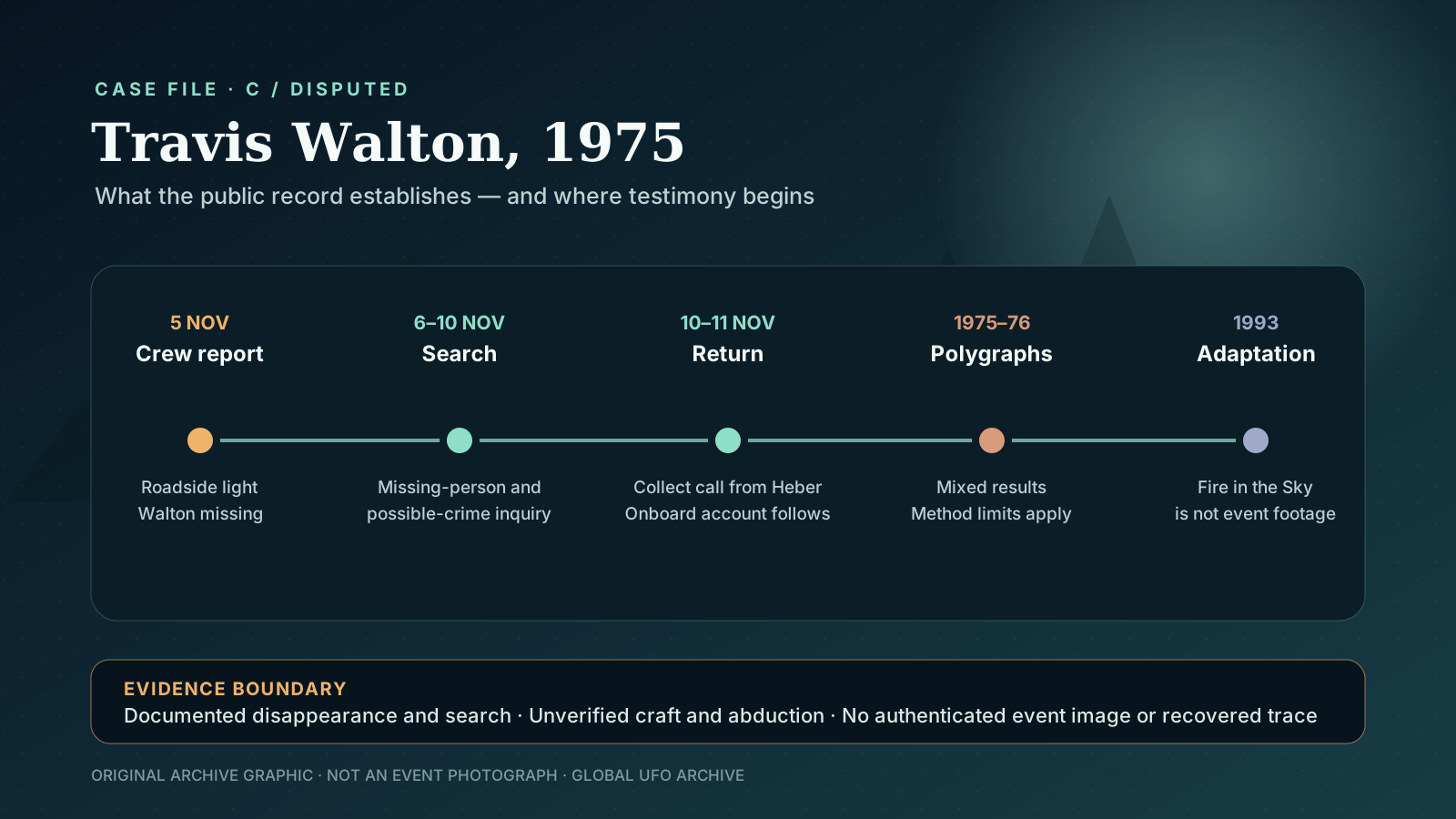
This case is disputed. The archive preserves the claims while separating evidence from interpretation.
- Documentation
- High documentation
- Primary location
- Apache-Sitgreaves National Forests near Heber, Arizona
- Source base
- 7 linked records
- Research use
- Comparison case
What the Travis Walton record establishes
- Confirmed record
- Walton was reported missing on 5 November 1975; authorities searched, and he returned alive about five days later.[1][2]
- Witness boundary
- Six coworkers supported the roadside light account; none witnessed Walton's alleged experience aboard a craft.[1][3]
- Polygraph limit
- The crew tests addressed belief and possible criminal responsibility, not whether an external spacecraft existed; later Walton results conflict.[3][5]
Case dossier
The event began after a timber-thinning crew finished work in the Apache-Sitgreaves National Forests near Heber, Arizona. The seven-man crew comprised Walton, crew boss Mike Rogers, Allan Dallis, John Goulette, Ken Peterson, Steve Pierce and Dwayne Smith. On the drive out, the six surviving witnesses said they encountered a bright, disc-like object above or beside a clearing. Walton left the truck and approached it. The men said a blue-green light struck him, after which they drove away in fear, returned within roughly fifteen minutes and found neither Walton nor the light. Those details are a collective report recorded after the disappearance; they are not six independent measurements of a craft.
The crew's report immediately created a terrestrial problem: a 22-year-old man was missing in cold forest country after coworkers said they had left him behind. Navajo County officers questioned the men and organized searches, treating accident or homicide as live possibilities. Contemporary reporting records ground search activity and later accounts mention aerial assistance, but the accessible file set reviewed here does not contain the signed original missing-person report, dispatch audio, search logs or a complete witness-interview set. The official layer therefore establishes a genuine disappearance inquiry and police skepticism—not official acceptance of the reported object.
While Walton remained missing, Arizona Department of Public Safety examiner C. E. Gilson tested the six coworkers. His signed 13 November letter—preserved as a later archival reproduction—reported conclusive results for Rogers, Goulette, Smith, Peterson and Pierce and an inconclusive result for Dallis. Gilson wrote that the five appeared truthful in saying they believed they saw a UFO and had not injured or murdered Walton. He also stated that the single UFO question was added at Sheriff Marlin Gillespie's request and did not make the examination a valid test of whether a UFO actually existed. That qualification is central: the tests addressed belief and criminal suspicion, not external reality.
Walton returned during the night of 10–11 November, after a collect call from a Heber payphone led relatives to him. Contemporary press described him as confused or exhausted and reported that the sheriff remained skeptical. Walton then gave UFO investigators a much more elaborate account: he said he awoke in a room, encountered three small nonhuman figures, escaped into other areas, met human-looking figures and lost consciousness again before awakening near the highway. The disappearance and return can be anchored by press and police response. Everything inside the alleged craft comes from Walton's later account, with no independent witness to those five days.
Polygraph publicity soon became part of the story rather than a clean evidentiary solution. A privately arranged 15 November examination reportedly judged Walton deceptive; that result was not included when the National Enquirer later promoted favorable examinations and awarded the group prize money. APRO subsequently publicized a different February 1976 examination that Walton and his brother Duane were said to have passed. The National Research Council's later scientific review explains why neither favorable nor unfavorable charts can authenticate an abduction: polygraphs infer deception from physiological responses, accuracy varies with design and context, and countermeasures or examiner judgment can affect outcomes.
The available record contains no authenticated event photograph or film, no dispatch or interview audio released with a verified chain of custody, no radar or other sensor record, and no recovered material tied to the reported object. Medical examinations described in advocacy sources occurred after Walton returned, but the accessible reports do not provide a distinctive injury or laboratory signature that identifies an abduction mechanism. Absence of such evidence does not by itself prove a hoax; it means the extraordinary portion of the case cannot be independently tested. The six coworkers corroborate a roadside light story, not Walton's later experience aboard a craft.
Walton published The Walton Experience in 1978. The 1993 film Fire in the Sky adapted that book but became a separate cultural artifact: the American Film Institute catalog documents the rights chain, production and release, while the film dramatizes events with actors and a scripted onboard sequence. KJZZ's 2025 interview is likewise retrospective testimony, useful for documenting how Walton now interprets the story, not for reconstructing 1975. Books, documentaries, podcasts and film stills may explain the case's cultural reach; none should be labeled contemporaneous evidence. The durable archival value lies in showing how a documented disappearance inquiry became an unresolved abduction narrative.
Timeline
- After work near Heber, six crew members report a luminous object, a light striking Walton and his disappearance; the case is reported to Navajo County authorities.
- Law enforcement and volunteers search while investigators consider accident or homicide; no publicly authenticated object trace or complete official case file emerges.
- DPS examiner C. E. Gilson tests the six coworkers during the missing-person inquiry; five results are conclusive and Dallis's is inconclusive.
- A collect call from a Heber payphone leads relatives to Walton; contemporary reports announce his return and record continued sheriff skepticism.
- Gilson signs his DPS letter, explicitly limiting the crew tests to stated belief and possible criminal responsibility rather than proof of an external UFO.
- A reported unfavorable Walton examination is followed by separately arranged favorable tests; selective publicity makes the polygraph record contested.
- Walton publishes The Walton Experience in 1978; Fire in the Sky adapts it for cinema in 1993, expanding the story's cultural reach without adding contemporaneous evidence.
Questions about the Travis Walton case
Was Travis Walton really missing for five days?
Yes. Contemporary reporting and the law-enforcement response support that Walton was reported missing after 5 November and returned during the night of 10–11 November. They do not establish where he spent that interval.
How many people said they saw the object?
Six coworkers—Mike Rogers, Allan Dallis, John Goulette, Ken Peterson, Steve Pierce and Dwayne Smith—gave the broad roadside account. Walton was the seventh crew member and later described approaching the light.
Did the crew pass lie-detector tests?
The DPS examiner judged five coworker charts conclusive and truthful on the relevant answers; Dallis's was inconclusive. The examiner explicitly said the added UFO question did not validate whether an actual UFO existed.
Did Travis Walton pass a polygraph?
The record includes a reported unfavorable examination on 15 November 1975 and later favorable examinations under different arrangements. Because test design, physiology and examiner judgment matter, no result proves or disproves an abduction by itself.
Is Fire in the Sky an accurate record?
No. It is a 1993 dramatic adaptation of Walton's 1978 book. AFI documents its production history, but its acted and scripted scenes are not contemporaneous evidence of the 1975 event.
What is the most evidence-based conclusion?
A real missing-person inquiry followed a shared report of a strange light, but the abduction account is not independently verified. Human staging or misinterpretation plus voluntary absence remain plausible, unproven alternatives. The correct status is C / DISPUTED.
Sources
- [1] ArchiveTaylor Arizona Museum Scrapbooks, 1972–1976, Volume 4Arizona Memory Project / Taylor Arizona Museum
- [2] News reportSheriff Skeptical of Story: Saucer Traveler Hiding After Returning to EarthAssociated Press via The Victoria Advocate
- [3] ArchiveArizona DPS polygraph examiner letter to Sheriff Marlin GillespieArizona Department of Public Safety document reproduced in the Philip J. Klass archive
- [4] News reportTravis Walton / Klass polygraph controversyWhite Mountain Independent via Arizona Memory Project
- [5] ResearchThe Polygraph and Lie DetectionNational Research Council / National Academies
- [6] ArchiveAFI Catalog: Fire in the Sky (1993)American Film Institute
- [7] News reportHis Arizona UFO abduction story became legendKJZZ / Rio Salado College
Original site-authored archive graphic built from the cited chronology. It is not a photograph of the 1975 event and does not depict an actual craft, beam or abduction.