
United States / 1955 / DISPUTED
Kelly-Hopkinsville encounter
The durable record begins with a frightened group arriving at Hopkinsville police headquarters late on 21 August 1955. The contemporary Kentucky New Era account estimated about ten or twelve people at the Sutton farmhouse and said officers could not determine how many claimed to see the figures. Billy Ray Taylor reported an initial bright object; Taylor and Cecil “Lucky” Sutton later reported small, bright-eyed figures, fired a .22 pistol and shotgun, then sought help. More than a dozen officers searched until after 2 a.m. without finding tracks, a landing mark or anything that proved or disproved the story. Later investigators proposed a meteor and great horned owls. That model is plausible but unproven, so the case remains C / DISPUTED.
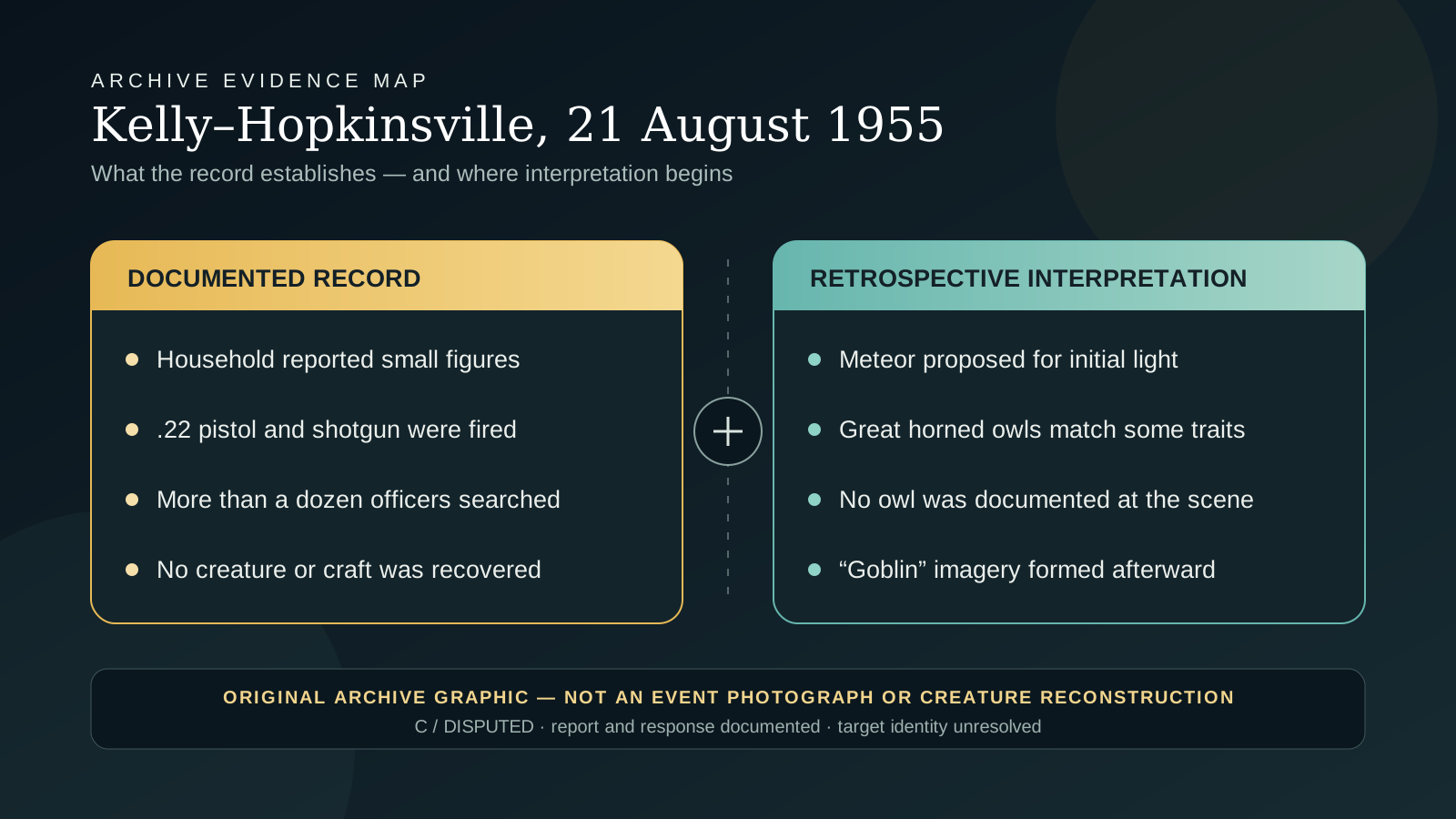
This case is disputed. The archive preserves the claims while separating evidence from interpretation.
- Documentation
- High documentation
- Primary location
- Kelly, Christian County, Kentucky
- Source base
- 6 linked records
- Research use
- Comparison case
What the Kelly-Hopkinsville record establishes
- Confirmed response
- A frightened household sought help, and more than a dozen officers searched the property after gunfire.[1]
- Unverified claim
- Small bright-eyed beings and bullets failing to harm them are witness claims, not independently verified observations.[1][2]
- Best conventional model
- A meteor may explain the first light, while great horned owls plausibly match several figure traits; neither identification is forensically proven.[2][4][5]
Case dossier
The incident occurred at the Sutton farmhouse on Old Madisonville Road, about eight miles north of Hopkinsville and near Kelly in Christian County. The 1955 local article estimated “some 10 or 12 persons,” including children, and said investigating officers could not determine exactly how many claimed to have seen the figures. Later rosters are more definite, but the contemporary uncertainty is the safer boundary: a household report is not the same as ten or twelve independent observations.
Taylor said that while fetching water he saw a bright object streak across the sky and disappear beyond trees. That statement is testimony, not a recorded trajectory. Meteors were reported in the broader period, and a meteor is a reasonable explanation for a brief luminous passage. It does not, by itself, identify what Taylor and Sutton later perceived near the farmhouse. Keeping those two episodes separate prevents the first light from being used as automatic proof of a landed craft.
Taylor and Sutton described a short, upright figure with a large head or ears, bright eyes and raised arms. They fired a .22-caliber target pistol and a shotgun, reported that the figure moved or floated away, and later fired at shapes near a window and roof. Their descriptions were made under darkness, alarm and repeated gunfire. No surviving photograph, film, audio recording or contemporaneous scale drawing captures the target, and no body, blood, feathers or other specimen was placed in a documented chain of custody.
Near 11 p.m., the group drove to Hopkinsville police headquarters. The Kentucky New Era reported that more than a dozen state, county and city officers went to the farmhouse between 11 p.m. and midnight and stayed until after 2 a.m. The paper said they saw nothing that proved or disproved the story. This is the strongest external corroboration: authorities responded to frightened people and searched a scene where shots had been fired. It is not corroboration that officers saw the reported beings.
The testimony chain changed as the story moved from a local front page to national UFO literature, books, television and anniversary reporting. The 1955 article used “little men” in its headline, while the now-familiar “goblins” and “little green men” imagery hardened later. Witness accounts described silvery or gray figures, not a verified green body. Modern portraits, statues and stylized creatures document cultural memory; none is a frame captured at the farmhouse.
The owl hypothesis is specific rather than generic. Kentucky wildlife authorities identify great horned owls as common statewide residents of forests and semi-open farmland, with large ear tufts and typically yellow eyes. Cornell documents their quiet flight, large night-adapted eyes and broad-winged maneuvering. Those traits can model ears, glowing eyes, silent movement and apparent floating in darkness. Yet no owl was documented at the Sutton property that night, and the model does not reproduce every duration or claimed encounter. It should therefore be presented as the strongest conventional candidate, not a forensic identification.
Timeline
- Billy Ray Taylor reported a bright object crossing the sky beyond the farmhouse.
- Taylor and Lucky Sutton reported small bright-eyed figures and fired a .22 target pistol and shotgun.
- The household drove to Hopkinsville police headquarters seeking help.
- More than a dozen officers searched the property but reported no confirming or disconfirming sighting.
- The Kentucky New Era published the local front-page account, beginning the documented press chain.
- Joe Nickell published a later meteor-and-great-horned-owl reconstruction in Skeptical Inquirer.
- WBKO's 70th-anniversary report showed the story's continuing family, festival and media afterlife; it was not 1955 footage.
Kelly-Hopkinsville encounter questions
Did the Kelly-Hopkinsville encounter really happen?
A disturbance and police response are documented. The extraordinary identity of what the witnesses reported is not verified.
How many people were at the farmhouse?
The 1955 local report estimated about ten or twelve people and said officers could not determine how many actually claimed to see the figures. Later sources commonly say eleven.
What did police find?
They searched after gunfire but the local newspaper said they saw nothing that proved or disproved the story. No creature, craft or tested specimen was recovered.
Were the figures great horned owls?
Possibly. The species matches several traits and is common in Kentucky, but no owl or site test proves that identification for this night.
Are the famous goblin pictures evidence?
No. They are drawings, sculptures and later designs based on retellings, not photographs from 21 August 1955.
Why is the case rated C / DISPUTED?
The report and police search are well established, but the target evidence is testimonial, no authenticated image or specimen survives, and the owl model remains retrospective.
Sources
- [1] ArchiveKentucky New Era archive: Police Probe Alleged Raid by Little Men in Space-ShipKentucky New Era archive special edition
- [2] ResearchSiege of the “Little Green Men”: The 1955 Kelly, Kentucky, IncidentSkeptical Inquirer / Joe Nickell
- [3] ResearchHauntings, homeopathy, and the Hopkinsville GoblinsFrontiers in Psychology
- [4] Official fileIdentifying Kentucky's OwlsKentucky Department of Fish & Wildlife Resources
- [5] ResearchGreat Horned Owl species accountCornell Lab of Ornithology
- [6] News report70 years later: Revisiting the Kelly-Hopkinsville EncounterWBKO
The displayed image is an original site-authored evidence-boundary graphic. It is not an event photograph, a creature portrait, a newspaper scan or a frame from WBKO. No authenticated photograph or film of the 1955 target was located.