
Evidence / Updated 2026-07-11 / 3 min read
Autokinesis: why a stationary light can seem to move
In a dark scene without visual references, a fixed point of light may appear to drift or dart. Aviation guidance treats this as a known perception illusion.
Reviewed and maintained byGlobal UFO Archive Editorial DeskEditorial policy
Quick answer
Autokinesis is the apparent motion of a stationary light viewed against a dark, featureless background. Small involuntary eye movements and the lack of stable visual references can make the light seem to drift, circle or jump. FAA guidance warns pilots about this illusion. Looking away briefly, using peripheral vision, comparing the light with stars or terrain, and recording it with a fixed camera can help separate perceived motion from physical motion.
Key points
- Autokinesis changes the observer's perception; it does not mean the light itself has physically moved.
- The effect is strongest when one isolated light is watched in darkness without a horizon or nearby reference.
- A fixed-camera sequence that includes stars, terrain or a compass direction provides a useful independent test.
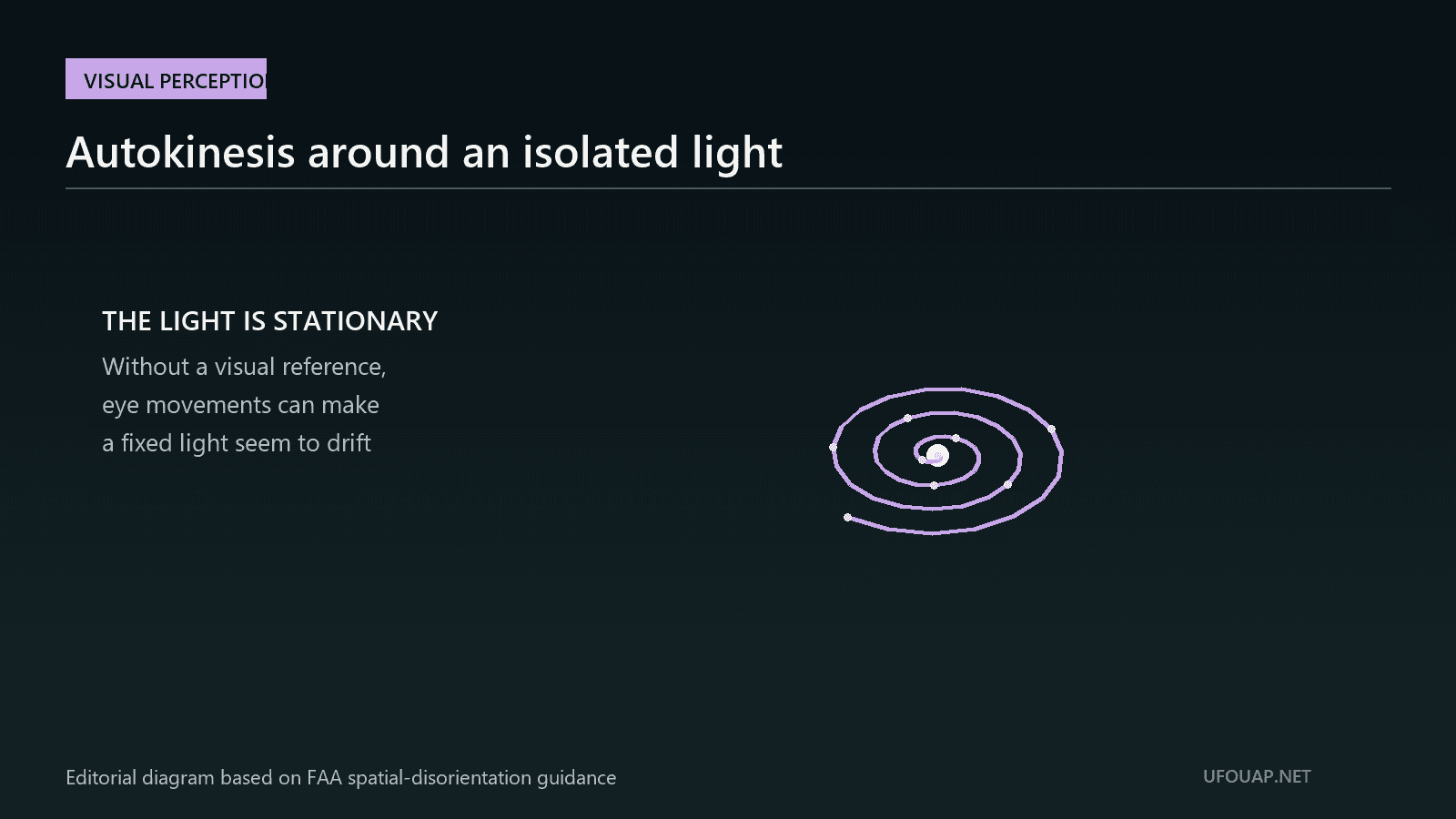
What the illusion feels like
A distant star, aircraft light or tower light can initially appear fixed and then seem to wander after sustained attention. The apparent path may be slow and curving or include sudden small jumps. Because the scene lacks scale, the observer may interpret tiny angular changes as large movements at an unknown distance. The experience can be vivid and sincere even when the external light remains stationary.
Why the brain creates apparent motion
Eyes are never perfectly still. In a textured scene, the brain compares small retinal shifts with edges, horizon and nearby objects and keeps the world stable. Against a featureless dark background, that correction lacks a reliable anchor. The FAA describes autokinesis as apparent motion that may arise after staring at a stationary light for several seconds, making it an operational aviation concern rather than a claim about witness honesty.
How to test the observation in real time
Shift gaze away from the light, blink, and then view it peripherally instead of staring directly. Align it with a roof edge, tree, horizon, star pattern or compass bearing. If safe, change the observer's position and note whether the bearing changes. Ask another observer to describe the motion independently before discussing it. These steps introduce reference information that the original dark scene lacked.
What a camera can and cannot show
Autokinesis occurs in perception, so a camera fixed on a tripod should not record the light moving relative to stars or terrain. Handheld video can still create apparent movement through shake, stabilization and digital zoom. A useful recording includes a wide field, fixed references and several seconds before and after the claimed maneuver. If physical displacement remains after stabilization and reference checks, autokinesis alone is insufficient.
Limits of the explanation
Autokinesis does not explain every report of a moving light. It cannot by itself account for synchronized motion captured by multiple fixed cameras, a measurable change in bearing, radar data or an object passing behind known structures. It is one hypothesis for reports based mainly on prolonged visual observation of an isolated light. The evidence should determine whether the hypothesis fits, not the familiarity of the term.
Careful assessment
A report consistent with autokinesis should be described as a perception-based possibility, not dismissed as imagination. The witness may have accurately reported what the light looked like. The archive's task is to separate the reported experience from the external motion claim. When no fixed reference or original video exists, the appropriate conclusion is often that apparent movement cannot be independently verified.
FAQ
Can several people experience autokinesis?
Yes, especially when they view the same isolated light under similar conditions. Their descriptions may still differ, so independent notes taken before discussion are useful.
Does a moving dot in handheld video prove autokinesis?
No. Autokinesis is perceptual, while handheld video movement may come from camera shake, stabilization or real target motion. Fixed references and stabilization are needed to distinguish them.
Official sources used
- Federal Aviation AdministrationMedical Facts for Pilots: Illusions in Flightwww.faa.gov
- Federal Aviation AdministrationSpatial Disorientation: Visual Illusionswww.faa.gov
- Federal Aviation AdministrationPilot's Handbook of Aeronautical Knowledge, Aeromedical Factorswww.faa.gov