
Arctic Ocean / 1971 / DISPUTED
USS Trepang UFO photographs
The USS Trepang photograph story is a provenance dispute, not a documented 1971 Navy UFO encounter. An official command history confirms that the submarine operated under Arctic ice from 22 February to 22 March 1971, gathering data for weapons systems and scientific research. No public log or contemporary report connects that voyage to the images. The link appeared in 2015, when the French paranormal magazine Top Secret received nine large prints and an unsigned letter naming Trepang, Commander Dean R. Sackett Jr. and crew member John Klika. Both named men later denied that anyone aboard saw anything unusual. In 2024 the U.S. Navy said it could not verify the images as official Navy photographs. The circulating material also contains distinct visual groups and later contamination: one image shows duplicated smoke consistent with editing, while a separate viral composite adds a disc to a documented 1982 USS Arkansas shock-test photograph. Target balloons or weapons tests remain hypotheses for some frames, not confirmed identifications. The case therefore remains C / disputed, with no Navy confirmation of the attribution or an extraordinary object.
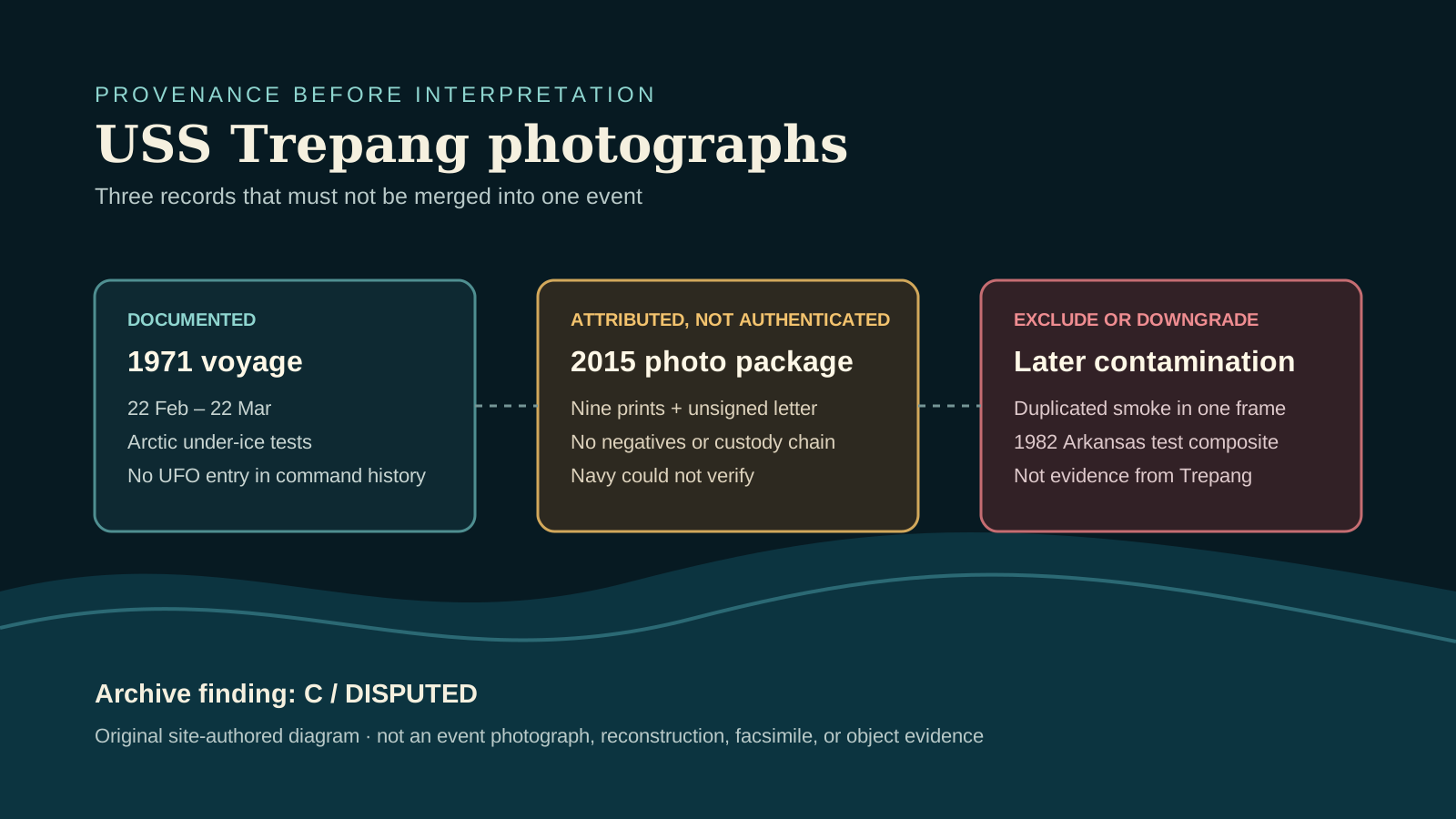
This case is disputed. The archive preserves the claims while separating evidence from interpretation.
- Documentation
- High documentation
- Primary location
- Arctic Ocean / North Atlantic
- Source base
- 6 linked records
- Research use
- Comparison case
What the Trepang record establishes
Case dossier
The voyage is the firmest part of the story. USS Trepang, a Sturgeon-class nuclear attack submarine commissioned in August 1970, was commanded by Dean R. Sackett Jr. Its 1971 command history says it operated beneath Arctic ice from 22 February to 22 March. The purposes were extensive testing that supplied data for new and improved weapons systems and experiments by ice scientist Walter Wittmann on the ice cap. Trepang then visited Faslane from 25 to 27 March and returned to New London on 6 April. The record does not mention an unusual aerial contact, photography of unknown craft, target balloons or a combat engagement.
The photograph claim entered the public record forty-four years later. According to a documented reconstruction of the magazine’s account, Top Secret received an envelope on 15 April 2015 containing nine A4 prints and an unsigned letter. The letter supplied the date, location, submarine, commander, alleged observer John Klika and an Arctic Submarine Laboratory leak narrative. The July 2015 issue then published the images. Because the sender was anonymous, the prints lacked a demonstrated custody chain and the dramatic account came from the same letter that attributed them, this publication documents circulation—not a 1971 event.
Checks of the named people weaken the attribution. The Black Vault’s published research says Sackett and Klika confirmed their presence aboard during the Arctic deployment but each denied seeing anything unusual. In a fresh 2024 interview, Sackett again said there were no sightings and the story was inaccurate. A Navy public-affairs officer separately told PolitiFact that the service was unable to verify the images as official Navy photographs. These statements do not identify every object in every print, but they directly contradict the anonymous witness story and any claim of Navy authentication.
The circulating ‘Trepang photographs’ should not be treated as one continuous sequence. The magazine itself described different markings and two apparent object groups, while later online collections changed order and context. Some frames resemble elongated balloons, test targets or effects around the sea surface, but no released Navy record ties a particular frame to a particular test. One dramatic smoke image contains repeated cloud regions consistent with copy-and-paste editing. That finding impeaches that frame and the integrity of the supplied set; it does not prove that every other image was made by the same method.
A separate viral image must be excluded entirely. AP traced a picture of a disc rising beside an explosion and a warship to a real 17 March 1982 shock test of the cruiser USS Arkansas. The original archive photograph shows the ship and explosive plume but no disc; the altered version appeared in the 2008 fictional short film The Orion Conspiracy. It is neither a Trepang photograph nor evidence from 1971. Its later association illustrates how visually similar naval imagery can be folded into an already weakly sourced dossier.
The most defensible conclusion is narrower than either ‘alien craft’ or ‘all solved as target balloons.’ Trepang’s Arctic deployment and weapons-related testing are documented. The image attribution, witness story, claimed security markings and laboratory leak are not independently documented. Some visual content may depict conventional tests or targets, and at least one supplied frame shows manipulation, but original negatives, metadata and a frame-by-frame custody chain are absent. Preserving the case is useful because it demonstrates how a true voyage can lend credibility to an unverified photo story; it does not justify treating the photographs as Navy-confirmed evidence.
Timeline
- USS Trepang is commissioned with Commander Dean R. Sackett Jr. in command.
- The official command history records Arctic under-ice weapons-system data tests and scientific experiments; it records no UFO encounter.
- Trepang returns to New London after the deployment and a Faslane port visit.
- Top Secret magazine receives nine prints and an unsigned letter attributing them to Trepang.
- Top Secret issue 79 publishes the photographs; subsequent research reports that Sackett and Klika deny any unusual sighting.
- Researchers identify duplicated smoke regions in one supplied photograph, consistent with digital editing.
- AP separates a viral disc composite from the case and traces its base image to a 1982 USS Arkansas shock test.
- PolitiFact reports that the Navy cannot verify the images as official and quotes Sackett denying the story again.
USS Trepang photograph questions
Did USS Trepang encounter a UFO in 1971?
No public contemporary record documents such an encounter. The commanding officer and a named crew member denied it.
Are the photographs official U.S. Navy images?
The Navy told PolitiFact it was unable to verify them as official photographs.
When did the photographs first become public?
The earliest documented public chain begins with an anonymous package received by Top Secret magazine in April 2015 and publication that July.
Do the images show Navy target balloons?
That is plausible for some shapes but unconfirmed. No public Navy record identifies the frames as particular targets.
Were any Trepang photographs edited?
One supplied smoke image has duplicated cloud regions consistent with editing. That does not establish the origin of every other frame.
Is the explosion-and-disc image part of the case?
No. AP traced it to a disc added to a 1982 USS Arkansas shock-test photograph for a fictional film online by 2008.
Sources
- [1] Official fileTrepang II (SSN-674)Naval History and Heritage Command
- [2] Official fileUSS Trepang 1971 command history and FOIA responseDepartment of the Navy / NHHC
- [3] News report‘Official’ Navy photographs of a UFO don’t hold waterPolitiFact
- [4] ResearchThe USS Trepang photographs: letter and publication chronologyRR0
- [5] ResearchArctic UFO photographs, USS Trepang, SSN 674The Black Vault
- [6] News reportA Navy test photo was edited to add a UFOAssociated Press
This is an original site-authored provenance diagram. It is not an event photograph, reconstruction, facsimile or evidence of an object. The anonymously supplied photographs and later composites are not reproduced because their custody and commercial republication rights are unclear.