
United Kingdom / 1952 / UNRESOLVED
1952 RAF Topcliffe UFO sighting
The Topcliffe case is a real, contemporaneously reported RAF visual sighting, but the object remains unidentified rather than proven extraordinary. At 10:53 local time on 19 September 1952, Flight Lieutenant John Kilburn and four other 269 Squadron Shackleton aircrew, standing on the airfield, watched a silver circular object behind a descending Meteor for 15 to 20 seconds. Kilburn said it descended like a falling sycamore leaf, appeared to turn with the Meteor toward Dishforth, then rotated and accelerated away. AIR 16/1199 holds the witness report; AIR 20/7390 holds the next-day signal. No event image, radar record, measured geometry or physical trace is public.
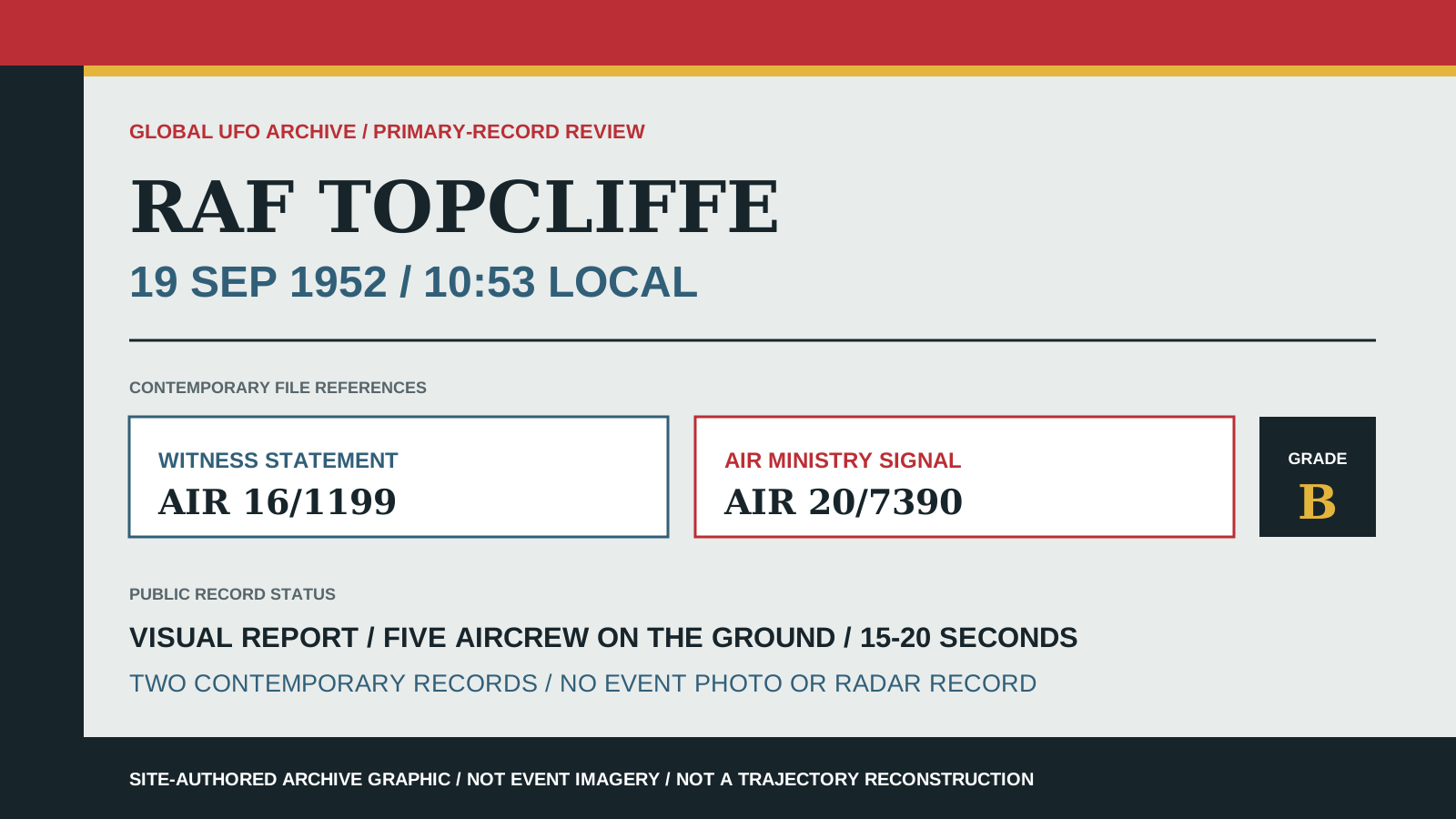
This case remains unresolved in the public record, with credibility grade B.
- Documentation
- High documentation
- Primary location
- RAF Topcliffe, North Yorkshire
- Source base
- 5 linked records
- Research use
- Comparison case
What the Topcliffe files support
- Contemporary record
- Kilburn's report is referenced as AIR 16/1199; a signal received on 20 September survives in AIR 20/7390.[1][2][3]
- Ground witnesses
- Kilburn and four other Shackleton aircrew watched from the airfield. They were not observing from the Shackleton shown in the legacy image.[1]
- Reported motion
- The object was described as silver and circular, descending like a sycamore seed, appearing to follow a Meteor, then rotating and accelerating away during a 15-to-20-second view.[1][2]
Case dossier
The witnesses were on the airfield, not inside an aircraft. The National Archives' later publication says Flight Lieutenant John Kilburn of 269 Squadron stood with four other Shackleton aircrew while they watched a Meteor descend. Kilburn's quoted statement says Flight Lieutenant Paris first noticed the white object. The public source set does not include separate signed accounts from Paris or the other three men, so five observers should not be counted as five independent narratives.
Kilburn placed the Meteor at about 5,000 feet, approaching from the east. He estimated the object at between 10,000 and 20,000 feet and about five miles behind the jet. It looked silver and circular, moved much more slowly than the Meteor, and initially followed a similar course. These were visual estimates made against the sky. No triangulation, instrument reading, angular size, observer separation or known object dimension survives with which to calculate its true range, size or speed.
The reported sequence was distinctive but qualitative. The object began descending with a pendular motion likened to a falling sycamore leaf, and the men first considered a parachute or an engine cowling. The Meteor turned toward Dishforth and the object, still descending, appeared to follow. Kilburn then said the descent and swinging stopped, the object rotated on its axis, accelerated west and turned onto a south-easterly heading before disappearing. The entire observation lasted 15 to 20 seconds. His comparison with a shooting star described an impression of acceleration, not a timed velocity measurement.
The administrative trail began immediately. The National Archives identifies Kilburn's report to Topcliffe's commanding officer in Fighter Command file AIR 16/1199. A separate signal in AIR 20/7390 says it originated at 16:44Z on 19 September, was received on 20 September, and was later recirculated through the Air Ministry registry. Its distribution list included senior operations and intelligence offices, the Chief of the Air Staff, the Secretary of State and the Ministry of Defence for the Director of Scientific Intelligence. That chain proves prompt official handling, not an official identification of the object.
Operation Mainbrace is context, not a cause. The National Archives places the sighting during that major NATO exercise, and NATO's own history describes Mainbrace as the first exercise of its kind, involving 200 ships from nine member countries in the North Atlantic. The exercise explains why RAF and allied command channels were active and why aircraft traffic deserves consideration. It does not show that the reported object belonged to the exercise, was tracked by NATO, or prompted a multinational UFO investigation.
The two file references must remain separate. AIR 16/1199 is the Topcliffe occurrence file and is the reference attached to Kilburn's quoted statement. AIR 20/7390 is a broader Air Ministry file of unidentified-object and aircraft reports from 1950 to 1954; it contains the short Topcliffe signal. The records also conflict: the full statement puts the Meteor near 5,000 feet, while the signal says about 500 feet. The signal encodes 10:53 local time, while the later National Archives narrative calls the sighting an afternoon event. The accessible record does not resolve either discrepancy.
Important evidence is missing. No authenticated photograph or film of the object is known, and the newspaper image later reproduced by the National Archives shows coverage, not the sighting. No radar plot, radio recording, Meteor crew statement, aircraft serial, meteorological report, measured bearing sequence, physical debris or follow-up technical finding accompanies the public case. The full AIR 16/1199 scan and separate statements from the other witnesses were not available in the reviewed public source set. Those absences prevent a reconstruction of the object's path or a reliable test of the speed claim.
The defensible result is an unresolved, brief, visual-only military report. Its strengths are a named reporting officer, four accompanying aircrew, a same-day report and a rapid official signal. Its weaknesses are the single surviving detailed narrative, unmeasured geometry, internal altitude and time discrepancies, and the absence of instrument or physical evidence. Balloons, airborne material, aircraft-related debris, optical perspective and other conventional explanations remain possible families, but the public record cannot select one. Equally, it contains no evidence that makes a nonhuman origin the default conclusion.
Timeline
- Operation Mainbrace brings a large NATO maritime exercise to the North Atlantic; NATO later describes 200 ships from nine countries.
- Kilburn and four other Shackleton aircrew observe the object from RAF Topcliffe for 15 to 20 seconds.
- Kilburn reports the sighting to Topcliffe's commanding officer; the report is preserved under AIR 16/1199.
- The Topcliffe signal records its time of origin and summarizes the witnesses' reported sequence.
- The signal is received and reported to the Air Ministry; a copy later survives in AIR 20/7390.
- Air Ministry registry telegrams recirculate the signal to senior operations, intelligence and defence recipients.
- Fighter Command issues formal instructions for future RAF aerial-phenomena reports to reach Air Ministry technical intelligence.
- The AIR 20/7390 cover marks the file closed until 1985 and later downgraded to the open series.
- A National Archives book extract publishes the Kilburn passage and reproduces the newspaper coverage and AIR 20/7390 signal as documentary illustrations.
- National Archives guidance explains the AIR 16 and AIR 20 holdings, pre-1967 destruction policy and the boundary between online and Kew-only access.
RAF Topcliffe questions
What happened at RAF Topcliffe in 1952?
Five Shackleton aircrew reported a 15-to-20-second daylight sighting of a silver circular object near a descending Meteor. They said it descended with a swinging motion, appeared to turn with the jet, then rotated and accelerated away.
Were the witnesses flying in a Shackleton?
No. The National Archives account says Kilburn and four other Shackleton aircrew were standing on the airfield. The aircraft-type photograph used by the older page is later background imagery, not a picture of the witnesses or event.
Did the object chase the Meteor?
The report says it appeared to follow when the Meteor turned toward Dishforth. That is witness wording, not a measured formation track. Different estimated heights and the lack of bearings, radar or pilot confirmation prevent proof of pursuit.
What are AIR 16/1199 and AIR 20/7390?
AIR 16/1199 is the Fighter Command occurrence file cited for Kilburn's statement. AIR 20/7390 is a broader Air Ministry file containing the next-day signal. The statement gives the Meteor about 5,000 feet; the signal says about 500 feet, an unresolved archival conflict.
Is there a photograph, radar record or video of the sighting?
No authenticated event image, radar plot or original video was found. The National Archives publication reproduces a newspaper clipping and a document page; both show the later record, not the object in the sky. The displayed cover is site-authored context only.
Was the Topcliffe object extraterrestrial?
The records do not establish that. They document an unidentified visual report and rapid official circulation. Conventional objects and perceptual effects remain possible, but the surviving data cannot identify one. Unresolved describes missing identification, not proof of a nonhuman cause.
Sources
- [1] Official fileThe UFO Files extract: the Topcliffe incident and AIR 16/1199The National Archives
- [2] ArchiveAIR 20/7390 Topcliffe signal, scan and transcript access copyUK Air Ministry / UFO Transparency
- [3] Official fileNational Archives briefing on British UFO recordsThe National Archives
- [4] Official fileNational Archives research guide to UFO recordsThe National Archives
- [5] Official fileNATO history: Operation MainbraceNATO
The displayed visual is a site-authored archive cover. Its date, file references and evidence labels summarize the accepted records. It is not a photograph of the sighting, an image of the reported object, a Meteor or Shackleton depiction, or a trajectory reconstruction. No authenticated event video was found.