
United States / 1973 / UNRESOLVED
Coyne helicopter incident
On a proficiency flight from Columbus to Cleveland, Army Reserve UH-1H 68-15444 carried pilot in command Capt. Lawrence Coyne, copilot 1st Lt. Arrigo Jezzi, crew chief Staff Sgt. Robert Yanacsek and flight medic Staff Sgt. John Healey. A signed Army disposition form dates the encounter to 23:05 on 18 October 1973 near Mansfield, Ohio, at 2,500 feet on heading 030. It records a red light apparently converging at high speed, Coyne's descent to about 1,700 feet, one Mansfield Tower acknowledgement without an answer to the aircraft query, and a later 3,500-foot altimeter reading while the collective was full down. The form does not mention a cigar shape, green beam, spinning compass or total radio failure. Those details appear in next-day testimony, early newspapers and Coyne's 1978 United Nations statement, with material differences among the four crewmen. A family of ground witnesses was located only after a 1976 newspaper appeal. No public radar plot, tower tape, flight recorder, maintenance analysis or authenticated event image has been recovered. Aircraft, an Orionid meteor and pilot response under collision stress remain debated but unverified. The archive therefore retains B / UNRESOLVED: unidentified in the surviving public record, not established as exotic.
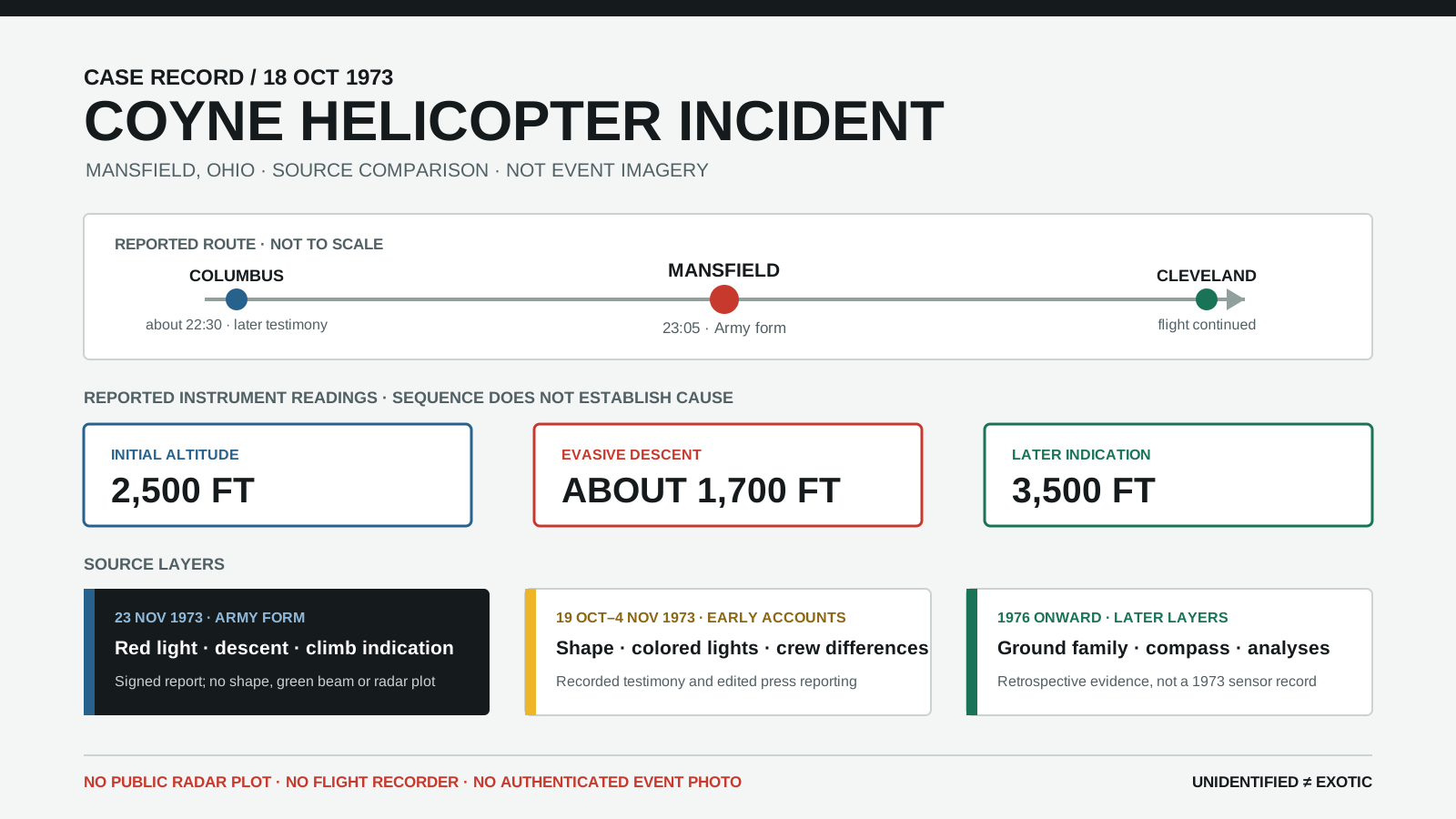
This case remains unresolved in the public record, with credibility grade B.
- Documentation
- High documentation
- Primary location
- Near Mansfield, Ohio
- Source base
- 9 linked records
- Research use
- Comparison case
What the surviving record establishes
- Flight record
- The signed Army form places helicopter 68-15444 near Mansfield at 23:05 on 18 October 1973, at 2,500 feet and heading 030 while returning from Columbus to Cleveland.[1][2][4]
- Crew
- The named crew were Capt. Lawrence Coyne, 1st Lt. Arrigo Jezzi, Staff Sgt. Robert Yanacsek and Staff Sgt. John Healey of the 316th Medical Detachment.[1][2]
- Report layers
- The Army form records a red light and altitude sequence. Cigar shape, green illumination, compass motion and broader radio failure come from next-day, press or later testimony and were not described uniformly by all four crewmen.[1][2][3][4]
- Altitude boundary
- The crew reported descending from 2,500 to about 1,700 feet and later seeing 3,500 feet with a 1,000-foot-per-minute climb indication. No synchronized control, power or altitude recorder establishes why the transition occurred.[1][2][5]
Flight record and testimony layers
Case dossier
The flight was an Army Reserve proficiency mission, not a combat sortie. Helicopter 68-15444, identified in later investigative material as a UH-1H, was returning from Columbus to its Cleveland facility. The signed 23 November 1973 Army form names Capt. Lawrence J. Coyne as pilot in command, 1st Lt. Arrigo Jezzi as copilot, Staff Sgt. Robert Yanacsek as crew chief and Staff Sgt. John Healey as flight medic, all assigned to the 316th Medical Detachment (Helicopter Ambulance). The typed form renders Jezzi's surname as Jozzi. It places the aircraft southeast or east-southeast of Mansfield Airport at 23:05, at 2,500 feet and heading 030. Coyne's 1978 testimony adds a 22:30 Columbus departure, 90-knot airspeed and 2,500 feet mean sea level; these are retrospective details, not all fields on the Army form.
The Army form begins with Yanacsek seeing a red light on the eastern horizon, about 90 degrees to the flight path. Roughly 30 seconds later he warned that it was converging at the same altitude on an apparent collision heading; the crew estimated a speed above 600 knots, but no range or angular measurement supports that estimate. Coyne took the controls and initiated a powered descent from 2,500 toward 1,700 feet. The form says Mansfield Tower acknowledged the helicopter's call but did not answer whether a high-performance aircraft was nearby. It then says the light or object hesitated over the helicopter, moved west and accelerated before turning about 45 degrees northwest. This is a signed crew report of perceived geometry, not a radar-confirmed near miss.
The most consequential instrument claim is narrower than many retellings. The Army form says Coyne indicated the altimeter was showing a 1,000-foot-per-minute climb and 3,500 feet while the collective remained full down. The crew then returned to 2,500 feet and continued to Cleveland. It does not say an unknown craft physically lifted the helicopter, and no control-position, engine-power or altitude recorder is available. The later CUFOS report explicitly says the point at which descent became climb was unknown. A delayed recovery input or an unremembered collective movement during a collision response is therefore possible, while the crew disputed that reconstruction. The surviving record establishes reported instrument readings and remembered control position, not an independently measured 1,800-foot external force.
Shape and color details enter through several layers. Healey's account, recorded according to CUFOS on 19 October, described a gunmetal-gray cigar-like body, a red nose light, a green underside light and a white rear light, with no noise or turbulence. The Plain Dealer on 21 October and a 4 November UPI report carried similar cigar and green-cabin descriptions, principally through Coyne. Coyne's 1978 United Nations testimony enlarged this into a 50-to-60-foot metallic symmetrical object and a pivoting, pyramid-shaped green light that illuminated the cockpit. Jezzi, whose detailed interview came more than three years later, said his position blocked the approach and that he mainly saw a brilliant white departure light. Healey later did not recall the whole cabin turning green or the full altitude sequence. These are witness layers, not one uniform four-person statement.
The communications record also grew with retelling. The Army form documents an acknowledgement from Mansfield Tower followed by no answer to the question about nearby traffic. Coyne later said transmit and channel tones were audible, Jezzi tried other frequencies and communications returned farther along the route. No tower tape, radio log or interference measurement is public. A spinning magnetic compass appears in Coyne's 1978 testimony but not in the Army form or earliest reports. Later interviews said the compass had behaved erratically before and was replaced, yet no maintenance card or laboratory examination has been recovered. Radio propagation, workload and an equipment fault are plausible categories; none has been matched to complete contemporary technical records.
Ground corroboration is retrospective. In August 1976, investigators placed a Mansfield News Journal notice asking for witnesses. A young caller then led them to a mother and four children or adolescents who recalled helicopter noise, red and green lights and green illumination on the ground. Interviews occurred almost three years after the event; names were withheld, and no diary, police call or dated 1973 statement from the family is public. A relative reportedly remembered hearing their story soon after the incident, but that too was recorded later. The CUFOS report acknowledges that some leading questions were asked. The family accounts are relevant because they were not crew interviews, yet they cannot be described as contemporaneous or fully independent documentation.
The official administrative trail is real but limited. The Army form says the flight plan was closed, an FAA Flight Service Station was notified, the crew was advised to contact the FAA General Aviation District Office at Cleveland Hopkins, and the 83rd U.S. Army Reserve Command was notified on 19 October. The four crewmen signed that they had read the report. The public set reviewed here does not include a radar return, tower recording, raw flight plan, FAA case file, aircraft movement log, maintenance finding or final Army explanation. Coyne later spoke to a United Nations committee in a private capacity; the official verbatim record authenticates what he said in 1978, not the physical details of 1973 and not a UN finding.
Conventional explanations solve different parts, not the complete later narrative. A head-on aircraft can appear nearly stationary before rapid angular motion, and the red, green and white lights overlap ordinary navigation-light categories; however, no public movement record identifies a matching aircraft. Coyne said an F-100 check found none airborne, but the underlying traffic record has not been recovered. The Orionids are active in mid-October and produce fast, bright meteors, so a meteor is relevant to the initial luminous approach; NASA's general shower page is not evidence of a specific 18 October fireball, and a meteor does not fit a prolonged nearby structured object if the later testimony is accurate. Perception, memory and pilot control response can address speed, distance and climb, but cannot be tested against missing recordings. Unresolved is therefore the honest record status, not a positive finding of non-human technology.
Timeline
- Coyne later testified that helicopter 68-15444 departed Columbus for Cleveland at about 22:30.
- The Army form fixes the reported convergence, evasive descent and later climb indication near Mansfield at 23:05.
- The Army reporting chain was notified; CUFOS says Healey recorded an account less than eighteen hours after the encounter.
- The Plain Dealer published the first known written press account, including shape and green-light details beyond the later Army form.
- The four crewmen signed the Army disposition form titled Near Midair Collision with UFO Report.
- A newspaper appeal for witnesses led investigators to the later-anonymized Mansfield family accounts.
- A MUFON Journal update described the ongoing investigation and explicitly noted no physical evidence that the object caused the climb or radio effects.
- Coyne described the encounter to a United Nations committee in a private capacity; the statement was published in the official verbatim record.
- CUFOS published Jennie Zeidman's full investigation with interviews, document appendices and an unresolved conclusion.
- The Sturrock review panel called the case puzzling but stressed the lack of solid physical evidence such as a laboratory compass analysis.
Coyne helicopter incident questions
What happened in the Coyne helicopter incident?
Four Army Reserve crewmen formally reported a red light converging near Mansfield, an evasive descent, and a later unexplained climb indication. Shape, green-light, compass and extended-radio details belong to separate testimony layers, not all to the signed Army form.
Who was aboard the helicopter?
The signed report names pilot in command Capt. Lawrence J. Coyne, copilot 1st Lt. Arrigo Jezzi, crew chief Staff Sgt. Robert Yanacsek and flight medic Staff Sgt. John Healey, all from the 316th Medical Detachment.
Did a green beam lift the helicopter?
The Army form records the climb indication and collective position but does not mention a green beam or say the object caused the climb. Green illumination appears in early testimony and press, while the more elaborate pivoting-beam description is from Coyne's 1978 testimony. No recorder measured an external force.
Were the ground witnesses contemporaneous?
No public 1973 statement from them is known. Investigators found the family after an August 1976 newspaper appeal and interviewed them almost three years after the event. Their account is separately situated but retrospective, anonymized and partly elicited with leading questions.
Could it have been an aircraft or meteor?
Both remain partial hypotheses. Aircraft perspective and navigation lights can address apparent convergence and colors, but no matching traffic record is public. The Orionids were seasonally active, but no specific Mansfield fireball record was found, and a meteor fits poorly with the prolonged structured description if that later testimony is accurate.
Why is the case still classified B / UNRESOLVED?
The signed multi-crew report and early accounts justify serious treatment and B credibility. Material witness differences and missing radar, recordings, maintenance evidence and authenticated imagery prevent a confident identification or causal claim. Unresolved means the surviving public record does not identify the light; it is not evidence by itself for an extraordinary origin.
Sources
- [1] Official fileU.S. Army DA Form 2496: Near Midair Collision with UFO ReportU.S. Army record / Patrick Gross archive transcription
- [2] ResearchA Helicopter-UFO Encounter Over OhioJennie Zeidman / Center for UFO Studies
- [3] News reportUPI report: Chopper pilot tells of encounter with UFOUnited Press International / Mansfield News Journal archive transcription
- [4] Official fileUnited Nations Special Political Committee, 35th meeting verbatim recordUnited Nations General Assembly
- [5] ResearchHelicopter case updateJennie Zeidman / MUFON UFO Journal
- [6] ResearchPhysical Evidence Related to UFO Reports: the Sturrock panel reviewPeter A. Sturrock et al. / Journal of Scientific Exploration
- [7] ResearchPhilip J. Klass memorandum on the Coyne helicopter casePhilip J. Klass / historical memorandum archive
- [8] Official fileOrionids meteor shower: activity and velocityNASA Science
- [9] News reportThe case of Ohio's best documented UFOOhio Magazine
The displayed visual is an original site-authored source-layer diagram. It is not an event photograph, witness sketch, flight-path reconstruction, radar plot, depiction of the reported object's shape or proof that an external force changed the helicopter's altitude. Route and altitude labels summarize reported record points and are explicitly not to scale. No authenticated photograph or video of the 18 October 1973 event was found; copyrighted CUFOS scans, magazine artwork and unverified television frames are not reused.