United States / 1952 / UNRESOLVED
Nash-Fortenberry UFO sighting
The Nash-Fortenberry sighting is a documented aircrew report, not proof of an extraordinary vehicle. William B. Nash and William H. Fortenberry told Air Force investigators that six sharply defined red-orange lights crossed below their southbound DC-4, appeared to reverse direction, and were joined by two more before climbing and going dark. The official packet records a roughly 12-to-15-second observation and an immediate investigation; it also records no physical evidence and only the two pilots as aircraft witnesses. Blue Book filed the report as Unknown. That label means the available inquiry did not identify the lights—not that it established extraterrestrial origin.
This case remains unresolved in the public record, with credibility grade B.
- Documentation
- High documentation
- Primary location
- Chesapeake Bay near Newport News and Norfolk, Virginia
- Source base
- 5 linked records
- Research use
- Comparison case
What the surviving record supports
- Confirmed record
- Two Pan American pilots made a prompt report that survives in a declassified Air Force case file.[1][2]
- Observation limit
- Only Nash and Fortenberry reported seeing the lights aboard the DC-4; the event lasted about 12 to 15 seconds.[1]
- Measurement limit
- The reported size, altitude and extreme speed were visual reconstructions, not radar or triangulated measurements.[1][3]
- Media boundary
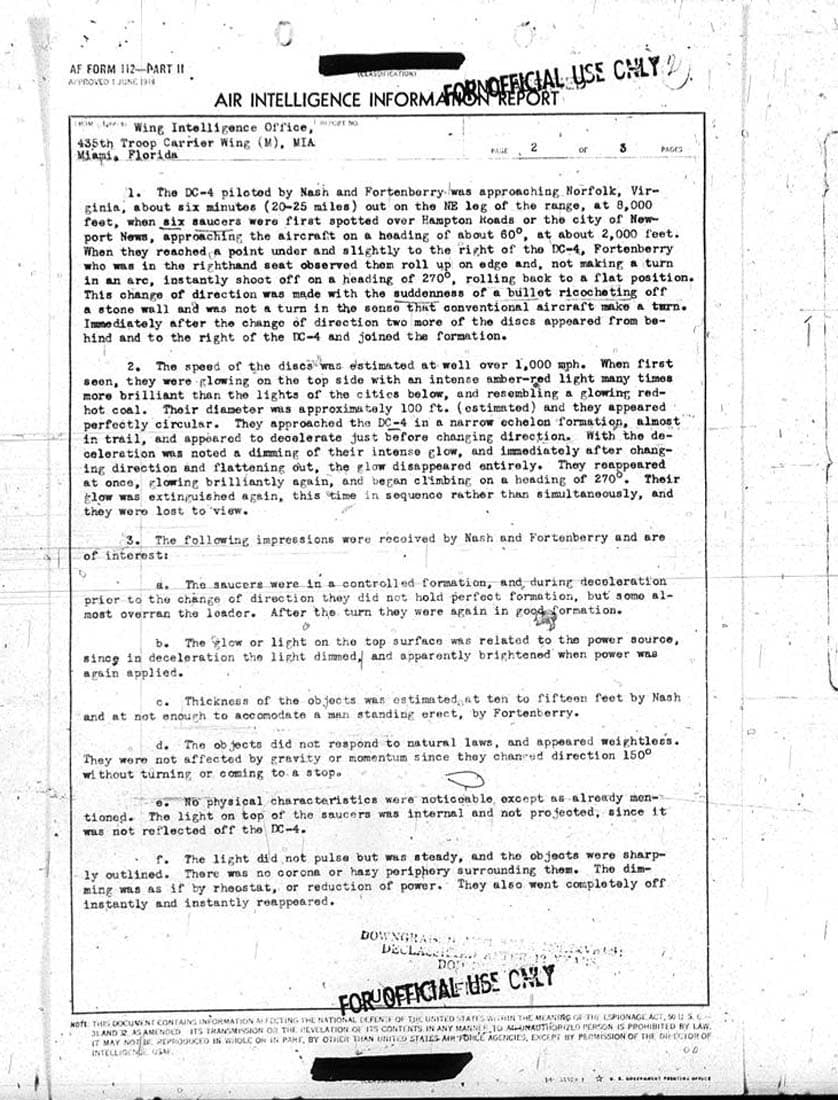
- No authenticated event photo, video, radar plot or physical trace is public; the displayed scan is an official report page.[1]
Declassified case record
Case dossier
Nash was first officer and Fortenberry second officer aboard a Pan American DC-4 traveling from New York toward Miami. The Air Force report places the aircraft about 20 to 25 miles from the Norfolk radio range, at 8,000 feet and on a southerly course. Captain F. V. Koepke was away from the flight deck when the lights appeared. The ten company passengers and the third crew member did not report seeing them, so this was one shared cockpit observation rather than nine independent accounts.
The pilots described six lights approaching from near Newport News in a narrow echelon. They looked circular and brighter than city lights, with a steady amber-red or red-orange glow. Near the DC-4, the line appeared to roll edge-on, reverse its order and depart west; two brighter lights then emerged from behind and to the right of the aircraft and joined it. The eight lights briefly went out together, reappeared, climbed, and extinguished one by one. These are witness descriptions preserved by an investigator, not a measured track.
The famous numbers require caution. The dossier gives a target altitude of about 2,000 feet, diameter near 100 feet, thickness of 10 to 15 feet and speed above 1,000 mph; later reconstructions reached 6,000 to 12,000 mph. None came from radar, triangulation or photography. They depended on assuming distance to objects of unknown size, then using that assumed distance to infer size and speed. Even experienced pilots could not break that circular geometry during a dark, seconds-long sighting.
The reporting chain began immediately. The pilots radioed Norfolk and asked that a message be passed to the military. On the morning of 15 July, Major John H. Sharpe and Office of Special Investigations personnel interviewed them in Miami and obtained written material. A 16 July intelligence cable circulated the report to Air Force commands and other agencies. The packet's date-time fields use 2012 and label it EST; later accounts commonly express the same clock moment as 9:12 p.m. EDT. This archive preserves that notation conflict instead of silently choosing one.
The official file noted five jets operating near Langley Air Force Base. A later critical reconstruction by Donald Menzel and Lyle Boyd said investigators ruled those jets out as the pilots' objects, but the reviewed packet supplies no radar track or complete flight log demonstrating that exclusion. Claims of seven corroborating ground observers are also absent from the Blue Book witness file. Later newspaper and advocacy accounts may document a wider story, but they do not create seven independent statements with matched time and geometry.
Menzel and Boyd tested several ordinary mechanisms in 1963. They rejected Mercury as too dim and cockpit-window reflections as improbable because the pilots followed the lights through three differently oriented windows. They instead proposed an unidentified coastal light or beacon multiplied by thin cloud or local temperature-and-humidity layers. The model addresses apparent multiplication and abrupt motion, but no specific light source was identified and no contemporaneous measurement established the required local layers. It is a plausible hypothesis, not a demonstrated solution.
Later retellings changed the evidentiary tone. Nash and Fortenberry's October 1952 magazine article presented their own interpretation of intelligently controlled craft, and Nash repeated an extraterrestrial conclusion in a 2002 oral-history interview. Those views belong to the witnesses, not to the original measurements or a government finding. The durable archival value of the case is narrower: two named pilots made a prompt, detailed report; officials preserved it as unidentified; the surviving evidence cannot establish what generated the lights.
Timeline
- Nash and Fortenberry report six red-orange lights below the DC-4, joined by two more, near Newport News and Norfolk.
- The pilots radio Norfolk and request that their unidentified-object report be forwarded to military authorities.
- Major John H. Sharpe and OSI personnel interview the two pilots in Miami and prepare an Air Intelligence Information Report.
- An intelligence cable distributes the report; the file notes five jets near Langley AFB.
- Project Blue Book retains the case with an Unknown conclusion; no public radar, photo or physical evidence accompanies it.
- Menzel and Boyd publish a ground-light and atmospheric-layer hypothesis after rejecting Mercury and cockpit reflections.
- The Condon Report notes that the older case was reviewed but presents no new evidence that resolved it.
- Nash gives a later oral-history interview and states an extraterrestrial interpretation; it remains a retrospective opinion.
Nash-Fortenberry sighting questions
What did Nash and Fortenberry report?
They reported six red-orange lights in formation below their DC-4, an abrupt apparent reversal, two more lights joining, and a climb before the lights went out.
Was the case in Project Blue Book?
Yes. Declassified Air Force records preserve the investigation and an Unknown disposition. Unknown means not identified from the file, not confirmed extraterrestrial.
How fast were the reported objects?
The file says above 1,000 mph and later reconstructions reached 6,000-12,000 mph, but these figures depend on assumed range and are not instrument measurements.
Could the lights have been aircraft or meteors?
Both are conventional possibilities with incomplete fit. Jets were nearby but reportedly excluded; meteors fit brevity and brightness but not the full coordinated sequence as described. The surviving data do not settle either.
What was Menzel's explanation?
After rejecting Mercury and cockpit reflections, Menzel and Boyd proposed a coastal light multiplied by thin atmospheric layers. No specific light or required local layer was demonstrated, so it remains a hypothesis.
Is there original video of the sighting?
No. No authenticated event photograph or film is in the accepted record. Later television programs and interviews are retrospective coverage, not 1952 footage.
Sources
- [1] Official fileProject Blue Book Nash-Fortenberry case dossierU.S. Air Force records / NICAP access copy
- [2] Official fileNational Archives Project Blue Book reference reportU.S. National Archives and Records Administration
- [3] ResearchThe World of Flying Saucers: The Chesapeake Bay CaseDonald H. Menzel and Lyle G. Boyd / Project Gutenberg
- [4] ResearchCondon Report, Section IV: Case StudiesUniversity of Colorado / National Capital Area Skeptics archive
- [5] ArchiveRevisiting the 1952 Nash-Fortenberry sightingTom Tulien / NICAP archive
The displayed image is a localized copy of a declassified U.S. Air Force Air Intelligence Information Report page dated 15 July 1952. It documents official handling and identifies the pilots; it is not a photograph of the reported lights, a trajectory reconstruction or proof of an extraordinary vehicle. No authenticated event image or original video was located.