
Canada / 1954 / UNRESOLVED
1954 BOAC Labrador UFO sighting
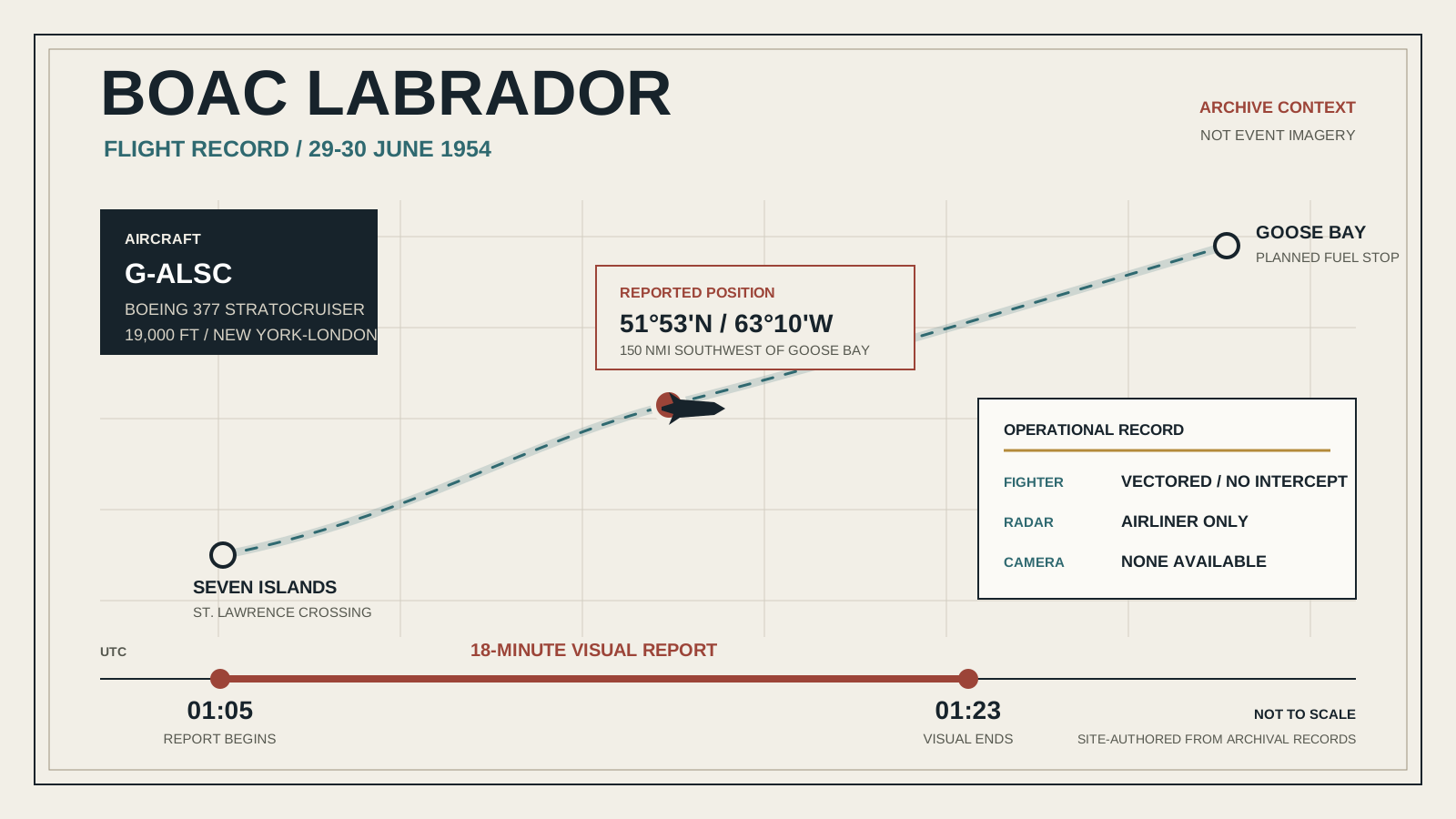
At 01:05-01:23 UTC on 30 June 1954, the evening of 29 June locally, Captain James R. Howard and other crew aboard BOAC Boeing 377 Stratocruiser G-ALSC reported one large, changing dark silhouette with usually six smaller forms off the port side. The New York-London aircraft was routing through a planned Goose Bay fuel stop and was near 51°53'N, 63°10'W, northeast of Seven Islands in eastern Quebec. The public record supports an 18-minute visual observation, not a measured size or range. It also confirms that a fighter was vectored but made no intercept and that Fighter Control tracked only the airliner, not the reported forms. Fifty-one passengers were aboard, but public sources conflict over the exact crew complement and passenger witness count. Project Blue Book's final Mars label relied on a separate ship report; the later Condon analysis favored a rare mirage while acknowledging missing meteorological data. With no verified event photograph, raw radar record, fighter report or complete witness set, the sighting remains visually unresolved. That status is not evidence of extraterrestrial origin.
This case remains unresolved in the public record, with credibility grade B.
- Documentation
- High documentation
- Primary location
- Eastern Quebec on the Seven Islands-Goose Bay route
- Source base
- 5 linked records
- Research use
- Comparison case
What the flight record establishes
- Flight record
- BOAC Boeing 377 Stratocruiser G-ALSC was flying New York-London with a planned Goose Bay fuel stop and was reported near 51°53'N, 63°10'W at 19,000 feet.[1][2]
- Observation window
- Contemporary records give 01:05-01:23 UTC, an 18-minute visual observation. The 22-minute figure comes from Howard's 1967 questionnaire.[1][2][5]
- People aboard
- Fifty-one passengers were aboard. The voyage-report extract identifies ten crew observer roles, but other records differ; no verified passenger-witness total survives publicly.[1][2][4]
Case dossier
The earliest operational account identifies G-ALSC as a BOAC airliner at 19,000 feet, about 150 nautical miles southwest of Goose Bay. A near-contemporary published extract of Howard's voyage report identifies the aircraft as a Boeing Stratocruiser on the New York-London service. Heavy passenger and freight loading led to a planned Goose Bay refuelling stop, and the route crossed the St. Lawrence near Seven Islands, now Sept-Îles. The primary military message fixes the reported position at 51°53'N, 63°10'W; the historical “Labrador” label therefore describes the route and Goose Bay context, although the coordinates lie in eastern Quebec.
Howard reported a large black silhouette with five or six smaller shapes, normally six, maintaining roughly the same bearing off the port beam while changing apparent arrangement and outline. The crew described no lights, color, exhaust or vapor trail. Terms such as “jellyfish,” wedge, dumbbell and arrow are witness comparisons, not stable measurements of one solid body. Howard's estimates of five or ten miles cannot be converted into physical dimensions because neither distance nor angular size was instrumentally measured.
The passenger and witness totals must be kept separate. The early Howard account says 51 passengers were aboard and names or identifies ten crew observation roles: captain, first officer, two navigators, radio officer, two engineers, two stewards and a stewardess. A Blue Book telex instead says “11 other crew members” verified the report, while contemporary press broadly claimed that awake passengers also agreed. McDonald later wrote of about 20 statements. No public passenger statement set or BOAC manifest was found, so 51 is an onboard passenger count, not a verified witness count, and the exact crew complement remains uncertain.
The fighter episode is real but routinely overstated. At 01: 07 UTC the crew asked Goose approach whether other aircraft were nearby, and the controller said a fighter would be sent. The voyage-report extract says the fighter reported approaching at 01:20. The first emergency telex is plainer: a fighter was vectored, no intercept was made and radar was “none.” Howard later said Fighter Control acquired the BOAC aircraft at 01:13 and had nothing else on the scope. A fighter message that it had “you” on radar therefore refers to the Stratocruiser. No pilot report, sortie log or visual confirmation of the reported forms was found, and later sources disagree over the fighter type.
Project Blue Book's own papers preserve two different institutional judgments. Northeast Air Command first called the event an unknown natural phenomenon, possibly a mirage because an inversion was thought possible. Air Technical Intelligence Center later marked it an inversion reflection of Mars after treating a report from USS Edisto as the same phenomenon. Yet the ship was about 300 miles away, reported a reddish-yellow light at a different bearing, and explicitly identified Mars. Those facts do not demonstrate that the aircrew's black silhouettes were Mars. The file's references to a photograph belong to the ship-side material; the BOAC record card says no photographs and Howard said no camera was available.
Gordon Thayer revisited the case for the University of Colorado's Condon study more than a decade later. His chapter expressly says there was no radar contact. He proposed that terrain seen through a thin refractive layer above the aircraft could have produced a dark, changing image, and judged a rare natural optical phenomenon almost certain. He also acknowledged the proposal's principal difficulty: maintaining the required directional refractive structure over roughly 85 nautical miles, with no surviving upper-air profile to test the mechanism. The chapter relied heavily on Howard's 1967 questionnaire, whose 22-minute timing differs from the 18-minute contemporary record.
James E. McDonald discussed the sighting in the 1968 House symposium on UFOs and argued that mirage explanations were inadequate. His printed statement is historically important advocacy, not a congressional finding or new instrument record. McDonald disclosed that he had not directly interviewed any witness; he relied on contemporary press, Howard's later report and BBC interviews. His account adds dramatic merging and recession language and varies between about 80 and 90 miles. It can test later interpretations, but it cannot overrule the contemporary no-radar, no-intercept record or establish an extraordinary origin.
Timeline
- Near 51°53'N, 63°10'W at 19,000 feet, Howard and other crew begin observing dark forms off G-ALSC's port side.
- The crew asks Goose approach about traffic; the controller reports none nearby and says a fighter will be sent.
- Fighter Control acquires the BOAC airliner on radar; Howard later reports that nothing else appeared on the scope.
- The fighter reports approaching. The contemporary file does not establish its type or any visual contact with the reported forms.
- The last form becomes indistinct and disappears at about the same bearing. The emergency message records no intercept and no radar target.
- U.S. and British authorities exchange reports. Blue Book moves from possible natural mirage to a final Mars label by combining the separate USS Edisto report.
- McDonald presents the case in the House UFO symposium, while disclosing that he had not directly interviewed the witnesses.
- Thayer's Condon-study chapter states there was no radar contact and favors a rare mirage mechanism, but notes missing upper-air data and a major propagation difficulty.
Questions about the BOAC sighting
What did the BOAC crew report in 1954?
They reported one large, changing dark silhouette with usually six smaller forms off the left side for 18 minutes. These are visual descriptions; no measured distance, size, light, exhaust or trail was recorded.
Was the aircraft and route verified?
Yes. Contemporary records identify BOAC Stratocruiser G-ALSC at 19,000 feet on the New York-London route with a planned Goose Bay fuel stop, northeast of Seven Islands at the reported position.
How many people witnessed the sighting?
The exact total is not recoverable from the public record. Fifty-one passengers were aboard, but that is not a witness count. The voyage-report extract identifies ten crew observer roles; later sources say some passengers or about 20 people, without a public statement set.
Did radar or the fighter confirm the UFOs?
No. A fighter was sent but the emergency telex records no intercept. Fighter Control detected the BOAC airliner and nothing else; no fighter visual report survives. Later claims of radar-confirmed objects misread radar contact with G-ALSC.
Why do sources say 18 or 22 minutes?
The contemporaneous voyage-report chronology and USAF messages give 01:05-01:23 UTC, or 18 minutes. A questionnaire Howard completed in 1967 gave 01:05-01:27 and fed the later Condon account. The archive therefore prefers 18 minutes and records 22 as a later discrepancy.
What is the best explanation?
A rare refractive or mirage effect is plausible and fits several features, but the needed atmospheric data are missing and the proposed long optical path is unusual. The Blue Book Mars label is poorly supported. The public evidence identifies neither a conventional object nor an extraordinary craft, so the visual report remains unresolved.
Sources
- [1] Official fileProject Blue Book case file: Labrador, Canada, 30 June 1954U.S. National Archives and Records Administration
- [2] ArchiveBOAC's Flying Jellyfish: 1954 article and voyage-report extractFate magazine / Project 1947 archive transcription
- [3] ResearchCondon Report optical analysis of the BOAC Labrador sightingUniversity of Colorado study / NCAS transcription
- [4] Official file1968 House symposium on unidentified flying objectsU.S. Government Publishing Office
- [5] ResearchThe BOAC Labrador sighting: source and chronology studyCaelestia / Martin Shough
The displayed image is a site-authored archival flight record, not a photograph of the sighting, a radar plot or a scale route reconstruction. No authenticated event photograph or original event video was found. The legacy Stratocruiser photograph shows the aircraft type only and is excluded from active media for this case.