
United States / 1950 / DISPUTED
1950 McMinnville UFO Photographs
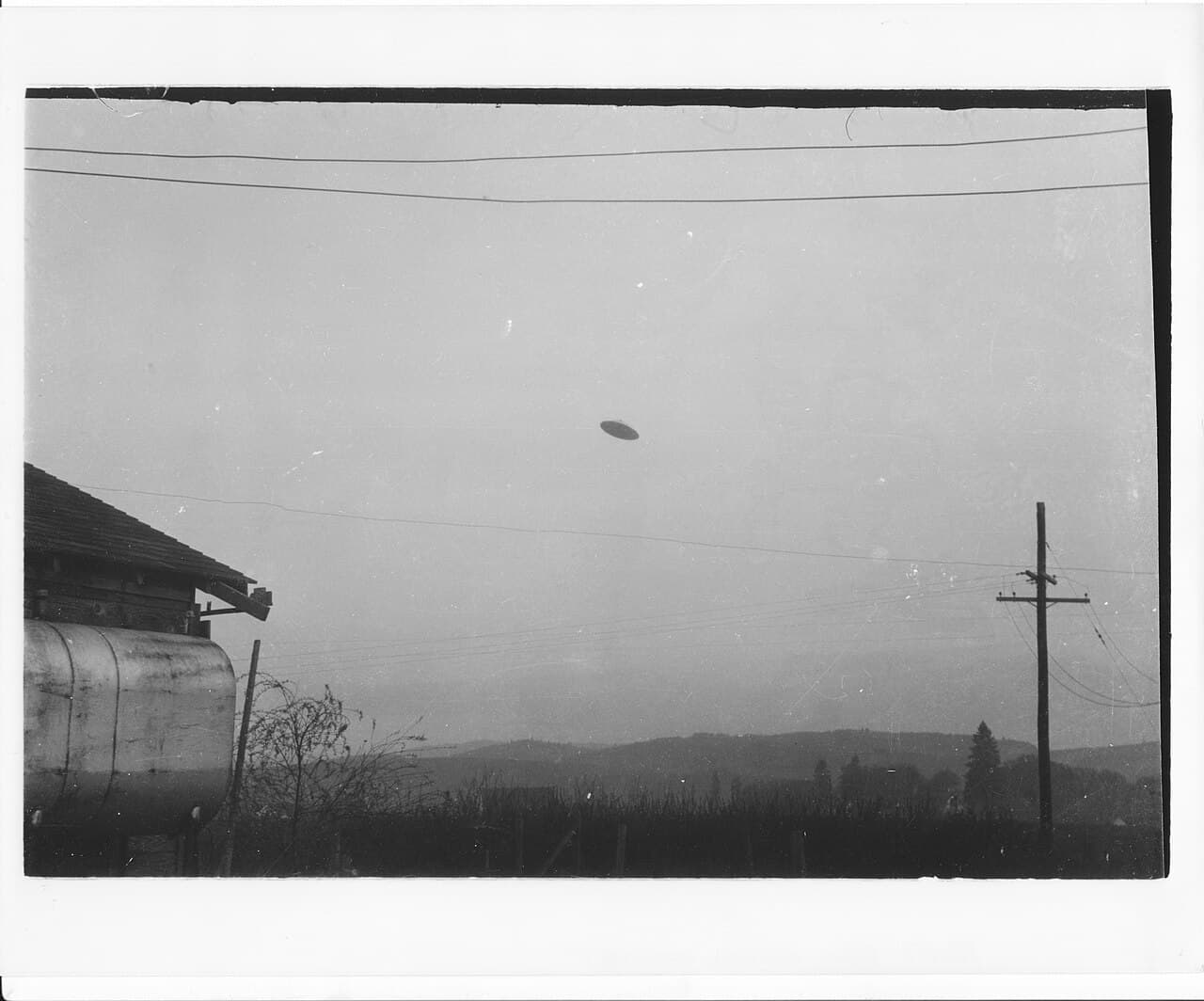
On 11 May 1950, Paul and Evelyn Trent said they saw a metallic, disk-shaped object near their farm between Sheridan and McMinnville, Oregon. Paul made two photographs with a roll-film camera before the object moved away. The original negatives entered national press circulation and were located for direct examination by the University of Colorado project in 1967; their present public custody is unclear. They show a small dark object in the sky, but a photograph alone cannot establish its size or distance. William Hartmann regarded the case as unusually resistant to a simple explanation while explicitly leaving fabrication open. Later analysts split between a distant-object interpretation and a small model suspended near overhead wires. The photographs are genuine case images; the identity of the photographed object remains disputed.
This case is disputed. The archive preserves the claims while separating evidence from interpretation.
- Documentation
- High documentation
- Primary location
- McMinnville, Oregon
- Source base
- 7 linked records
- Research use
- Comparison case
What the photographic record supports
- Confirmed record
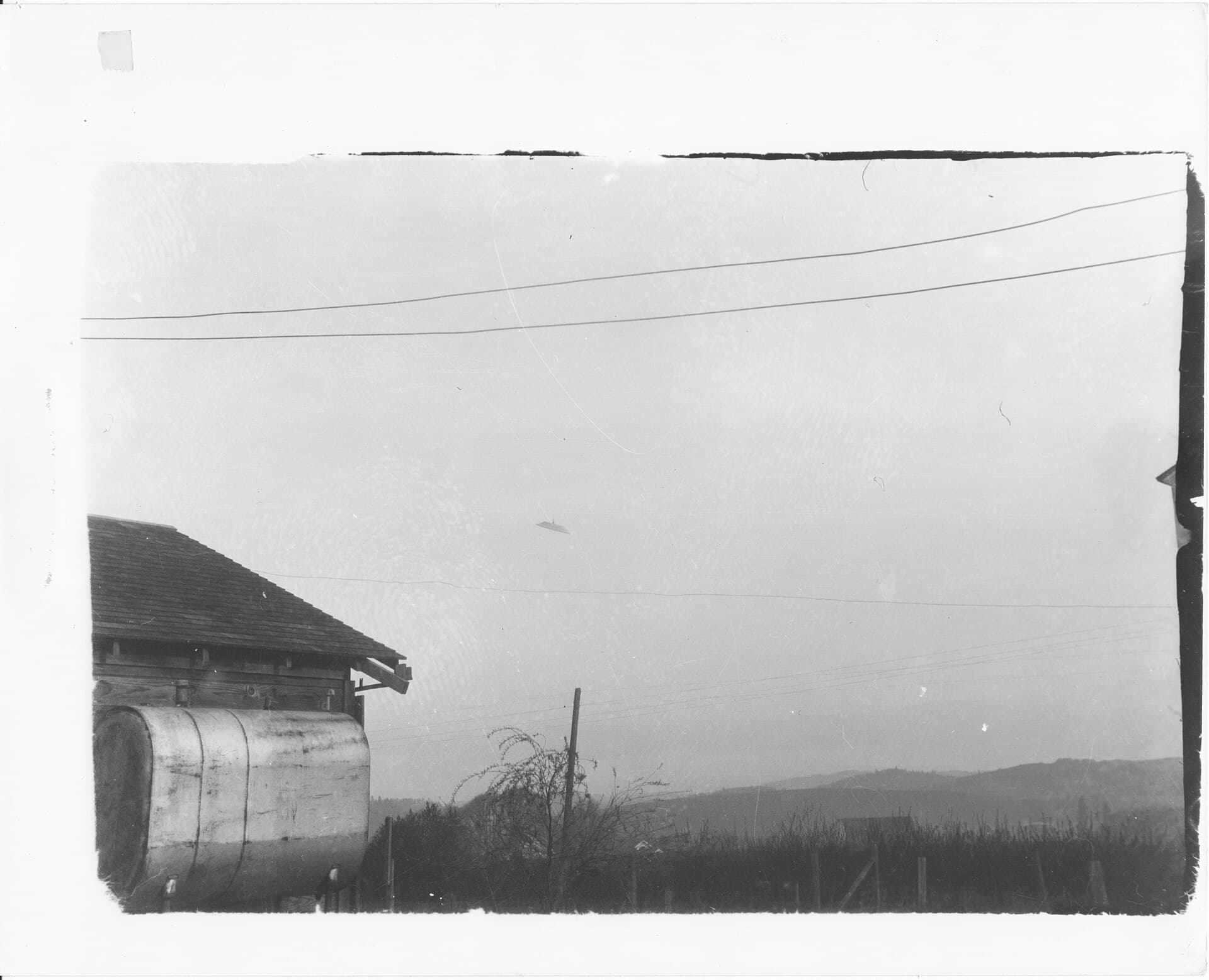
- The two negatives made by Paul Trent on the reported date were located and directly examined in 1967; surviving reproductions show the same unidentified shape from two camera positions.[1][4][5]
- Unverified claim
- The photographs do not establish the object's physical size, distance, support method or extraordinary origin.[1][2][3]
- Negative analysis
- Direct examination found no simple retouching, but an unaltered negative can still record a staged model.[1][2]
Second Trent photograph
Case dossier
The reported sighting occurred on the evening of 11 May 1950 at the Trent family farm, roughly ten miles southwest of McMinnville, Oregon. Evelyn Trent said she first noticed a metallic-looking disk while outdoors and called Paul. Accounts differ slightly over where each witness stood when the object was first seen, but both later described a silent object moving across the sky. No independent witness, radar record or physical trace accompanied the report.
Paul Trent used a roll-film camera to make two exposures from positions a short distance apart. Both frames include the farm buildings, utility wires and distant terrain, allowing later analysts to compare geometry. The object appears as a dark, asymmetric disk with a small upper feature. The two views demonstrate that something produced an image on the negatives; without a verified range, however, the same angular image could represent a large distant object or a small nearby model.
The Trents did not immediately deliver the film to authorities or journalists. The roll already contained family exposures, was finished and then developed locally. Reporter Bill Powell learned of the images through local bankers Ralph and Frank Wortman and found the negatives at the Trent home. The McMinnville Telephone-Register published the photographs on 8 June 1950, after which wire services, larger newspapers and Life magazine spread them nationally.
Press circulation complicated custody. The original negatives were passed among media organizations and for a time could not be located. During the University of Colorado UFO study in 1967, investigators recovered the negatives from the International News Service or United Press International files and examined them directly. That access permitted more analysis than a newspaper reproduction, but the present public custody of the negatives is unclear and the chain does not reveal the object's distance or origin.
Astronomer William K. Hartmann treated the incident as Case 46 in the Condon Report. He reviewed the witness history, camera geometry, negative density and lighting. Hartmann found no obvious evidence that the negatives had been retouched and considered the lighting broadly compatible with a distant object. His often-cited assessment nevertheless stopped short of authentication: he stated that a fabrication, including a small model, could not be positively ruled out.
The most persistent skeptical hypothesis is a model suspended beneath one of the overhead wires. Hartmann noted that the photographed object lay below a similar point on a wire in both views, which makes the geometry testable but not decisive. Missing exact camera positions, incomplete site measurements and uncertain lens and object distances prevent a unique reconstruction. The photographs therefore support competing scale models rather than a measured craft size.
Later analyses sharpened rather than ended the disagreement. Bruce Maccabee argued that photometry and negative inspection did not establish a thread or hoax and could fit a more distant object, while acknowledging missing geometry and alternative constructions. A 2013-2014 IPACO study reported image-processing evidence consistent with a vertical suspension thread and estimated a small nearby model as the most probable explanation. IPACO also documented a corrected computation, so its result should be read as a technical claim with stated assumptions, not as official proof.
McMinnville belongs in the archive because the two original event photographs, publication history and decades of competing technical work can be inspected separately. The secure conclusion is limited: Paul Trent exposed two negatives showing an unidentified shape at the reported place and date. Witness sincerity, object distance, physical scale and method of support remain unresolved. The case is stronger as a documented photographic controversy than as evidence for an extraordinary vehicle.
Later local-news retrospective
Central Oregon Daily News reviews the photographs and their civic legacy. This is later reporting, not motion-picture evidence recorded on 11 May 1950.
Related video
Timeline
- Paul and Evelyn Trent reported seeing a silent disk-like object at their Oregon farm; Paul made two photographs.
- The remaining roll was finished and developed locally; the delay left no contemporaneous official observation of the object.
- The McMinnville Telephone-Register published both photographs on its front page.
- Regional and national newspapers reproduced the images after wire-service distribution.
- Life and other national outlets expanded the photographs' audience and moved the negatives through press custody.
- The University of Colorado project located the original negatives in press-agency files and subjected them to direct examination.
- Hartmann's Case 46 analysis appeared with the Condon study, finding the case unusually difficult but not excluding fabrication.
- Bruce Maccabee conducted a new photometric and geometric study and argued that the evidence did not establish a hoax.
- McMinnville began an annual UFO festival that made the photographs part of the city's public history.
- IPACO published and updated a study interpreting image features as evidence for a small model suspended by a thread.
Frequently asked questions
When were the McMinnville UFO photographs taken?
Paul Trent said he made both photographs on 11 May 1950 at the family farm southwest of McMinnville, Oregon.
Are the McMinnville UFO photos original case images?
Yes. They reproduce the two exposures made on the reported date, not later reconstructions. Investigators directly examined the original negatives, although their present public custody is unclear. Their subject remains disputed.
Did investigators examine the original negatives?
Yes. The University of Colorado project recovered and examined them in 1967, and later researchers also studied scans and negative characteristics.
Did the Condon Report authenticate a UFO?
No. Hartmann considered the case difficult and found no obvious retouching, but explicitly did not rule out fabrication with a small model.
Could the object have been suspended from a wire?
That is the leading conventional hypothesis. The geometry is suggestive, while missing site measurements and disagreement over a visible thread prevent a universally accepted demonstration.
Is there original video of the McMinnville sighting?
No authenticated motion picture of the 11 May 1950 event is known. The linked video is a later local-news retrospective.
Why is the case still important?
It preserves two original photographs, an early publication trail and multiple technical analyses that clearly expose the limits of estimating distance and scale from a single camera scene.
Sources
- [1] Official fileCondon Report Case 46: McMinnville photographic analysisUniversity of Colorado / NCAS archive
- [2] ResearchBruce Maccabee's photometric analysis of the Trent photographsBruce Maccabee / NICAP archive
- [3] ResearchIPACO technical report on the McMinnville photographsIPACO
- [4] ArchiveFirst high-resolution scan of Paul Trent's 11 May 1950 photographPaul Trent / Wikimedia Commons
- [5] ArchiveSecond high-resolution scan of Paul Trent's 11 May 1950 photographPaul Trent / Wikimedia Commons
- [6] Reference databaseOregon Encyclopedia: McMinnville history and UFO-festival contextOregon Encyclopedia
- [7] News reportCentral Oregon Daily News retrospective on the McMinnville photographsCentral Oregon Daily News / YouTube
Both displayed images are scans of the two photographs Paul Trent made on 11 May 1950. They are authentic case photographs, but do not establish the object's size, distance, identity or extraordinary origin. The later news video is not event footage.