
United States / 1975 / UNRESOLVED
1975 Loring AFB UFO incursions
Between 27 October and 1 November 1975, Loring Air Force Base in Maine treated several reports near its weapons storage area as an airspace-security incident. National Military Command Center records describe an unidentified aircraft or helicopter at about 150 feet, repeated but unsuccessful search sorties, coordination with Canadian and U.S. police agencies, and one later slow target detected by RAPCON radar. The records never identify the operator or aircraft. Some detailed tower and witness claims survive only in later reconstructions, and no verified event photograph, film, raw radar plot or recovered object is public. The case is therefore a well-documented unresolved incursion, not proof of an extraterrestrial craft.
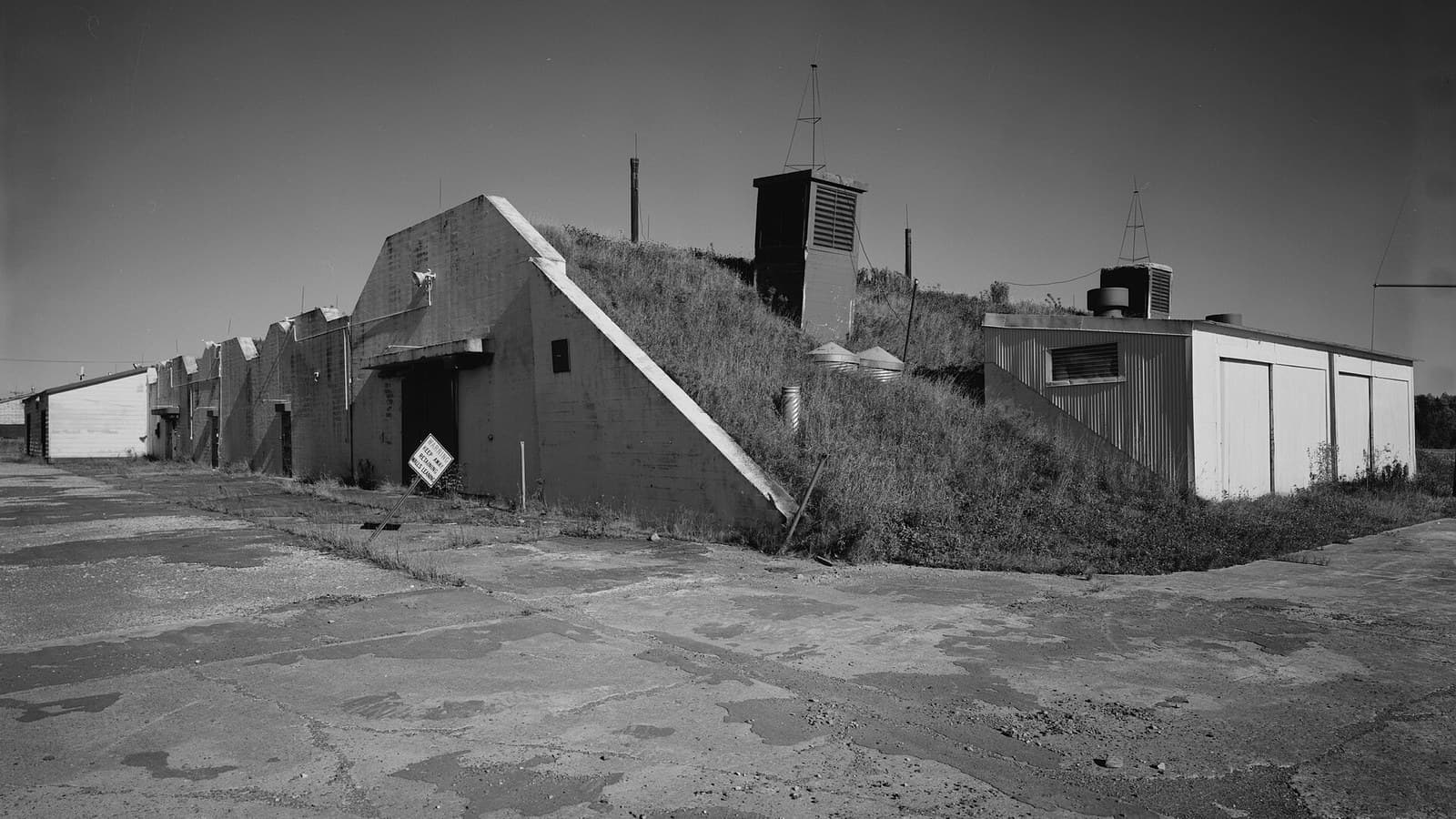
This case remains unresolved in the public record, with credibility grade B.
- Documentation
- High documentation
- Primary location
- Loring Air Force Base, Maine
- Source base
- 8 linked records
- Research use
- Comparison case
What the record establishes
- Confirmed response
- Command records document repeated low-altitude reports, alert measures, search-helicopter launches and cross-border coordination.[1][2]
- Identification boundary
- Officials used aircraft and helicopter as operational labels, but no search crew positively identified the intruder.[1]
- Radar boundary
- A 1 November update records a slow RAPCON target; raw plots and a demonstrated link to earlier visual reports are absent.[1]
- Media boundary
- No verified contemporaneous photograph or film of the reported target is public; the displayed image is 1998 location documentation.[8]
Case dossier
Loring was not an ordinary rural airfield. The 42nd Bombardment Wing operated B-52 bombers and KC-135 tankers from the base as part of Strategic Air Command's Cold War mission. The 1975 messages repeatedly locate the concern at or near a weapons storage area. That setting explains why an aircraft that might have drawn a routine identification call elsewhere produced command-level reporting, armed security measures and coordination across the U.S.-Canada border.
A later documentary chronology dates the first reported activity to the evening of 27 October and names security and control-tower personnel. It says a lighted aircraft approached the northern perimeter while a separate radar return was observed east-northeast of the base. Those names and the detailed forty-minute track are valuable leads, but the surviving public command records reviewed here do not include the raw radar plot, radio log or signed tower statement. The first-night reconstruction must therefore remain attributed rather than treated as a complete sensor record.
The strongest public record begins with National Military Command Center updates dated 29 October. They say an unidentified helicopter, possibly two, had been seen flying low over Loring near the weapons storage area. A 42nd Bomb Wing report placed one sighting 300 to 500 metres from the area at about 150 feet, followed roughly two hours later by another sighting over the storage area. A Maine Army National Guard helicopter responded on both occasions but did not contact or identify the reported intruder.
The response expanded beyond the base. The records show notification of Strategic Air Command and NORAD, liaison with the Maine State Police and Royal Canadian Mounted Police, and legal discussion over whether the Guard helicopter could cross into Canada. The approved mission was tracking and identification, not an open-ended armed pursuit. On 29 October, U.S. officials obtained authority to cross the border only with Canadian consent and considered carrying military personnel plus FBI, FAA or Border Patrol representatives if required.
Reports did not end with the first two nights. A 1 November command update says an unidentified object was seen four nautical miles northwest of Loring late on 31 October; the alert helicopter launched but made no contact. It launched again after a slow-moving target was detected by RAPCON in the early hours of 1 November, again without contact. This is the clearest radar-linked episode in the reviewed primary record, but the public file gives no plot, altitude, transponder information or demonstrated link to the earlier visual reports.
Later reporting broadened the story. The Washington Post used released military material to connect Loring with reports at other Strategic Air Command bases, while later witnesses described lights, unusual motion or a football-shaped object. These recollections may preserve genuine experiences, but they were recorded years after the incident and often contain details not recoverable in the command summaries. No verified contemporaneous photograph or motion picture of the Loring target has been located; modern articles, base photographs and personal videos are context or retrospective testimony, not event imagery.
Timeline
- A later documentary chronology places the first security and tower reports near the weapons storage area on this evening.
- A CIA Operations Center log records an NMCC update about unidentified helicopter activity at Loring; the asserted Canadian origin was not independently established.
- A 42nd Bomb Wing update reports an unidentified helicopter 300-500 metres from the weapons storage area at about 150 feet; the Guard search makes no contact.
- A second sighting is reported over the weapons storage area; the Guard helicopter responds again without identification.
- Army approval allows the Guard helicopter to cross the border with Canadian consent for tracking and identification.
- A visual report northwest of Loring and a later slow RAPCON target each prompt helicopter sorties; neither produces contact.
- The Washington Post reviews released military records and places Loring within the broader 1975 strategic-base reports.
Frequently asked questions
What happened at Loring AFB in 1975?
Personnel repeatedly reported an unidentified low-flying aircraft near the weapons storage area. The base launched search helicopters, raised security and coordinated with Canadian and U.S. agencies, but did not identify an intruder.
Did radar track the Loring UFO?
A command update explicitly records a slow-moving RAPCON target on 1 November. Later chronologies describe tower-radar contacts on earlier nights, but no raw plots are public and the reports are not proven to involve one object.
Was the object confirmed to be a helicopter?
No. Military messages often call it a helicopter or aircraft, which shows the working security assessment. Search crews repeatedly failed to make contact or identify it, so the label is not a confirmed type.
Did the intruder come from Canada?
Some contemporary reporting asserted a Canadian direction and officials prepared for cross-border tracking. The public record does not establish a launch point, operator or recovered route, so Canadian origin remains unconfirmed.
Are there authentic photos or videos of the 1975 Loring object?
No verified contemporaneous event image has been located in the public sources reviewed. The page's photograph documents a Loring weapons-area building in 1998; later witness videos and news illustrations are not original sighting evidence.
What is the best explanation for the Loring reports?
An unauthorized or misidentified conventional aircraft, perhaps more than one event combined, remains plausible. The documents do not identify an operator, so the case stays unresolved; they also do not show performance requiring an exotic explanation.
Sources
- [1] Official fileNMCC and 42nd Bomb Wing Loring incident records, 28 October-1 November 1975National Military Command Center / 42nd Bomb Wing (SMU scan mirror)
- [2] ArchiveCIA Operations Center log: penetration of Loring AFBCentral Intelligence Agency Operations Center (UFOScans mirror)
- [3] Official file42 Air Base Wing historical fact sheetAir Force Historical Research Agency
- [4] News reportWhat Were Those Mysterious Craft?The Washington Post
- [5] News reportSuit Seeks to Lift Secrecy Veil From Agency's UFO DocumentsThe Washington Post / CIA Reading Room
- [6] News reportThe Mysterious Cold War Case of Unidentified Aircraft Descending on Loring Air Force BaseThe War Zone
- [7] ResearchLoring AFB 1975 chronology and document indexNICAP
- [8] ArchiveHAER photograph of Building 216 in Loring's weapons-area assembly complexHistoric American Engineering Record / Library of Congress / Wikimedia Commons
The displayed 1998 Historic American Engineering Record photograph shows Building 216, an ammunition maintenance shop in Loring's weapons-area assembly complex after the base closed. It is public-domain location documentation, not a photograph of the 1975 object, a sighting scene or proof of an incursion.