
United States / 1968 / UNRESOLVED
1968 Minot AFB UFO encounter
During the early hours of 24 October 1968, Minot-area missile teams reported changing or moving lights while a B-52 conducted local training. The aircraft later recorded a weather-radar return, temporarily lost UHF transmission and photographed its radar scope; the crew did not visually see that return during the main radar episode. A separate orange-light observation and an Oscar 7 security alarm followed. Project Blue Book attributed different portions to stars, the B-52, ground lights or possible plasma, but its language was tentative and the released record lacks enough synchronized raw data to prove one complete reconstruction.
This case remains unresolved in the public record, with credibility grade B.
- Documentation
- High documentation
- Primary location
- Minot Air Force Base and surrounding missile fields, North Dakota
- Source base
- 8 linked records
- Research use
- Comparison case
What the records establish
- Contemporaneous reports
- Named missile-site personnel and a B-52 crew submitted reports through Air Force channels within days of the event.[4][5]
- Instrument record
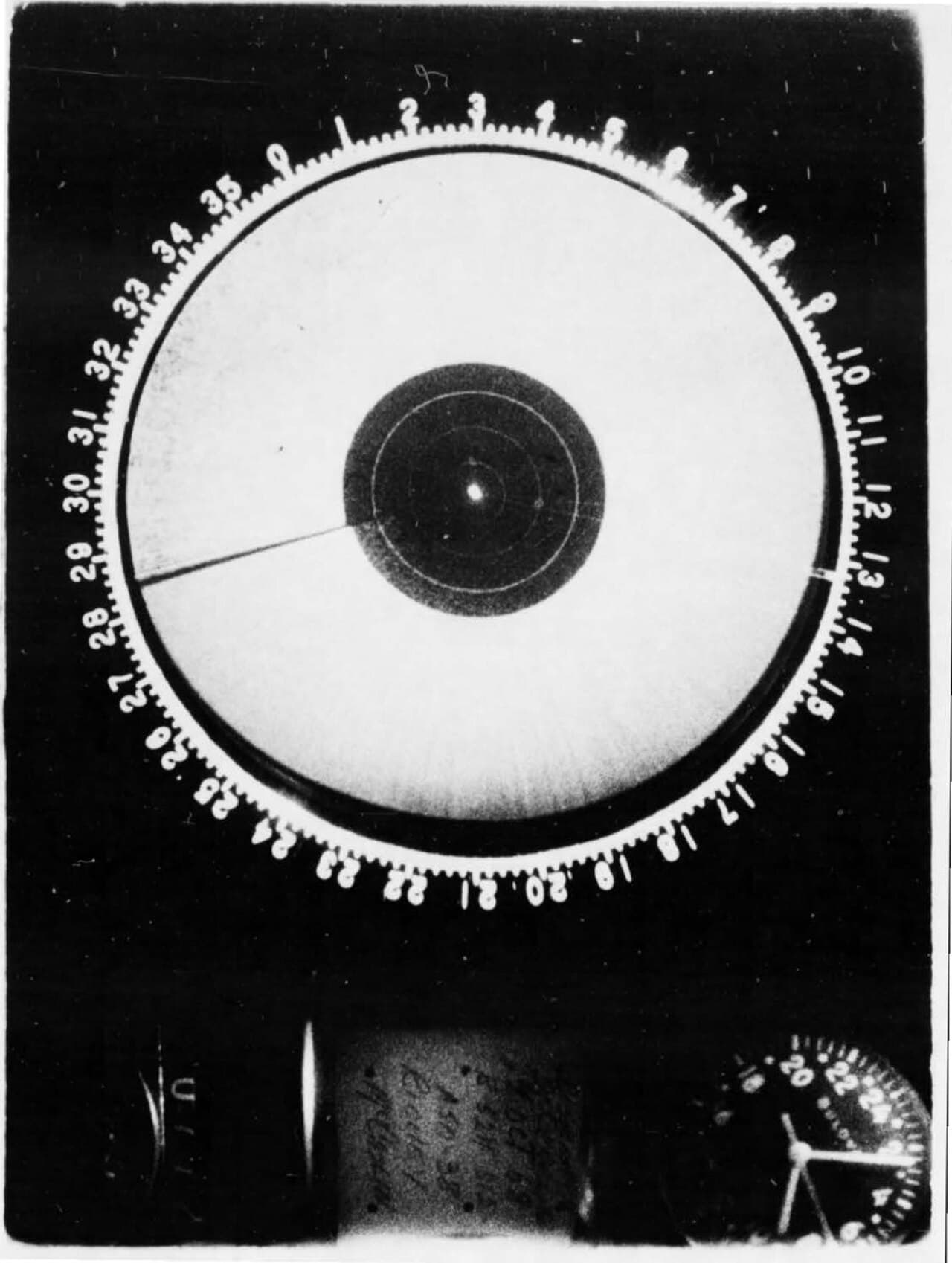
- Thirteen photographs of the B-52 weather-radar scope survive in the released Project Blue Book file.[3][4]
- Radio boundary
- The reported interruption affected UHF transmission; reception and IFF/SIF functions remained available.[4][5]
- Official assessment
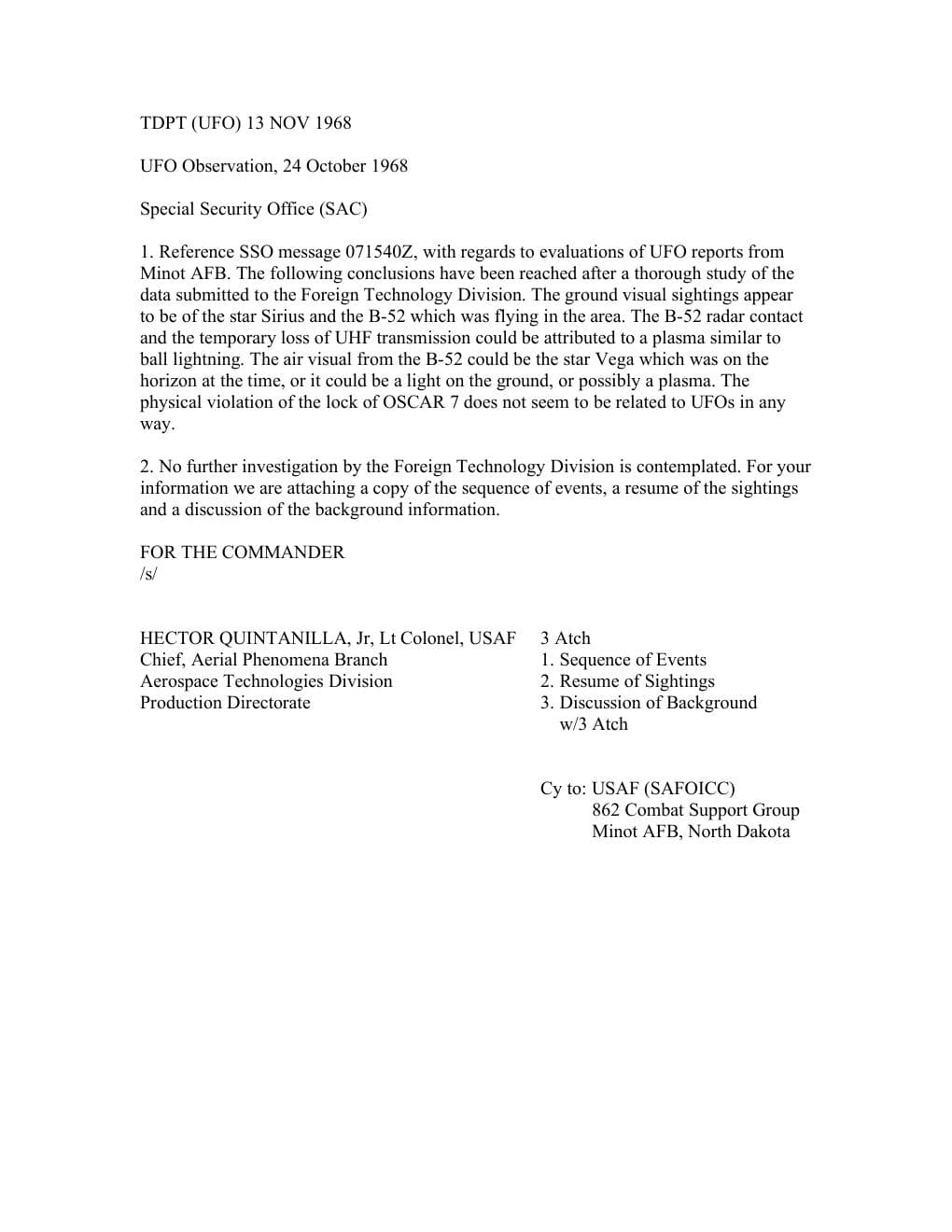
- Project Blue Book proposed different tentative explanations for separate portions: stars, the B-52, ground lights and possible plasma.[5]
Official case-file image
Case dossier
Separate ground reports began the case: The 29 October basic report names missile personnel Robert O'Connor, Lloyd Isley, James Bond, Gregory Adams, Joseph Jablonski and William Smith, among others, as observers assessed as reliable by their reporting chain. Between roughly 00:30 and 03:25, teams described distant red, orange, green or white lights that seemed to change colour, move, stop or vanish. The file confirms that military personnel made reports; it does not show that every observer watched the same object or that all supplied equally detailed statements.
The B-52 was on a training mission, not a UFO intercept: Major James Partin and navigator Captain Patrick McCaslin were conducting local instrument practice, including a VOR penetration, low approach and missed approach. After ground teams reported an orange light, the aircraft was asked to look. The final report later noted that an alleged simultaneous visual at about 03:35 was not supported by the pilot's detailed Form 117. That discrepancy is important because it prevents the early ground lights and the later aircraft observations from being treated as one continuous track.
The radar episode was recorded but incompletely reconstructed: Around 03:52, the official chronology says a radar report placed a return about three miles from the B-52. The crew's weather radar then showed an echo suddenly appearing ahead and to the left, closing and remaining near the aircraft during part of a TACAN penetration. The report says the crew could not see the return through haze. Blue Book also acknowledged that detailed supporting information for the earlier three-mile radar placement and the exact aircraft timing had not been submitted.
The UHF failure was narrower than later retellings imply: The basic report says the B-52 temporarily lost UHF transmission while its receiver and IFF/SIF functions remained available. Transmission returned after the radar episode. This temporal overlap is worth recording, but it is not proof that an external object caused the fault. The public file contains no engineering trace, component inspection or controlled test linking the transmitter loss to the radar return.
The radar photographs are genuine case records, not an identification: Between approximately 04:06:15 and 04:06:51, the crew took a series of scope photographs. Thirteen images survive in the released Project Blue Book file. They establish that a display was photographed and allow the official record to be inspected. A still photograph of a radar display does not by itself provide the full sweep sequence, calibration, antenna behaviour, precise aircraft geometry or independent track correlation needed to determine the return's physical cause.
The later aircrew visual was a separate observation: At about 04:30-04:35, after the principal radar episode, the pilot reported a stationary orange light near or on the ground. Blue Book proposed Vega on the horizon, a ground light or possible plasma. Whatever its cause, the chronology does not justify automatically equating this later stationary light with the earlier moving ground reports or the weather-radar return.
Oscar 7 was a real security event but not evidence of a craft: At 04:49, alarms were reported at the Oscar 7 launch facility. An outer padlock or gate condition and an unsecured or open inner horizontal door were investigated, but no tracks or prints were found. The basic report allowed accident or prank as possibilities, and Blue Book concluded that the lock violation did not appear related to the UFO reports. The reviewed primary record does not document missile shutdowns caused by an aerial object.
Why the case remains in the archive: The Minot file has unusually good documentary survival for a 1968 report: named military observers, a contemporaneous reporting chain, aircraft radar photographs and a signed official assessment. Its value lies in comparison and method, not in proving one exotic object. The surviving record shows how multiple observations can become one famous case even when their timing, sensors and possible causes differ. Preserving those distinctions is more informative than labelling the whole night either solved or extraterrestrial.
Timeline
- Lloyd Isley reported a distant light east of his missile position, beginning the official sequence.
- Robert O'Connor and William Smith made additional ground reports; later teams described lights of changing colour and apparent motion.
- Bond, Adams, Jablonski and other missile personnel reported red, orange, green or white lights from separate locations.
- The B-52 was asked to look for an orange light. Blue Book later said an alleged simultaneous visual was not supported by the pilot's detailed form.
- The official chronology recorded a radar report about three miles from the B-52, while haze prevented visual confirmation.
- The B-52 temporarily lost UHF transmission; its receiver and IFF/SIF reportedly remained usable, and transmission returned minutes later.
- The crew photographed the B-52 radar scope. Thirteen photographs survive in the released Project Blue Book file.
- Missile-site observers stopped reporting the lights at different times rather than recording one synchronized disappearance.
- The pilot separately reported a stationary orange light near or on the ground after the main radar episode.
- Oscar 7 alarms prompted a security check with no tracks found. On 13 November, Project Blue Book issued its final multi-explanation assessment and planned no further investigation.
Frequently asked questions
What happened near Minot AFB on 24 October 1968?
Missile-site teams reported lights while a B-52 flew a training mission. The aircraft later recorded a radar echo, briefly lost UHF transmission and photographed its radar scope. A later orange-light report and an unrelated security alarm followed.
Did the B-52 photograph a UFO on radar?
It photographed a weather-radar display containing a return. The images document the display, but without the complete raw sequence, calibration and independent track correlation they do not identify the return as a solid or extraordinary object.
Did the crew see the same object as the radar return?
Not during the main radar episode. The report says haze prevented a visual sighting. The pilot later described a separate stationary orange light near or on the ground, so the records should not merge the two observations.
What was Project Blue Book's explanation?
Blue Book used a multi-explanation: Sirius and the B-52 for ground reports, possible plasma for radar and UHF effects, and Vega, a ground light or plasma for the later air visual. Its wording was tentative rather than a demonstrated single solution.
Was the Oscar 7 alarm caused by the reported object?
The official final report treated Oscar 7 as unrelated. A security check found no tracks or other physical evidence linking the alarm to the light or radar reports.
Did a UFO disable nuclear missiles at Minot?
No reviewed primary record establishes a missile shutdown caused by a UFO. The documented equipment issue was a temporary loss of the B-52's UHF transmitter, while a separate missile-site security alarm produced no physical evidence.
Is the Minot AFB UFO case solved?
Project Blue Book administratively closed it with tentative conventional explanations. Because the public file lacks synchronized witness geometry, complete radar data and engineering records, this archive labels the whole case unresolved while recognizing that several portions have plausible conventional explanations.
Sources
- [1] Official fileProject Blue Book records at the National ArchivesNational Archives and Records Administration
- [2] ArchiveNational Archives UAP records bulk downloadsNational Archives and Records Administration
- [3] ArchiveProject Blue Book Minot radar-scope photograph fileProject Blue Book / Wikimedia Commons
- [4] Official file862 Combat Support Group basic reporting data862 Combat Support Group / United States Air Force
- [5] Official fileProject Blue Book final case report on Minot AFBProject Blue Book / United States Air Force
- [6] Reference databaseMinot AFB UFO case documentary reconstructionThomas Tulien / Zenodo
- [7] News reportInForum retrospective on the 1968 Minot encounterInForum
- [8] Reference databaseNICAP directory of Minot case documentsNICAP
The main image is one of thirteen radar-scope photographs in the released Project Blue Book case file. It is a public-domain U.S. federal record that shows the B-52 weather-radar display; it does not identify the return or prove an extraordinary craft. The supplementary image is the final Blue Book analysis page, not event photography. No authenticated ordinary photograph of the reported lights or original motion-picture footage was located.