
United Kingdom / 1974 / EXPLAINED
Berwyn Mountain incident
The Berwyn Mountain incident is best understood as several events later fused into one crash legend. Instruments and 448 later-assessed questionnaires establish a real North Wales earthquake at 20:38 on 23 January 1974. Contemporary reports also describe a bright meteor or fireball over a much wider region, plus other lights at different times. Police treated early calls as a possible aircraft crash, searched with RAF support, and recorded no wreckage, crater or missing aircraft. Public files document those inquiries and later correspondence; they do not document a recovered craft, occupants or a secret military removal. “Welsh Roswell” is a retrospective media label, not a name or conclusion from 1974.
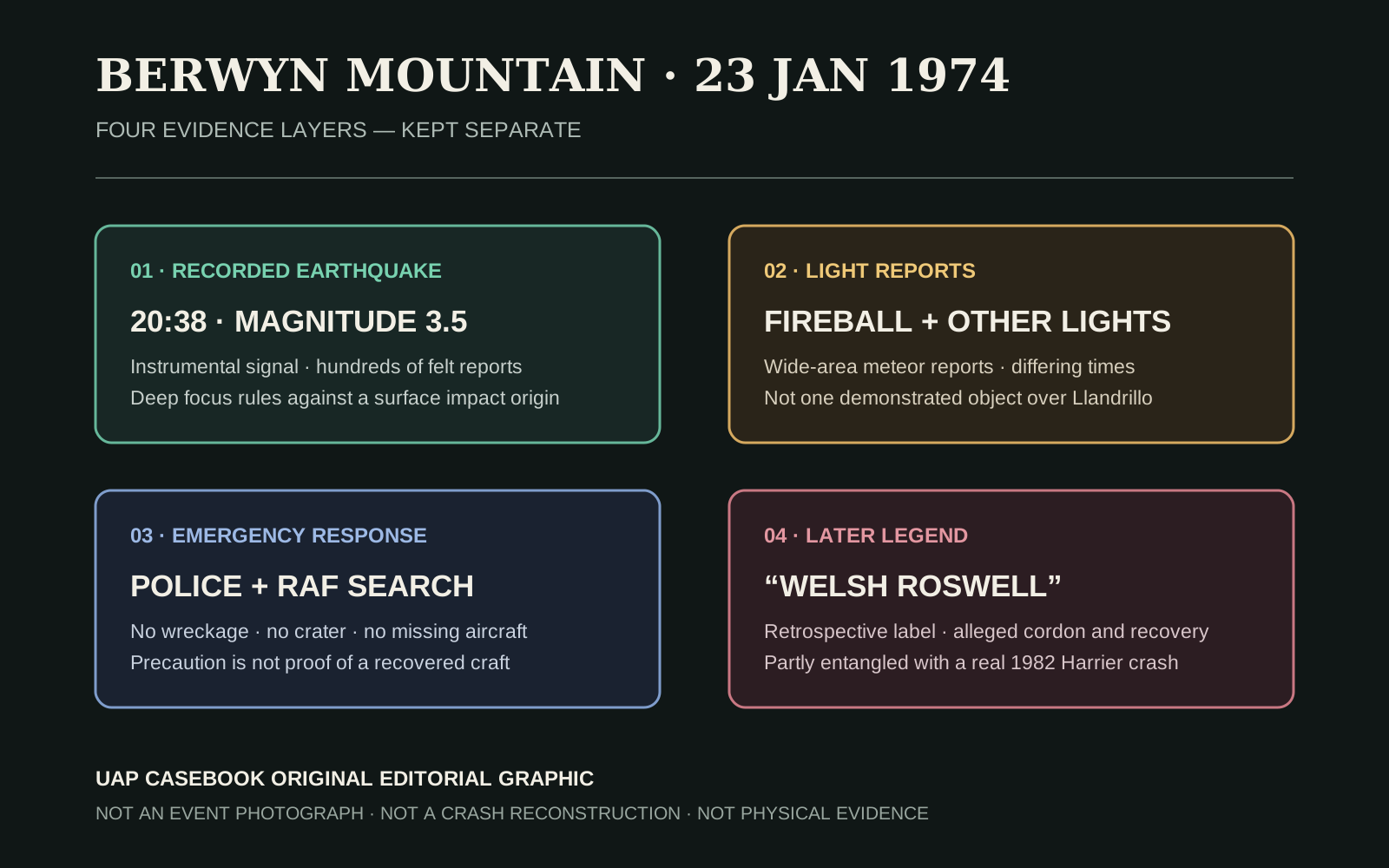
This archive treats the case as explained or substantially resolved by conventional evidence.
- Documentation
- High documentation
- Primary location
- North Wales
- Source base
- 4 linked records
- Research use
- Comparison case
What the Berwyn record establishes
- Confirmed shock
- A magnitude 3.5 earthquake began at 20:38 and was recorded instrumentally.[1]
- Light reports
- A bright meteor or fireball was reported widely, while other lights were reported at different times.[1][3][4]
- Crash claim
- No public record supplies a crash site, recovered craft, occupants or traceable material.[1][2][3]
- Cordon story
- Police logs contradict immediate military exclusion; a real cordoned Harrier crash occurred on Berwyn in 1982.[1]
- Later label
- “Welsh Roswell” is a retrospective media nickname, not a 1974 official designation.[3]
Case dossier
The shock at 20: 38: Seismologist Roger Musson reconstructed the sequence from instruments, police logs, contemporary newspapers and Institute of Geological Sciences records. At 20:38, a magnitude 3.5 local earthquake began near Bala and Corwen. Within minutes, police in North Wales and Cheshire received calls about a bang and rumbling. The event was felt over a broad area; later macroseismic work assessed 448 replies from 112 places and maximum intensity 5 EMS at Bala, Carrog, Corwen, Llandrillo and Maentwrog.
Why a search began: Callers also reported lights, and police heard that something resembling a meteorite had descended toward the Berwyn range. With no immediate identification of the tremor, Gwynedd Constabulary reasonably opened a major-incident log for an explosion and considered both civil and military aircraft. Officers went onto the mountain; fire and ambulance services were placed on standby; RAF Valley and Preston air traffic control were contacted. This response proves uncertainty and precaution, not prior knowledge of a spacecraft.
The night search and its result: The police log records continuing contact with the RAF and parties on the mountain. By 23:30 the senior officer at Llandrillo reported that police teams had come down after finding nothing, although they saw a green glare to the south. Some mountain lights were later attributed to poachers. The RAF mountain-rescue team arrived around midnight and searched at first light with police. Searches ended at 14:13 on 24 January after no site was found and no aircraft was reported missing.
The lights were not one timed observation: Contemporary accounts describe a green meteor or fireball from the Isle of Man, Anglesey, Formby and farther north, while other light reports occurred after the earthquake. A detailed “sphere” report at Betws-y-Coed was timed at 21:58—eighty minutes later—and another disc-like report near Gobowen was made the next morning. The BBC's archive-based review describes a fireball reported from Somerset to Edinburgh. These reports matter, but their differing times and geography prevent treating every light as one object over Llandrillo.
What the seismic record rules out: The shock was recorded by seismometers, and later relocation placed its focus kilometres underground with substantial positional uncertainty. Musson notes that an impact energetic enough to generate a magnitude 3.5–4.0 seismic event would have left an unmistakable large crater. None was found. The evidence therefore supports a tectonic earthquake independent of the aerial lights; it does not support a meteor, aircraft or spacecraft striking the mountain hard enough to cause the recorded shock.
How the cover-up story grew: The Institute of Geological Sciences sent a four-person survey team from 26 to 30 January to interview residents and distribute questionnaires. Musson reports that later memories of unfamiliar investigators were interpreted as “men in black.” More importantly, police logs contradict an immediate military exclusion of police. A genuine RAF Harrier crash on Berwyn on 12 February 1982 did bring a cordon and wreckage recovery; later retellings appear to have transferred parts of that real response back to 1974.
What the public files do and do not show: The National Archives research guide identifies AIR 2/19083 as containing brief details and DEFE 24/2045/1 as later disclosure correspondence. The BBC's 2010 report summarizes a May 1974 ministerial letter considering a meteor that burned up and disintegrated, alongside a separately suggested earth tremor. This is an official conventional assessment, not proof that every light was reconstructed. Conversely, the existence of UFO files shows administrative interest and public correspondence; it is not evidence that officials possessed alien wreckage.
Timeline
- A magnitude 3.5 local earthquake begins near Bala/Corwen and is recorded instrumentally.
- Police receive numerous calls about a bang, rumbling and lights; a possible aircraft crash is considered.
- Gwynedd Constabulary opens a major-incident log for an explosion at Llandrillo.
- Police coordinate with RAF Valley and air traffic control; mountain parties search and return without finding a crash site.
- A separate “flying sphere” is reported at Betws-y-Coed, eighty minutes after the earthquake.
- RAF mountain rescue and police search at first light; the operation ends at 14:13 with no wreckage, crater or missing aircraft.
- An Institute of Geological Sciences team surveys residents and gathers macroseismic evidence.
- A junior RAF minister writes that a disintegrating meteor could explain the reported aerial phenomena and lack of impact signs.
- An RAF Harrier crashes on Berwyn; its real cordon and wreckage recovery later become entangled with the 1974 legend.
- BBC News reports on released files using “Welsh Roswell,” a retrospective label rather than a 1974 official term.
Questions about the Berwyn Mountain incident
What happened at Berwyn Mountain in 1974?
A real earthquake coincided with fireball and other light reports, prompting an unsuccessful crash search.
Did a UFO crash on Berwyn Mountain?
No public evidence establishes a crash: no site, wreckage, crater, missing aircraft or recovery chain was documented.
What caused the bang and shaking?
Instrumental and felt evidence supports a magnitude 3.5 tectonic earthquake near Bala and Corwen.
Were the lights a meteor?
A widely seen fireball explains an important part of the reports, but not every later or local light has a secure identification.
Did the military seal off the mountain?
Surviving police logs show police and RAF searching together, not police being excluded; the cordon story partly resembles the 1982 Harrier crash.
Why is it called the “Welsh Roswell”?
Later media and UFO culture used the comparison for the alleged cover-up. It was not the contemporary official name.
What do the released files prove?
They prove official inquiries, correspondence and conventional assessments existed; they do not document recovered alien technology.
Sources
- [1] ResearchThe enigmatic Bala earthquake of 1974British Geological Survey / Astronomy & Geophysics
- [2] Official fileUFOs: Research Notes 6The National Archives
- [3] News reportFiles released on 1974 'Welsh Roswell'BBC News
- [4] ResearchMeteor, not shower, over BalaAstronomy & Geophysics / Oxford Academic
Original text-and-shape editorial graphic with no third-party assets. The old generic cover is superseded in active rendering but need not be deleted.