
Russia / 1908 / EXPLAINED
Tunguska UFO theories
On 30 June 1908, a cosmic body entered the atmosphere over central Siberia and released its energy above the ground, producing light, heat, shock waves and a vast treefall without a conventional impact crater. Leonid Kulik did not inspect the devastated forest in 1908: he first tried to reach the region in 1921 and arrived at the blast area in 1927. His missing crater and missing large meteorite became openings for later speculation, especially after Aleksandr Kazantsev's 1946 science fiction proposed an atomic-powered alien spacecraft. Nature later published antimatter and black-hole suggestions, but publication records a hypothesis, not corroborating evidence. Modern airburst simulations, treefall surveys and fragmentation physics support a natural impactor—most probably a stony asteroid—breaking up in the atmosphere. The precise size, trajectory, energy and composition remain model-dependent; an alien craft does not become competitive merely because those parameters retain uncertainty.
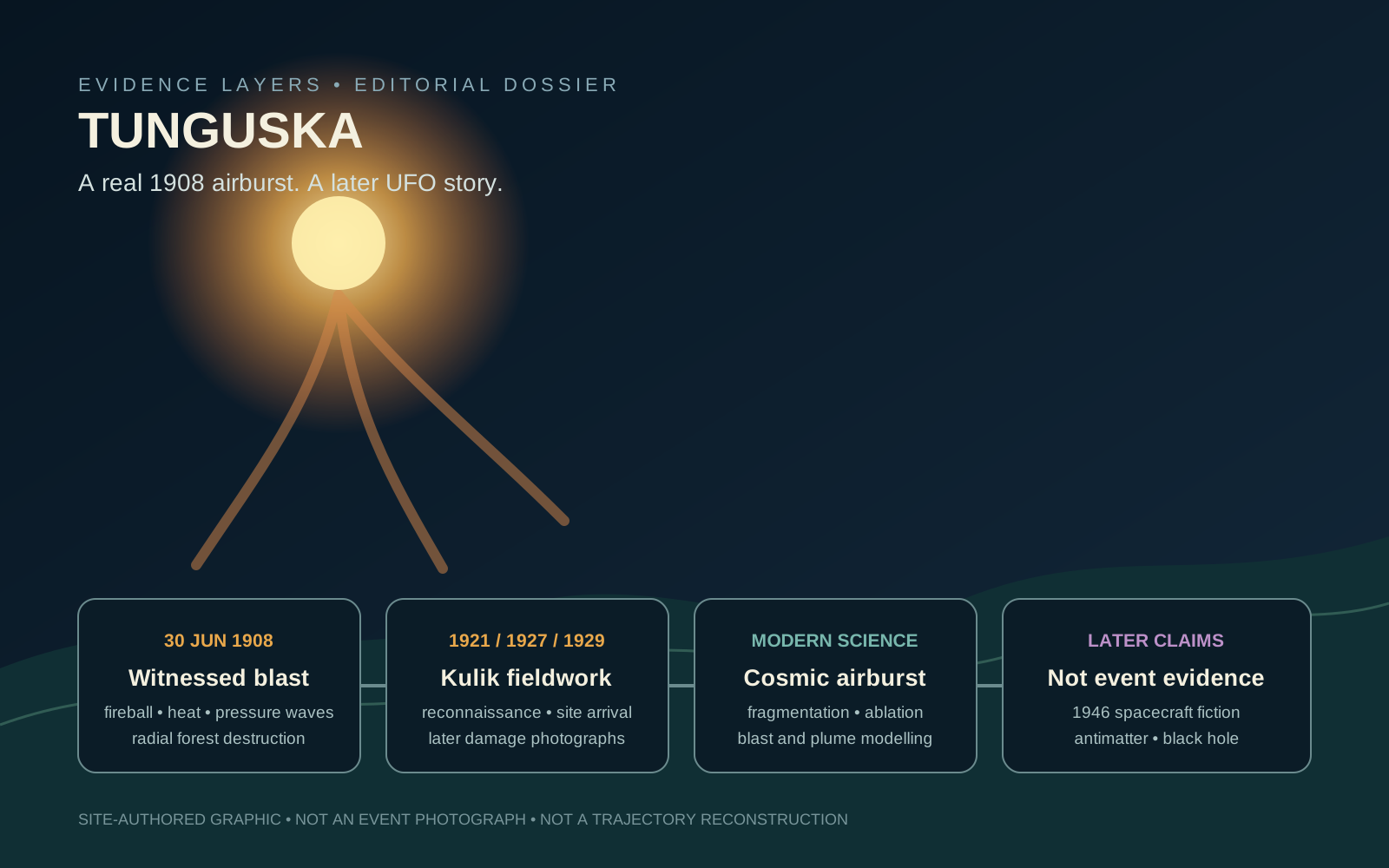
This archive treats the case as explained or substantially resolved by conventional evidence.
- Documentation
- High documentation
- Primary location
- Podkamennaya Tunguska, central Siberia
- Source base
- 10 linked records
- Research use
- Comparison case
What the Tunguska record establishes
- Confirmed event
- A high-energy atmospheric blast on 30 June 1908 flattened roughly 2,000 km² of forest.[1][3][5][10]
- Investigation timing
- Kulik reached the blast area in 1927; later expedition images are aftermath records, not 1908 event images.[1][2]
- Best explanation
- Atmospheric disruption of a small natural cosmic body explains the damage without a ground crater.[3][4][5][10]
- Debris boundary
- No macroscopic fragment or accepted crater is confirmed; fragmentation and ablation make that absence plausible.[4][6]
- UFO boundary
- The spacecraft story arose in 1946 fiction, not in 1908 testimony or Kulik's field record.[7]
Case dossier
Case scope: On 30 June 1908, a cosmic body entered the atmosphere over central Siberia and released its energy above the ground, producing light, heat, shock waves and a vast treefall without a conventional impact crater. Leonid Kulik did not inspect the devastated forest in 1908: he first tried to reach the region in 1921 and arrived at the blast area in 1927. His missing crater and missing large meteorite became openings for later speculation, especially after Aleksandr Kazantsev's 1946 science fiction proposed an atomic-powered alien spacecraft. Nature later published antimatter and black-hole suggestions, but publication records a hypothesis, not corroborating evidence. Modern airburst simulations, treefall surveys and fragmentation physics support a natural impactor—most probably a stony asteroid—breaking up in the atmosphere. The precise size, trajectory, energy and composition remain model-dependent; an alien craft does not become competitive merely because those parameters retain uncertainty.
Source finding — NASA History / Johnson Space Center: NASA separates the 1908 blast from Kulik's failed 1921 attempt and 1927 arrival, and reports no conclusively linked large bolide or microparticles.
Source finding — NASA History / Johnson Space Center: Retrospective source, not a contemporaneous 1908 instrument record. It supports only the stated chronology or interpretation and does not prove a spacecraft or fix every model parameter.
Source finding — Tunguska electronic archive / Krinov monograph: Krinov's expedition history documents Kulik's 1927 arrival and crater expectations, fixing the first on-site scientific survey nineteen years after the event.
Source finding — Tunguska electronic archive / Krinov monograph: Retrospective source, not a contemporaneous 1908 instrument record. It supports only the stated chronology or interpretation and does not prove a spacecraft or fix every model parameter.
Public chronology: 1908-06-30: A cosmic body explodes above central Siberia, producing a fireball, shock waves, heat effects and extensive forest damage. This is the event date attached to the structured archive record. Dates on later archive pages, news reports or documentary programs describe the source history and are not treated as a second occurrence or as contemporaneous evidence.
Evidence basis: The linked record includes material published or preserved by NASA History / Johnson Space Center, Tunguska electronic archive / Krinov monograph, Nature / Princeton University, and Nature. Agreement between independent records carries more weight than repeated summaries of the same claim, while later broadcasts and documentary programs are treated as context rather than original sighting evidence.
Archive assessment: Tunguska UFO theories remains in the archive as a substantially explained report because its public record can be tied to Podkamennaya Tunguska, central Siberia in 1908 and compared across 10 linked sources. Those sources document the report, its reception and later analysis; they do not by themselves prove that an extraordinary craft or non-human cause was present.
Timeline
- A cosmic body explodes above central Siberia, producing a fireball, shock waves, heat effects and extensive forest damage.
- The Soviet Academy of Sciences sends Leonid Kulik toward the Tunguska region, but he does not reach the blast area.
- Kulik reaches the devastated forest nineteen years after the event and begins the first direct scientific survey of the blast area.
- Kulik's expedition photographs the enduring treefall; these are aftermath records from the survey, not images of the incoming body in 1908.
- Aleksandr Kazantsev publishes science fiction linking Tunguska to an atomic-powered alien spacecraft, a later cultural origin for the UFO theory.
- Nature publishes an item proposing possible antimatter content; its title records a speculative hypothesis, not a new observation from 1908.
- A Nature letter suggests a substellar black hole; no measured black-hole trajectory or predicted exit disturbance accompanies the proposal.
- V. V. Svetsov publishes a fragmentation-and-radiation calculation explaining why a stony Tunguska body could leave no identified solid debris.
- Sandia reports three-dimensional airburst simulations in which asteroid momentum drives hot gas downward and reproduces key surface-damage patterns.
- NASA summarizes a multi-code reassessment favoring a stony asteroid airburst while retaining ranges for size, altitude, energy and frequency.
Questions about Tunguska UFO theories
Was Tunguska a UFO crash?
No evidence establishes a craft. The spacecraft idea appeared in 1946 fiction; physical evidence supports a natural airburst.
What caused the Tunguska event?
The strongest model is atmospheric breakup of a small asteroid or related natural cosmic body.
Why is there no Tunguska crater?
Most energy was released above ground; fragmentation and ablation can leave no single classic crater.
Did Kulik investigate in 1908?
No. He tried to reach the region in 1921 and arrived at the blast area in 1927.
Was antimatter detected at Tunguska?
No confirmed detection established antimatter. It was proposed and tested as a later hypothesis.
Could a black hole have caused Tunguska?
A 1973 letter proposed it, but contemporary critiques found it inadequate or extremely unlikely. It is not accepted.
Sources
- [1] Official file115 Years Ago: The Tunguska Asteroid Impact EventNASA History / Johnson Space Center
- [2] ArchiveThe first 1927 expeditionTunguska electronic archive / Krinov monograph
- [3] ResearchThe 1908 Tunguska explosion: Atmospheric disruption of a stony asteroidNature / Princeton University
- [4] ResearchTotal ablation of the debris from the 1908 Tunguska explosionNature
- [5] Official fileLow-Altitude Airbursts and the Impact ThreatSandia National Laboratories
- [6] ResearchSedimentation rate in Lake ChekoDoklady Earth Sciences
- [7] ResearchAtomic Visitors from Outer SpaceThe Russian Review
- [8] ResearchWas the Tungus Event due to a Black Hole?Nature
- [9] ResearchExperiment to measure the antimatter content of the Tunguska MeteorNature
- [10] Official fileTunguska Revisited: modern multi-code impact reassessmentNASA Ames Research Center
Original text-and-shape graphic with no third-party assets. The legacy Commons JPEG is excluded because its 1929 Kulik description conflicts with embedded 1968 RIA Novosti metadata.