
United Kingdom / 1993 / DISPUTED
Cosford UFO incident
During the night of 30-31 March 1993, reports of bright lights crossed southern and western Britain. The National Archives' summary of Ministry of Defence file DEFE 24/2086 says that more than 30 sightings reached the MoD during a six-hour period, including observations by police officers and military witnesses and a police patrol at RAF Cosford. The MoD asked the RAF to replay radar tapes; the review found nothing unusual. The same official summary says that the majority of sightings were soon attributed to the atmospheric re-entry of the Russian rocket that had launched Cosmos 2238. It does not say every report was explained. Later accounts, especially those associated with former MoD desk officer Nick Pope and a 2024 BBC programme, emphasize a triangular craft and RAF Shawbury. The open official pages and PDF reviewed for this archive do not reproduce the alleged Shawbury witness's original statement, a Met Office report, a police incident log, raw radar data or event photographs. The case is therefore best read as a documented report wave with a strong explanation for most observations and a narrower residue whose public evidential record remains incomplete.
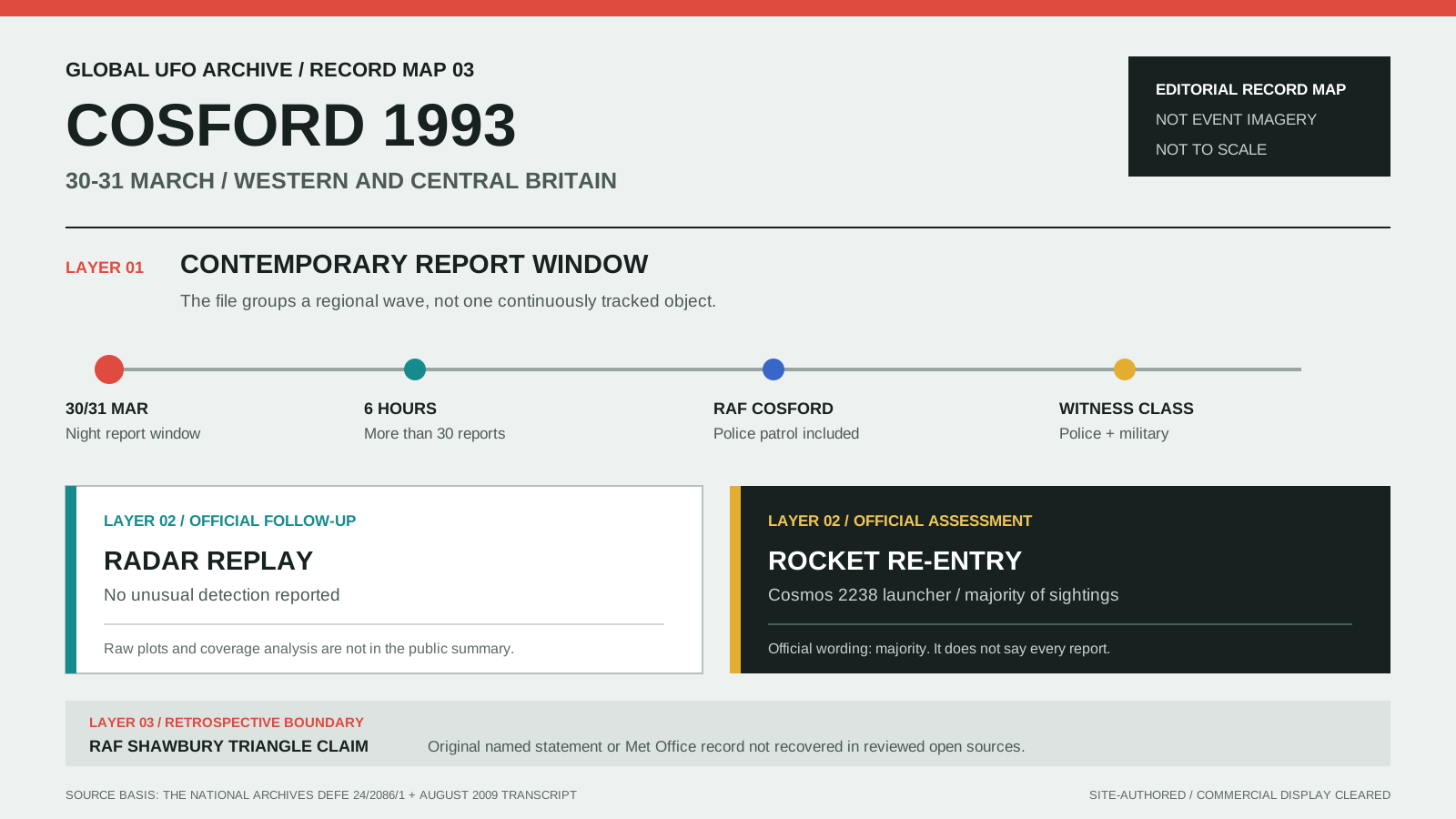
This case is disputed. The archive preserves the claims while separating evidence from interpretation.
- Documentation
- High documentation
- Primary location
- RAF Cosford, RAF Shawbury and western Britain
- Source base
- 8 linked records
- Research use
- Comparison case
What the 1993 record establishes
- Report window
- The file covers the night of 30-31 March 1993. The official summary describes more than 30 reports reaching the MoD over six hours across southern and western Britain.[1][2]
- RAF Cosford
- The National Archives specifically includes a police patrol at RAF Cosford among police and military witnesses. The public summary does not name the officers or reproduce their statements.[2][4]
- Radar result
- The MoD requested a replay of RAF radar tapes. The official account says the review found that nothing unusual had been detected; no raw plot is published with the summary.[2]
- Leading explanation
- The National Archives attributes the majority of sightings to re-entry of the Russian rocket that launched Cosmos 2238. It does not say all reports were explained.[2][7]
Report chain and explanation boundary
Case dossier
The defensible event window spans the night of Tuesday 30 March into the early hours of Wednesday 31 March 1993. The catalogue title for DEFE 24/2086/1 is deliberately broad: 'UFO reports sightings, 30/31 March 1993; with redactions.' The National Archives' 2009 transcript narrows the main activity to six hours and more than 30 reports across the south and west of the British Isles. This is a regional report wave, not one continuously tracked object moving from witness to witness.
The official public summary describes bright lights seen across central England by police officers and military witnesses. It specifically includes a police patrol at RAF Cosford, near Wolverhampton. That supports a contemporaneous service-report chain and fixes Cosford within the wave. The summary does not publish the officers' names, a verbatim statement, a precise time, bearing, angular size or duration for their observation. Those details must not be filled from later television or web accounts.
The Ministry of Defence treated the cluster seriously enough to request a replay of RAF radar tapes. According to The National Archives, that review found nothing unusual had been detected. This is useful negative evidence: the reviewed radar record did not corroborate an anomalous tracked target. It is not proof that witnesses saw nothing, and it is not a substitute for raw plots, coverage maps, antenna limits or a time-matched technical report, none of which appears in the public summary.
The leading incident-specific explanation is rocket re-entry, not a generic list of aircraft or stars. The National Archives says the majority of sightings were caused by the atmospheric re-entry of the Russian rocket that launched Cosmos 2238. A re-entering body can fragment into several bright, slowly crossing lights and produce geographically separated reports along one broad path. The official wording is still bounded: 'majority' is not 'all,' and the transcript supplies no trajectory table matching each report to a fragment and time.
RAF Shawbury enters the case mainly through later narrative. Its official RAF page confirms the station and its long flying-training and air-traffic-control history, but says nothing about a 1993 UFO report. Widely repeated accounts assign a dramatic low-level triangular object to a meteorological officer there. In the open official material reviewed for this project, no named statement, Met Office form or separate Shawbury incident record was available to test that description. It can be reported as a later-attributed claim, not merged into the documented Cosford patrol account.
Nick Pope's later role is relevant but must be dated correctly. His own website says he worked for the MoD for 21 years and ran its UFO project from 1991 to 1994; a BBC programme blurb compresses those into 21 years on the 'UFO desk.' Pope calls Cosford a classic case, while the 2024 programme advertises a triangular craft and hundreds of reports. These are retrospective framing choices, not contemporaneous evidence. The narrow archival conclusion is firmer: a real report file, numerous visual reports, no unusual radar return, a strong re-entry explanation for most sightings and insufficient open primary material to settle every residual claim.
Timeline
- A regional report window develops during the night across southern, western and central Britain. The catalogue groups the material under 30/31 March rather than one single observation.
- More than 30 sightings are reported to the MoD over six hours. The official summary names police and military witnesses and specifically includes a police patrol at RAF Cosford.
- The MoD asks the RAF to replay radar tapes. The official later account says nothing unusual had been detected.
- The majority of sightings are attributed to re-entry of the Russian rocket that launched Cosmos 2238. The public summary does not map every report to the re-entry.
- A Defence Intelligence briefing later cites Cosford while arguing for continued UFO-related work. Archival researcher David Clarke notes that this institutional use did not incorporate the already available re-entry explanation.
- The redacted digital copy DEFE 24/2086/1 opens in The National Archives catalogue. A TNA podcast transcript summarizes the reports, radar check and majority re-entry attribution.
- BBC Radio Shropshire releases a 17-minute retrospective programme. Its triangular-craft framing and Nick Pope biography are later media, not additions to the 1993 evidence record.
Cosford incident questions
When did the Cosford UFO incident occur?
The official file covers the night of 30-31 March 1993. The National Archives places the main reports in the early hours of 31 March and describes a six-hour period with more than 30 reports.
What was reported at RAF Cosford?
The public official summary says bright lights were seen and includes a police patrol at RAF Cosford among police and military witnesses. It does not publish a verbatim patrol statement or enough geometry to reconstruct that observation independently.
Did RAF radar detect an unknown object?
The MoD asked for RAF radar tapes to be replayed, but The National Archives says the check found nothing unusual had been detected. This is negative corroboration, although the public summary does not provide the raw radar data or coverage analysis.
Was the incident explained by a Russian rocket?
The official 2009 summary says the majority of sightings were caused by re-entry of the Russian rocket that launched Cosmos 2238. It does not say all sightings were matched, so the archive uses this as a strong majority explanation rather than a total solution.
What is the RAF Shawbury part of the story?
Later retellings describe a meteorological officer at Shawbury seeing a low triangular object. The open official sources reviewed here do not reproduce that witness's original statement or a Met Office report. The claim is therefore kept separate from the documented Cosford patrol and labelled retrospective pending primary documentation.
Did Nick Pope run the MoD UFO desk for 21 years?
No. Pope's own site says he worked for the MoD for 21 years, from 1985 to 2006, and worked on its UFO project from 1991 to 1994. A 2024 BBC programme description conflates the total career with the shorter posting.
Sources
- [1] Official fileDEFE 24/2086/1: UFO reports, 30-31 March 1993The National Archives (UK)
- [2] Official fileScript for The National Archives UFO files, August 2009 podcastThe National Archives (UK)
- [3] Official fileUFO reports: Ministry of Defence records and reporting contextThe National Archives (UK)
- [4] Official fileRAF Cosford official station profileRoyal Air Force
- [5] Official fileRAF Shawbury official station profile and historyRoyal Air Force
- [6] ResearchNick Pope's position statement and MoD UFO-project chronologyNick Pope
- [7] ResearchMoD files make UFOs history: the 1995 briefing and CosfordDr David Clarke
- [8] News reportThe RAF Cosford UFO incidentBBC Radio Shropshire
The displayed visual is an original site-authored record map derived from The National Archives catalogue and 2009 transcript. It is not an event photograph, an archival scan, a radar plot, a rocket trajectory, a sky reconstruction or a depiction of the reported object's shape. No authenticated 1993 photograph or video was found. BBC programme artwork, station photographs and unverified triangle images are not reused.