
United States / 1983 / DISPUTED
Hudson Valley UFO wave
The Hudson Valley UFO wave was not one encounter but a changing cluster of night-light reports across Westchester, Putnam and Dutchess counties in New York and nearby western Connecticut. Contemporary reporting places the best-documented core from March 1983 through summer 1984; the later book Night Siege broadened the public narrative through 1986. Witnesses described V, boomerang or circular arrangements of white, red and green lights, often perceived as very large, slow and quiet. New York State Police Sergeant Kenneth V. Spiro told The New York Times that a trooper followed one display to Stormville Airport and found five or six small aircraft flying together. A contemporary Discover article separately reported local pilots practicing day and night formations and an FAA inspection in September 1984. These records make light-aircraft formations a strong explanation for many displays, but they do not match every report to a named flight. No consolidated police file, flight log, radio recording, radar plot, FAA final report or authenticated original event image was located. Public counts are also incompatible: a private hotline logged more than 600 calls, investigators spoke of roughly 900 forms, and much larger estimates of thousands had no published counting method. The famous Bob Pozzuoli video has conflicting June and July 1984 dates in later sources and no public original tape, metadata or custody record. Grade B / DISPUTED therefore reflects a substantial contemporary record and a well-supported conventional mechanism, while preserving the limits of incident-by-incident identification.
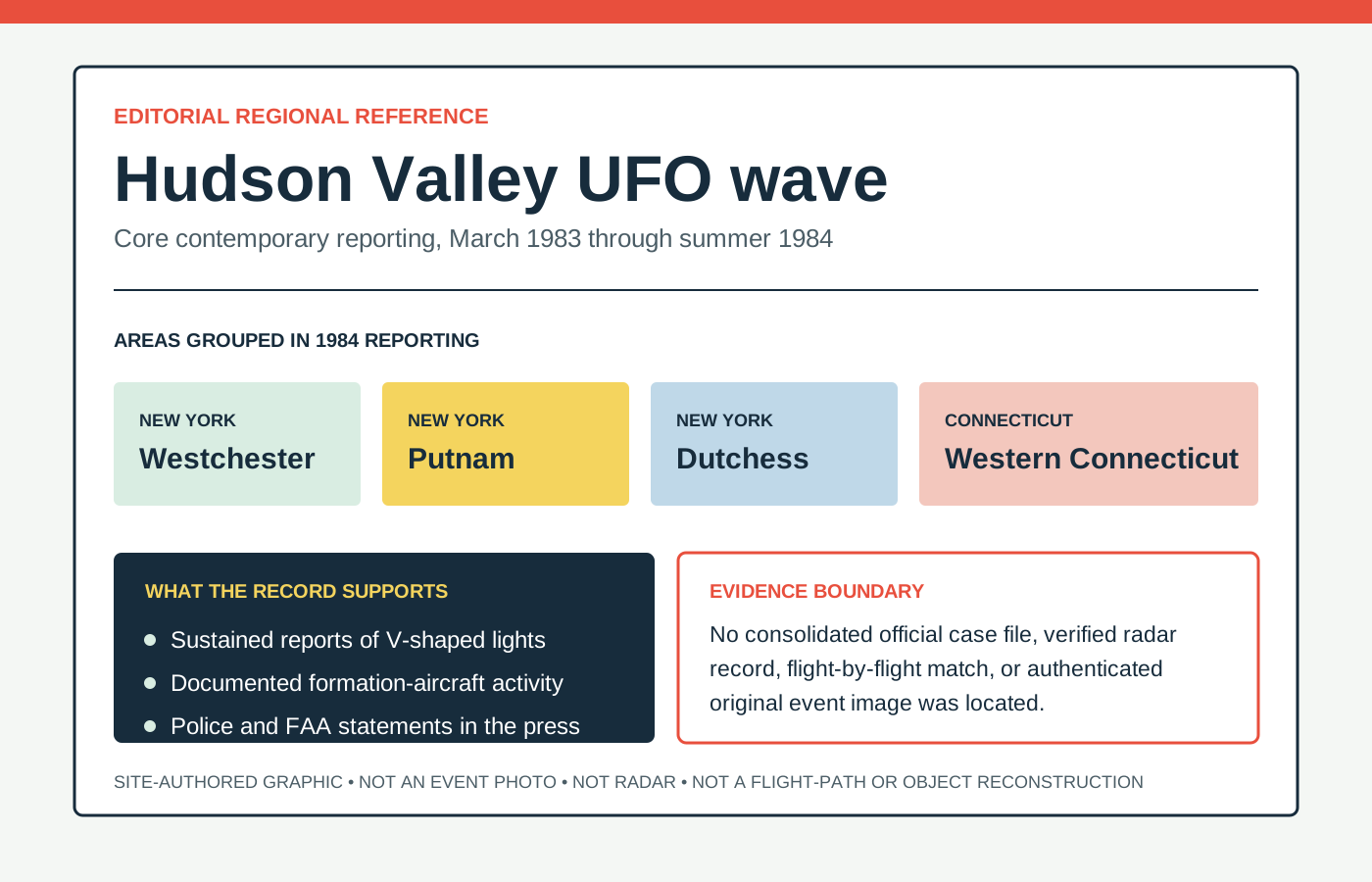
This case is disputed. The archive preserves the claims while separating evidence from interpretation.
- Documentation
- High documentation
- Primary location
- Hudson Valley, New York, and western Connecticut
- Source base
- 6 linked records
- Research use
- Comparison case
What the surviving record establishes
- Core report window
- Contemporary sources place the strongest cluster from March 1983 through July or summer 1984. The familiar 1983-1986 range comes from later books and television.[1][2][3][4]
- Regional scope
- Westchester, Putnam and Dutchess counties plus western Connecticut were grouped together in 1984 reporting. That was a media and civilian-investigator wave, not one official multi-state incident.[1][2][3][4]
- Aircraft evidence
- State Police traced one display to small planes at Stormville; pilots described formation practice; Discover reported night formations and an FAA inspection. No flight-by-flight master record survives.[1][3][4]
Case dossier
The label Hudson Valley UFO wave joins many reports that were separated by date and place. The strongest contemporary sources describe activity beginning in March 1983 and continuing into July or summer 1984 across northern Westchester, Putnam and Dutchess counties and western or southwestern Connecticut. This cross-state geography was already present in 1984 reporting, so Connecticut is not merely a later addition. It was, however, a press and civilian-investigator grouping, not a single officially defined multi-state incident. Night Siege and later television widened the remembered window to 1983-1986, but that broader frame should not replace the better-documented core.
A later television archive dates Dennis Sant's Brewster account to 17 March 1983 and places New Castle officer Andi Sadoff's patrol observation one week later. A contemporary New York Tribune report identifies 24 March as the first date in a 15-month series discussed at the August 1984 Brewster conference. Keeping 24 March as the structured case date is therefore defensible, but it marks a principal early cluster rather than the proven start of every report. Claims that hundreds watched that exact night come from later reconstructions; no complete dispatch log or roster of independent witnesses was found.
Across the reports, witnesses used V, boomerang, triangle and circle language for arrangements of white, red and green lights. Many described an apparent solid body, football-field scale, hovering, slow motion and little or no engine noise. Those descriptions establish what observers perceived; they do not independently establish distance, size or a connected structure. At night, separated lights can be perceptually grouped into one outline, apparent angular motion can be mistaken for hovering, and engine sound depends strongly on range, wind, terrain and traffic noise. The record contains no surveyed geometry or synchronized instrument data that fixes these quantities.
Police participation is documented, but mostly through journalism rather than released case files. The New York Times reported that state and local police received many calls and that patrol officers were among observers. Sergeant Kenneth V. Spiro of State Police Troop K said a trooper followed one display to Stormville Airport, saw a group of five or six light planes with dark undersides and bright changeable lights, and spoke with pilots there. UPI also recorded a New Castle officer confirming that four officers and roughly 15 people at a meeting watched lights on 11 June 1984. These accounts are significant corroboration of both public reporting and aircraft activity, yet the trooper's name, incident number, pilot identities and underlying logs were not published.
The aviation explanation has more than a single police quotation behind it. Glenn Garelik's 1984 Discover report described local amateur pilots moving from daytime practice to tight night formations, changing shapes, coordinating by radio and sometimes switching exterior lights. The article said conversations were overheard on 122.8 and 122.9 MHz, but it did not publish recordings or identify every pilot. It also reported that an FAA team inspected parked aircraft at Stormville in mid-September for altered lights or other violations; the parked planes passed that inspection. This supports real formation activity and plausible visual effects, not a complete flight-by-flight solution.
FAA and police statements need to be read in sequence. In August 1984, FAA eastern-region deputy director Timothy L. Hartnett told The New York Times that formation spacing was left to pilots' safety judgment and that aircraft could fly as low as 500 feet in sparsely populated areas. Spiro said no law had been violated in the encounter described to him. Discover later said simultaneous switching off of required navigation lights at night would be illegal and that the September inspection followed public attention. These are not necessarily contradictory: they address different conduct and moments. No public FAA enforcement decision, inspection worksheet, flight plan or final report was found, so the archive should not convert press descriptions into a federal adjudication.
Witness totals are measures of different things. UPI attributed an estimate of 6,000-7,000 observers between 11 June and 12 July 1984 to civilian investigator Philip Imbrogno, not to police or a census. Discover said a private hotline had received more than 600 calls by mid-September. The 1987 Publishers Weekly review of Night Siege referred to about 900 people who completed witness forms and to hundreds of reported observers. Conference attendance is itself reported as about 500 by UPI and more than 1,000 in local and New York Tribune coverage. None of these numbers is an audited count of unique, independent witnesses, and they cannot be added together.
The image record is weaker than its reputation. The New York Times reported that residents brought many rolls of film to a Yorktown photo processor, and Discover said a few sightings were photographed, but neither source supplies an authenticated original with a custody history. The Unsolved Mysteries archive identifies a Bob Pozzuoli home video over Brewster as 10 June 1984 and repeats Imbrogno's claim that unnamed experts saw rigid motion; later newspaper-based references date Pozzuoli footage to 24 July. The original tape, camera data, full-quality transfer and named analysis are not public. Program stills, magazine illustrations, newspaper scans and later Randy Etting imagery therefore remain context, not licensed or authenticated event evidence.
Timeline
- A later Unsolved Mysteries archive dates Dennis Sant's Brewster account to 17 March. It is a retrospective witness date, not a surviving police report.
- A contemporary New York Tribune article later identified 24 March as the first date in the 15-month series discussed at Brewster. Television recollection places police and Taconic Parkway reports about one week after Sant, but no complete call log fixes the crowd size.
- For summer 1983, with no exact day stated, air-traffic specialist Anthony Capaldi later recalled seeing a tight aircraft formation from a tower: at that distance it first looked like one large light. His statement documents the visual mechanism, not every ground report.
- UPI reported that a New Castle officer confirmed four officers and about 15 people at a meeting watched lights. Civilian investigators used 11 June as the start of a later high-count estimate; no official witness census accompanied it.
- UPI listed 24 July among the recent report dates. Later sources disagree on whether Bob Pozzuoli's Brewster home video was made on 10 June or 24 July; the original tape and metadata were not located to resolve the date.
- The New York Times and UPI published major contemporary accounts as a public UFO conference met in Brewster. UPI estimated attendance near 500, while local and New York Tribune reports said more than 1,000, illustrating the archive's counting problem.
- Discover reported that an FAA team made a surprise mid-September inspection of parked aircraft at Stormville for altered lights or other violations. The aircraft present passed; the article did not publish an FAA worksheet or final enforcement report.
- Publishers Weekly reviewed Night Siege, which broadened the narrative to 1983-1986 and described roughly 900 completed witness forms. That number belongs to the authors' collection, not an official unique-witness total.
- A 1992 Unsolved Mysteries segment preserved interviews with witnesses, police and an air-traffic specialist and publicized the Pozzuoli video claim. It is a later television production with reconstructions, not a contemporary investigative file.
Questions about the Hudson Valley wave
What was the Hudson Valley UFO wave?
It was a regional cluster of night-light reports, not one encounter. Observers across three New York counties and western Connecticut described V, boomerang, triangular or circular light arrangements, especially from March 1983 through summer 1984.
Did the wave run from 1983 to 1986?
That is the scope popularized by Night Siege and later television. Complete contemporary sources concentrate on March 1983 through July or summer 1984. Later and outlying reports may be related culturally, but were not shown to be one continuous official case.
Were the lights small planes flying in formation?
For many displays, that is strongly supported. State Police traced one event to Stormville, pilots described formation practice, and a contemporary magazine reported night formations. The absence of flight logs and incident-by-incident matching prevents proving that every report had that cause.
What did police and the FAA establish?
Police documented heavy call volume, officer observations and one formation followed to an airport. FAA officials explained ordinary flight rules, and Discover reported a September inspection of parked aircraft. No consolidated police file, FAA final report, enforcement decision or radar record was found.
How many people witnessed the wave?
There is no audited total. Sources variously count hotline calls, completed forms, estimated observers over selected weeks and conference attendance. Figures from more than 600 to several thousand cannot be treated as the same population or added together.
Is the famous photo or video reliable evidence?
Not at archival standard. Contemporary sources mention photographs, and later television identifies a Pozzuoli home video, but no public original with metadata and custody history was found. Sources conflict on whether that video dates to 10 June or 24 July 1984, and the claimed expert review is unnamed.
Sources
- [1] ArchiveStrange sights brighten the night skies upstateThe New York Times (Internet Archive capture)
- [2] News reportUFO buffs gather in close encounterUnited Press International
- [3] ArchiveThe Great Hudson Valley UFO Mystery (Discover, November 1984)Discover / Imprint public PDF reprint
- [4] ArchiveRash of UFO sightings draws crowd to upstate conferenceNew York Tribune / UFO Newsclipping Service public PDF
- [5] ResearchPublishers Weekly review of Night SiegePublishers Weekly
- [6] ArchiveUnsolved Mysteries archive: Hudson Valley UFOUnsolved Mysteries
The displayed image is a site-authored regional reference, not an event photograph, radar image, flight-path reconstruction or depiction of an object. No external image with both adequate provenance and reusable rights was selected. The Pozzuoli video remains unembedded because its date, original-file custody and named analysis are unresolved.