
Canada / 1996 / EXPLAINED
Yukon giant UFO (1996)
The Yukon report is best treated as a retrospectively assembled mass sighting with a strong conventional identification. UFO*BC investigator Martin Jasek interviewed witnesses between February and September 1999 and published an initial account in October 1999, later expanding a minimum of 22 named-to-him witnesses in three areas to 31 across four areas. One Fox Lake witness had written an account about a month after the event, and witnesses recalled next-day radio discussion, but this audit found no 1996 witness roster, broadcast recording, air-traffic record or government investigation file. In 2012 satellite tracker Ted Molczan used U.S. Strategic Command orbital elements to place rocket body 1996-069B / 24671—the second stage that launched Cosmos 2335—in final descent within sight of all four areas at about 20:25–20:27 local time. Harro Zimmer’s independent propagation refined the same match. The payload itself remained in orbit; the rocket stage re-entered. Time, direction, low northern elevation and a breaking row of lights fit the reports closely. The defensible classification is therefore B / explained, while exact witness counts and some close-range recollections remain less secure.
This archive treats the case as explained or substantially resolved by conventional evidence.
- Documentation
- High documentation
- Primary location
- Klondike Highway: Fox Lake, Carmacks, Pelly Crossing and Mayo, Yukon
- Source base
- 6 linked records
- Research use
- Comparison case
What the evidence supports
- Date and place
- The best-supported date is 11 December 1996, with reports near Fox Lake, Carmacks, Pelly Crossing and Mayo along the central Yukon corridor.[2][3]
- Witness count
- UFO*BC first reported at least 22 people in three areas, then 31 in four. The larger count is a 1999–2000 investigator compilation, not a recovered 1996 official roster.[2]
- Technical match
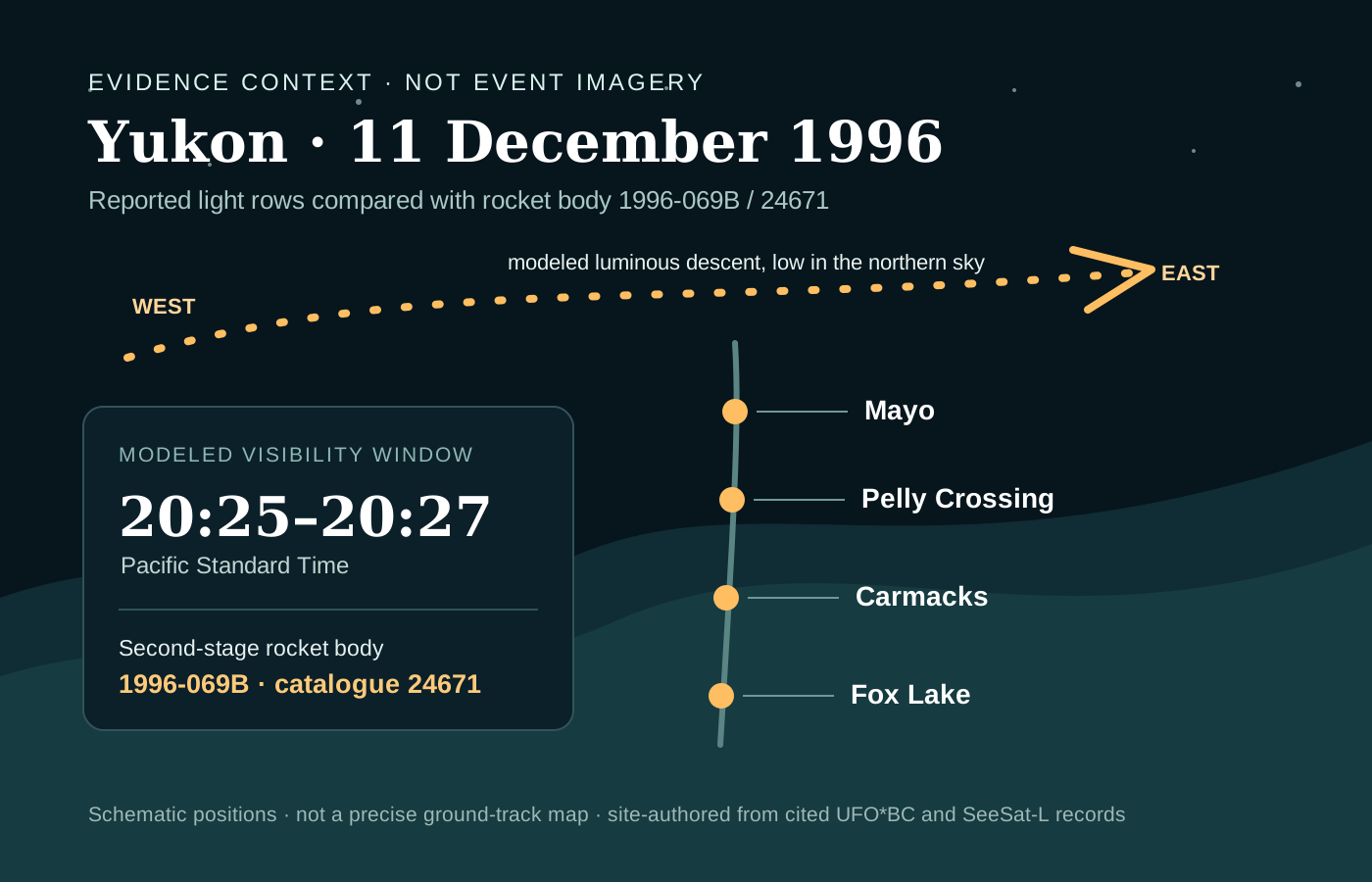
- Rocket body 1996-069B / 24671 was modeled in breakup within sight of the four locations at about 20:25–20:27 PST, matching direction and appearance.[5][6]
Case dossier
The best-supported event date is Wednesday, 11 December 1996, local Pacific Standard Time. Reports later assembled by UFO*BC placed observations along the Klondike Highway near Fox Lake, Carmacks and Pelly Crossing, with additional reports from Mayo. The initial web report described 22 people—six, nine and seven in the first three areas—over roughly 216 kilometres. Its June 2000 expansion raised the total to 31 and added a fourth area. These are investigator totals, not a contemporaneous census. Several reports cluster near 20:23–20:30; others were reconstructed more loosely from journeys or next-day conversations.
The accounts share a useful core: a long row or cluster of white, yellow, orange, blue or green lights moved generally west to east, low across the northern sky, without reported sound. Interpretation varied. Some witnesses described only lights or compared them with aircraft; others, especially in later interviews, perceived a huge solid structure, windows, a beam, hovering or rapid departure. FOX3’s narrative, written about one month after the event and later posted by UFO*BC, fixes 20:30 and describes a bright streak at departure. It is the closest surviving witness text located here, but it is still one person’s interpretation and was not preserved in a public 1996 official file.
The source chronology sharply limits the phrase ‘mass sighting.’ FOX3 said he spoke to CHON-FM the next day, and FOX5 recalled CBC discussion, but no recording or transcript was located. Jasek’s detailed interviews occurred from February to September 1999, more than two years later. His published witnesses were coded to preserve anonymity, and two listed people had not yet been interviewed in the February 2000 version. Separate groups may well have seen the same luminous event, but the public record cannot verify that all 31 supplied independent, contemporaneous statements or identical descriptions.
The technical chain begins with a real launch, but requires the correct object. Russian registration data and NASA’s orbital-debris review record Cosmos 2335 (1996-069A) launching aboard a Tsiklon-2 from Baikonur on 11 December into a roughly 400-kilometre orbit. That payload remained aloft until 1999. The object relevant to Yukon was its second-stage rocket body, 1996-069B, catalogue 24671, left in a highly elliptical orbit with a perigee near 100–120 kilometres. A contemporaneous 12 December 1996 satellite-observer message published the final orbital element set and predicted decay on that revolution. Thus ‘Cosmos 2335 re-entered over Yukon’ is shorthand that must not be read as the satellite itself falling that night.
Molczan’s 2012 calculation used the last U.S. Strategic Command two-line elements with Satana and Satevo decay models. Ten combinations yielded estimates from 03:34 to 05:13 UTC on 12 December; eight fell between 04:10 and 04:33, with a mean and median of 04:22 UTC. His preferred final decay estimate was 04:26 UTC, or 20:26 PST on 11 December. The modeled path was visible low in the north from Fox Lake, Carmacks, Pelly Crossing and Mayo around 20:25–20:27, moving west to east. Zimmer then used a special-perturbations program and independently placed the stage at about 83 to 68 kilometres during that interval, with breakup as it entered view. The match is analytical, not an official Canadian ruling, but it is unusually specific and testable.
Canada’s Office of the Chief Science Advisor mentioned the case in the June 2025 Sky Canada report as an example of a memorable sighting, stating that at least 31 people in four Yukon areas reported a row of lights. Sky Canada’s stated project was to review public-reporting systems and recommend improvements; it did not reopen this event, publish witness statements, analyze the rocket trajectory or declare an unknown craft. Its wording supports that the story entered Canadian public memory, not that the federal government verified the witness count or rejected re-entry. Later documentaries and YouTube clips likewise preserve recollections and cultural reception, but add no contemporaneous sensor record and are not embedded here as original event video.
Timeline
- Cosmos 2335 launches from Baikonur on a Tsiklon-2; its payload reaches orbit while second stage 1996-069B remains on a rapidly decaying trajectory.
- Witness times near Fox Lake cluster around rows of lights moving west to east; other Yukon times are less precisely reconstructed.
- A contemporary satellite-observer message publishes the final orbit of rocket body 24671 and predicts decay on that revolution; witnesses later recall local radio coverage.
- After interviews conducted in 1999, UFO*BC posts an account totaling at least 22 witnesses in three areas.
- UFO*BC’s expanded hard-copy report raises the total to 31 and includes Mayo; the larger number becomes the best-known public count.
- Ted Molczan identifies the Cosmos 2335 second-stage re-entry; Harro Zimmer’s separate propagation confirms and refines the trajectory and breakup altitude.
- Sky Canada cites the 31-person story in a policy report about UAP reporting; it does not conduct a case investigation or rule on the re-entry analysis.
Frequently asked questions
When and where was the Yukon giant UFO reported?
On 11 December 1996 along the Klondike Highway corridor, principally near Fox Lake, Carmacks, Pelly Crossing and Mayo. Several Fox Lake times cluster near 20:23–20:30 PST.
Were there really 31 witnesses?
Thirty-one is UFO*BC’s expanded 2000 total across four areas. The initial report counted at least 22 known-to-the-investigator people in three areas. No contemporaneous public roster verifies 31 independent statements.
Was it Cosmos 2335?
More precisely, the leading identification is the re-entry of the second-stage rocket body that launched Cosmos 2335: 1996-069B / 24671. The satellite payload itself remained in orbit.
What does Sky Canada prove?
It proves that a 2025 federal policy report repeated the case as a memorable public report. It does not prove a 1996 government investigation, verify every witness or reject the re-entry explanation.
Is there original event footage?
No authenticated event photograph or video was located. Later documentaries and online clips are recollections or retellings, not footage recorded on 11 December 1996.
Sources
- [1] Official fileManagement of public reporting of unidentified aerial phenomena in CanadaOffice of the Chief Science Advisor of Canada
- [2] Research22+ Witnesses Observe a UFO Larger than a Football StadiumUFO*BC / Martin Jasek
- [3] ArchiveFOX3 statement written about one month after the eventUFO*BC witness archive
- [4] Official fileRegistration data on space objects launched by the Russian Federation in December 1996United Nations Office for Outer Space Affairs
- [5] ResearchOld Unknown Identified as a Re-entrySeeSat-L / Ted Molczan
- [6] ResearchRE: Old Unknown Identified as a Re-entrySeeSat-L / Ted Molczan and Harro Zimmer
The hero is a site-authored schematic evidence diagram, not event imagery. No authenticated photograph or original video from 11 December 1996 was located. UFO*BC reconstructions, a Royal Canadian Mint coin image and documentary/YouTube frames were not copied because they are later interpretations or have restricted commercial rights.