
United Kingdom / 1977 / DISPUTED
Broad Haven UFO sightings
The confirmed core is a school report, not a confirmed landing. On 4 February 1977 a group of children at Broad Haven Primary School in Pembrokeshire said they saw a silver object beyond the playground; some also described a figure. The headteacher later separated pupils and collected drawings, which became the case’s principal contemporary record. A 1979 BUFORA paper places the report among many spring 1977 claims in Pembrokeshire, but it is an investigator’s selective summary, not an official census or proof that the reports shared one cause. Ministry of Defence records show concern about the wider local response and a discreet RAF inquiry; officials considered a practical joker and refinery-type protective clothing, while an RAF visit to a later hotel report found no landing evidence. BBC’s 2017 anniversary coverage preserves drawings, archive footage and adult recollection forty years later. It does not create new contemporaneous evidence. The case remains C / disputed: the children reported something sincerely enough to generate a durable record, but the public evidence cannot determine what they saw or establish an extraterrestrial craft.
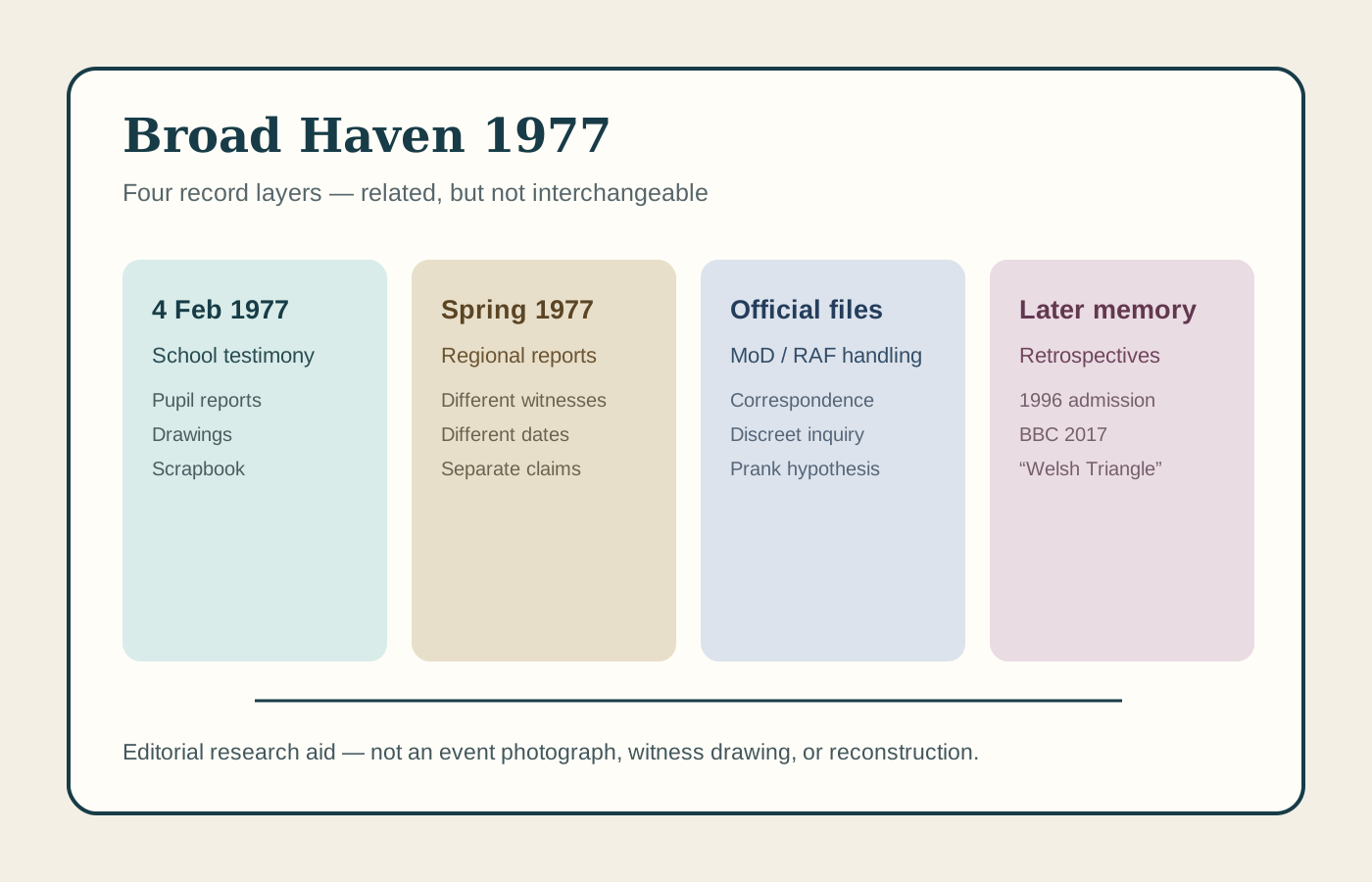
This case is disputed. The archive preserves the claims while separating evidence from interpretation.
- Documentation
- High documentation
- Primary location
- Broad Haven, Pembrokeshire, Wales
- Source base
- 6 linked records
- Research use
- Comparison case
What the record supports
- Confirmed core
- Pupils made a group report on 4 February 1977 and the school preserved drawings.[1][5]
- Evidence limit
- No authenticated event image, radar record or physical trace identifies the object.[1][3]
- Official boundary
- MoD and RAF records document inquiry and conventional hypotheses, not confirmation of an extraordinary craft.[3][4]
Case dossier
The school report on 4 February
The event anchor is Friday, 4 February 1977. Pupils said an object was visible across wooded fields beside the Broad Haven school playground. Descriptions varied between disc-like and cigar-shaped, usually with a dome and an orange-red or flashing light. Some children said a figure was associated with it; others did not see one. The archive therefore records a group report with overlapping features, not a single perfectly uniform observation. [5] PDF p. 12 (printed p. 11) · [1]
Drawings preserve accounts, not measurements
The drawings matter because they were made close to the report, but their production was not a laboratory test. BBC’s retrospective says the headteacher separated pupils and asked them to draw; it also notes slight variations. The surviving scrapbook images demonstrate that children expressed broadly similar forms. They do not establish distance, scale, independent viewing conditions or the physical presence of what was drawn. [1] · [2]
David Davies’s brief view and later recollection
In the BBC’s 4 February 2017 interview, David Davies recalled hearing other pupils discuss flying saucers before he went to look. He described a silver, domed shape appearing briefly above or beyond a tree and disappearing behind it; his own view lasted only a couple of seconds. That is his adult account of his particular viewing opportunity, not a duration measured for the whole group. He also recalled intense press attention making it difficult to reflect on the experience. These details explain why separately collected drawings should not automatically be treated as observations made without prior discussion. They do not establish that the children deliberately invented their reports. [1]
A region’s stories require separate files
Public retellings often merge the school report with later claims at Ripperston Farm, the Haven Fort Hotel and elsewhere. They should not. Different witnesses, dates and circumstances require separate evaluation. Anthony Pace’s 1979 BUFORA paper is valuable because it documents how investigators grouped the spring reports, while also admitting that its national count was raw and that most reports would eventually be explained. [5] PDF pp. 11–16 (printed pp. 10–15) · [3]
What Anthony Pace’s survey counted
Pace’s paper was delivered at a BUFORA conference on 16 April 1978 and printed in July–August 1979. He says he visited Pembrokeshire in August and September 1977 to interview witnesses to selected cases, after local investigator Randall Jones-Pugh’s earlier work. This is later field research, not a transcript of an investigator watching the school event. His opening total of roughly 450 reports concerns the United Kingdom in 1977; a footnote updates it to about 600 by July 1979. Neither figure counts Broad Haven witnesses or confirmed unusual craft. Pace explicitly calls the reports unprocessed and anticipates that at least 90 percent will be explained. That forecast is not a published set of completed identifications. [5] PDF pp. 11, 16 (printed pp. 10, 15)
The teacher’s report was on another date
The dated entries in Pace’s paper also separate adult and child testimony. His 4 February entry describes approximately 15–20 schoolboys and says only some reported a humanoid. His entry for teacher Mrs Morgan is dated 17 February, at about 10:30 a.m., and describes an oval, metallic-looking object with a small dome and ridges. It is a second reported observation thirteen days later, not an adult simultaneously confirming the pupils’ 4 February view. The paper compares sketches across the regional reports and proposes related causes, but such visual comparison cannot by itself establish that the same object returned. Its illustrations are explicitly not to scale. [5] PDF pp. 11–12 (printed pp. 10–11)
The Ministry of Defence and the hotel inquiry
The official record concerns handling and inquiry, not confirmation. After a later hotel witness contacted MP Nicholas Edwards, the Ministry of Defence received correspondence and an RAF officer examined that site. A private request asked the RAF Provost and Security Service whether discreet local inquiry was worthwhile. The surviving official account considered practical jokes and protective clothing; it did not authenticate the school object or announce a common cause for every report. [3] PDF p. 2 · [1]
Machinery and protective-suit explanations
Two conventional ideas recur. A sewage tank or farm machinery could have supplied a familiar shape seen under uncertain distance and viewing conditions; pranksters in protective suits could account for some later humanoid reports. Neither explanation has a documented demonstration matching every child’s account on 4 February. Conversely, the failure to prove one ordinary cause is not positive evidence for an extraterrestrial vehicle. [1] · [3] · [6]
The Welsh Triangle and retrospective memory
“Dyfed Triangle” and “Welsh Triangle” are media and retrospective labels for a cluster of stories, not names used by the children to identify their observation. BBC’s 2017 anniversary report is useful for reception history and for David Davies’s adult recollection. Memory after forty years, media attention and later theories must be dated as later material rather than inserted into the children’s 1977 statements. [1] · [6]
Related checks and records
Timeline
- Pupils at Broad Haven Primary School report a silver, domed object beyond the playground; some report a figure.
- The headteacher separates pupils and collects drawings; press attention follows. The exact interview day should not be inferred beyond the surviving accounts.
- A separate report at the Haven Fort Hotel prompts correspondence through MP Nicholas Edwards and an RAF site visit; no landing evidence is found there.
- The MoD asks whether a discreet RAF security inquiry is warranted; surviving summaries record suspicion of a practical joker in the wider area.
- BUFORA publishes Anthony Pace’s selective summary of spring 1977 Pembrokeshire reports, based on later field interviews and case collection.
- Glyn Edwards publicly says he wore a silver suit as a prank in 1977. The admission is relevant to some humanoid stories but does not independently reconstruct the school sighting.
- BBC News marks the fortieth anniversary with drawings, archive footage and later witness recollection.
Frequently asked questions
What happened at Broad Haven school in 1977?
On 4 February pupils reported a silver, domed or cigar-like object beyond the playground; some also reported a figure. The school collected drawings.
How many children saw the object?
Later accounts commonly say a class or roughly 14–20 pupils, but accessible summaries vary and no complete public roster fixes an exact count. The dossier therefore avoids false precision.
Do the children’s similar drawings prove a UFO landed?
No. They document broadly similar reported shapes. They do not establish scale, distance, viewing independence or the physical identity of the object.
Did the Ministry of Defence confirm the sighting?
No. Records show correspondence, an RAF site visit connected to a later report and consideration of prank explanations. They do not confirm an extraordinary craft at the school.
Was it a prank or a mistaken object?
Both are plausible hypotheses. A silver-suit prank is documented for some later regional activity, and machinery was suggested for the school shape, but neither has been demonstrated as a complete solution to 4 February.
Is the BBC video original footage of the UFO?
No. It is a 2017 anniversary page using BBC archive footage of children discussing their accounts. It does not show the alleged object.
Sources
- [1] News reportBBC’s 2017 Broad Haven retrospectiveBBC News
- [2] News reportBBC archive-footage video pageBBC News
- [3] Official fileNational Archives transcript on the Pembrokeshire filesThe National Archives
- [4] Official fileThe National Archives guide to UK UFO recordsThe National Archives
- [5] ResearchAnthony Pace’s 1979 BUFORA field summaryJournal of Transient Aerial Phenomena / BUFORA
- [6] News reportLater regional review of reports and explanationsHerald.Wales
The main image is a site-authored record-layer graphic. It separates the 4 February school testimony from later regional reports, official handling and retrospective media. It is not event evidence. BBC photographs, witness drawings and archive footage are linked at their source pages and not copied because republication rights were not established.