
Zimbabwe / 1994 / DISPUTED
1994 Ariel School encounter
The Ariel School encounter is a documented group-report case, not a verified landing or extraterrestrial contact. On 16 September 1994, pupils at a private primary school near Ruwa said that unusual objects and small figures appeared in scrub beyond the playground while teachers were in a staff meeting. The school collected drawings, and investigator Cynthia Hind and later psychiatrist John Mack recorded selected interviews. Broad motifs recur, but the accounts differ in object number, shape, movement and figure details. No adult reported seeing the alleged event, the exact witness roster and complete first statements are not public, and reported soil tests found no significant anomaly. The case remains disputed because the testimony is notable but cannot by itself identify an external craft or its origin.
This case is disputed. The archive preserves the claims while separating evidence from interpretation.
- Documentation
- High documentation
- Primary location
- Ruwa, Mashonaland East, Zimbabwe
- Source base
- 9 linked records
- Research use
- Comparison case
What the record supports
- Documented event
- Pupils at Ariel School made a group report on 16 September 1994, and the school collected drawings that day.[1][2]
- Adult witnesses
- No identified adult saw the alleged objects or figures; teachers were meeting and the adult at the tuckshop did not leave to look.[1]
- Witness count
- Early sources say more than 60 or 60 pupils; the familiar number 62 is a later public count, not a released roster of 62 independent statements.[1][3]
- Physical record
- No authenticated event image, radar record, preserved material or significant soil anomaly publicly confirms a landing or extraordinary craft.[2]
Case dossier
The reports began during the mid-morning break on Friday, 16 September 1994, at Ariel School, a private primary school outside Harare near Ruwa. `UFO Afrinews` described the weather as clear and warm and placed the event at about 10:00 a.m. Teachers were inside for their weekly staff meeting. The only other adult identified on the premises, physiotherapist Alyson Kirkman, was operating the tuckshop and did not leave it to look. The alleged objects and figures were therefore reported by children without an adult eyewitness at the scene.
According to the early account, some pupils ran toward the school buildings and reported that one or more bright or silvery objects had descended or hovered near scrub beyond the playground. Headmaster Colin Mackie gathered the children and asked them to draw what they believed they had seen. This same-day drawing exercise is valuable because it predates the later international attention, but it was not a blinded test: pupils had already been together, could discuss the event and produced drawings under a shared school response.
Investigator Cynthia Hind catalogued the report as Case 96 and published the first detailed account located for this review. Her article records recurring descriptions of a small figure with prominent dark eyes and of objects near the scrub. It also preserves substantial variation: children described one large object or several smaller ones, cigar-like or disc-like forms, different movements and figures with differing hair, clothing and posture. Hind argued that the shared elements were compelling, but her publication combined witness material with an explicitly pro-UFO interpretation rather than a neutral official investigation.
The often repeated figure of 62 child witnesses should be read as an approximate public count, not as 62 independently documented statements. `UFO Afrinews` said that more than 60 of roughly 250 pupils were witnesses; a John Mack Institute account used 60, while later reporting commonly uses 62. No public signed roster, complete collection of first statements or interview schedule allows every child to be counted and compared. The large number matters, but repetition of one precise number can imply a level of documentation the available archive does not provide.
John Mack and Dominique Callimanopulos arrived later in 1994 and, according to their own account, interviewed 12 children over two days. These sessions helped preserve detailed testimony but occurred after school discussion, Hind's investigation and growing press attention. Claims that some pupils received telepathic warnings about pollution or damage to Earth are most clearly documented in this Mack-era material; they should not be retroactively described as a unanimous message reported by all witnesses on the morning of 16 September.
The public physical-evidence record is weak. `UFO Afrinews` reported that soil was sampled from several areas within about seven days and submitted for scientific reading. The follow-up said some readings differed but none was significant and better, more relevant measurements were needed. The archive contains no authenticated photograph or video of the alleged objects, no radar or air-traffic record linked to the school report, and no preserved material with a documented chain of custody. Drawings and interview tapes document testimony; they are not independent measurements of a landing.
Two days before the school report, a luminous event was widely seen across southern Africa. Later orbital reconstruction identifies that 14 September display as the reentry of the Kosmos-2290 rocket body. It helps explain why unusual lights and UFO stories were already in regional conversation, but it occurred at a different time and cannot directly account for the daylight school narrative on 16 September. Later television, books, web clips and the 2022 documentary `Ariel Phenomenon` further shaped how selected testimony reached the public.
Ariel belongs in the archive because it is an unusually large and culturally influential set of child-witness reports with surviving early drawings and interviews. Those records support the conclusion that many pupils reported an experience they found striking; they do not establish that one shared external object was present or that its origin was extraterrestrial. Social contagion, memory reconstruction, suggestion, play or hoax and misperception of an ordinary stimulus are all plausible to different degrees, but none has been demonstrated as a complete reconstruction. The defensible conclusion is therefore disputed, with a meaningful testimony record and substantial unresolved evidentiary limits.
Timeline
- A bright event seen across southern Africa is later reconstructed as the reentry of the Kosmos-2290 rocket body, creating regional UFO attention before the school report.
- During morning break, more than 60 pupils are reported to have described objects and small figures beyond the Ariel School playground; no adult sees the alleged event.
- Headmaster Colin Mackie has pupils draw what they believe they saw, creating an early but socially non-isolated record.
- Cynthia Hind begins interviewing pupils and soil samples are reportedly collected from several areas; later readings are described as not significant.
- John Mack and Dominique Callimanopulos visit the school and, by their account, interview 12 children over two days after the case has already received attention.
- `UFO Afrinews` No. 11 publishes the first detailed event account located for this audit, including school conditions, drawings and differing statements.
- `UFO Afrinews` No. 12 adds Mack-era interviews, a site map, cautious comments from Colin Mackie and the inconclusive soil-testing account.
- Mail & Guardian publishes a regional retrospective on Hind, Mack, former pupils and the event's long public afterlife.
- Randall Nickerson's documentary `Ariel Phenomenon` packages archival interviews and later witness recollections for a new audience.
- WHYY reviews the documentary and later testimony, including mixed staff views and one former pupil's claim that he helped start the story.
Frequently asked questions
Did 62 children see a UFO at Ariel School?
More than 60 pupils were described as witnesses in the earliest detailed report, another early account used 60, and later coverage commonly used 62. No public roster and complete set of independent first statements verifies one exact count.
Did any teacher or other adult witness the event?
No identified adult reported seeing the alleged objects or figures. Teachers were in a staff meeting, and the adult running the tuckshop did not leave her post to look.
Were all children interviewed independently?
The public archive does not contain a controlled set of independent interviews with every claimed witness. Children could speak together, investigators arrived in stages, and Mack's team said it interviewed 12 children over two days.
Did a craft land or leave physical traces?
Some children described an object near the ground, but no authenticated event image or preserved material confirms a landing. Reported soil readings were described as not significant.
Did the children receive an environmental warning?
Environmental and telepathic themes are most clearly preserved in selected Mack-era interviews. They should not be described as a unanimous same-day statement by every reporting pupil.
Was the 14 September rocket reentry the same event?
No. The documented reentry occurred two days earlier and was a regional night-sky display. It provides context for local aerial discussion but does not directly explain the daylight school reports on 16 September.
Was the Ariel School case a hoax or extraterrestrial contact?
Neither conclusion is established. A late former-pupil hoax claim conflicts with other testimony, while witness reports alone do not prove extraterrestrial visitors. The case remains disputed.
Sources
- [1] ArchiveUFO Afrinews No. 11: first detailed Ariel School case reportUFO Afrinews
- [2] ArchiveUFO Afrinews No. 12: follow-up interviews, site map and soil readingsUFO Afrinews
- [3] ResearchExploring African and other alien encounters: John Mack-era accountJohn E. Mack Institute
- [4] ResearchOrbital reconstruction of the 14 September 1994 southern African fireballJames Oberg / SeeSat-L
- [5] News reportRemembering Zimbabwe's great alien invasionMail & Guardian
- [6] News reportDocumentary revisits the Ariel School reports and later testimonyWHYY
- [7] News reportAriel Phenomenon: official documentary informationJohn E. Mack Institute
- [8] ResearchScience-fiction media and the Ariel School narrative: a skeptical reviewThe Skeptic
- [9] ArchiveCentral Harare in 1997: regional context imageDamien Farrell / Wikimedia Commons
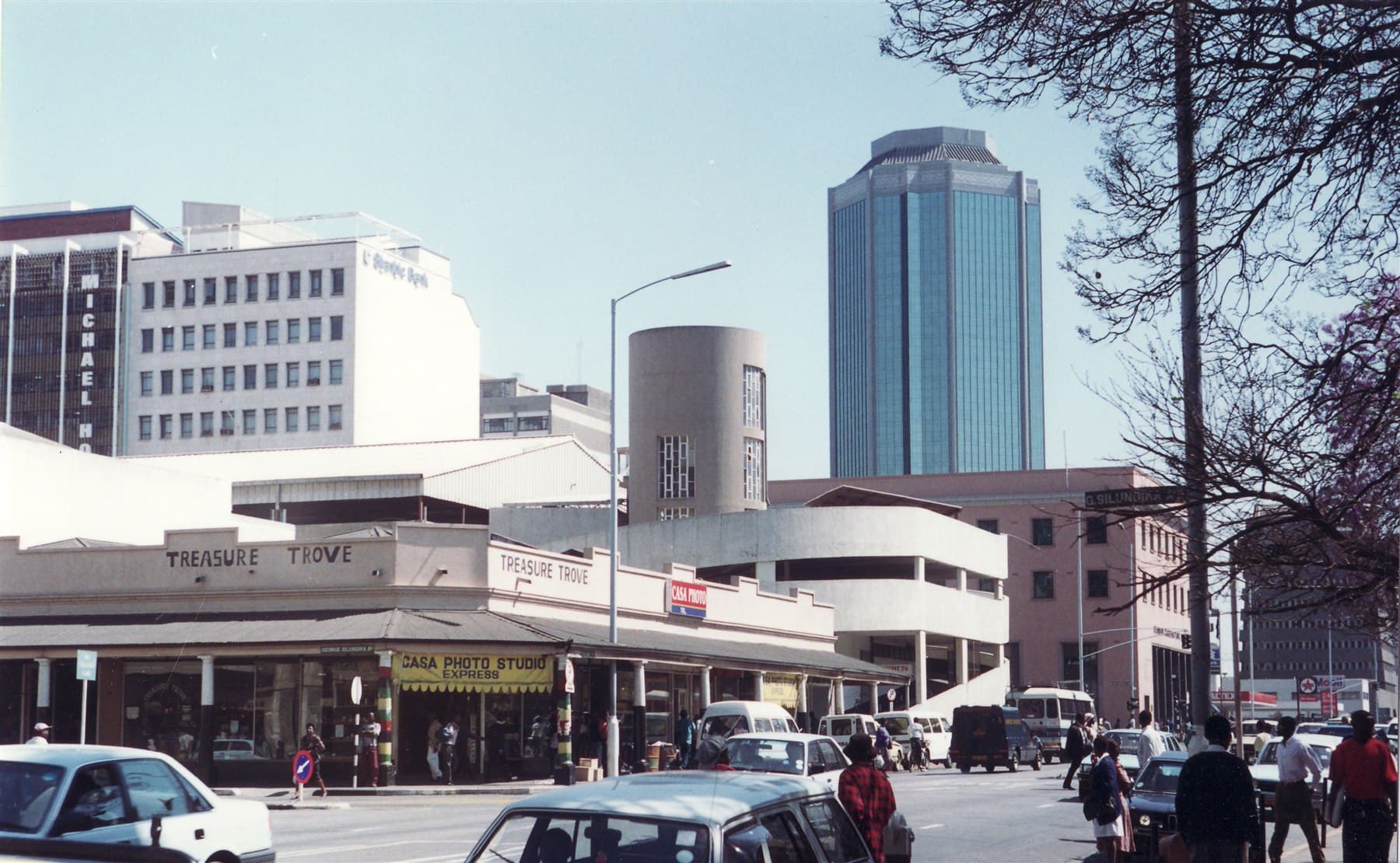
The main image shows central Harare in 1997, photographed by Damien Farrell and published under CC BY 2.0. Ariel School is near Ruwa, southeast of Harare. The photograph provides regional context only: it does not show the school, the 16 September 1994 event, any witness, object or alleged landing site. No rights-cleared authenticated event image or original event video was found for publication.