
Russia / 1986 / DISPUTED
Height 611 UFO incident
The event is documented publicly through later Soviet conference abstracts, press coverage and local institutional histories—not through an accessible police, military or Academy of Sciences case file. A 1988 Tomsk abstract by Valery Dvuzhilny and V. K. Zhuravlev describes witness reports of a bright, self-luminous ball with a trail, an apparent descent, about an hour of fire, and a later 2-by-2-metre collection site. A separate 1991 materials abstract says Dalnegorsk lead droplets and charred wood reached the Paton Institute in 1989, but it does not publish a continuous chain of custody or analyze the famous “mesh.” It also distinguishes an iron sphere from Kerch that later retellings sometimes fold into this case. Meteor, rocket or space debris, rare atmospheric phenomena and local industrial material remain possible at different stages; none is proved. The responsible status is C / DISPUTED, with no extraterrestrial conclusion.
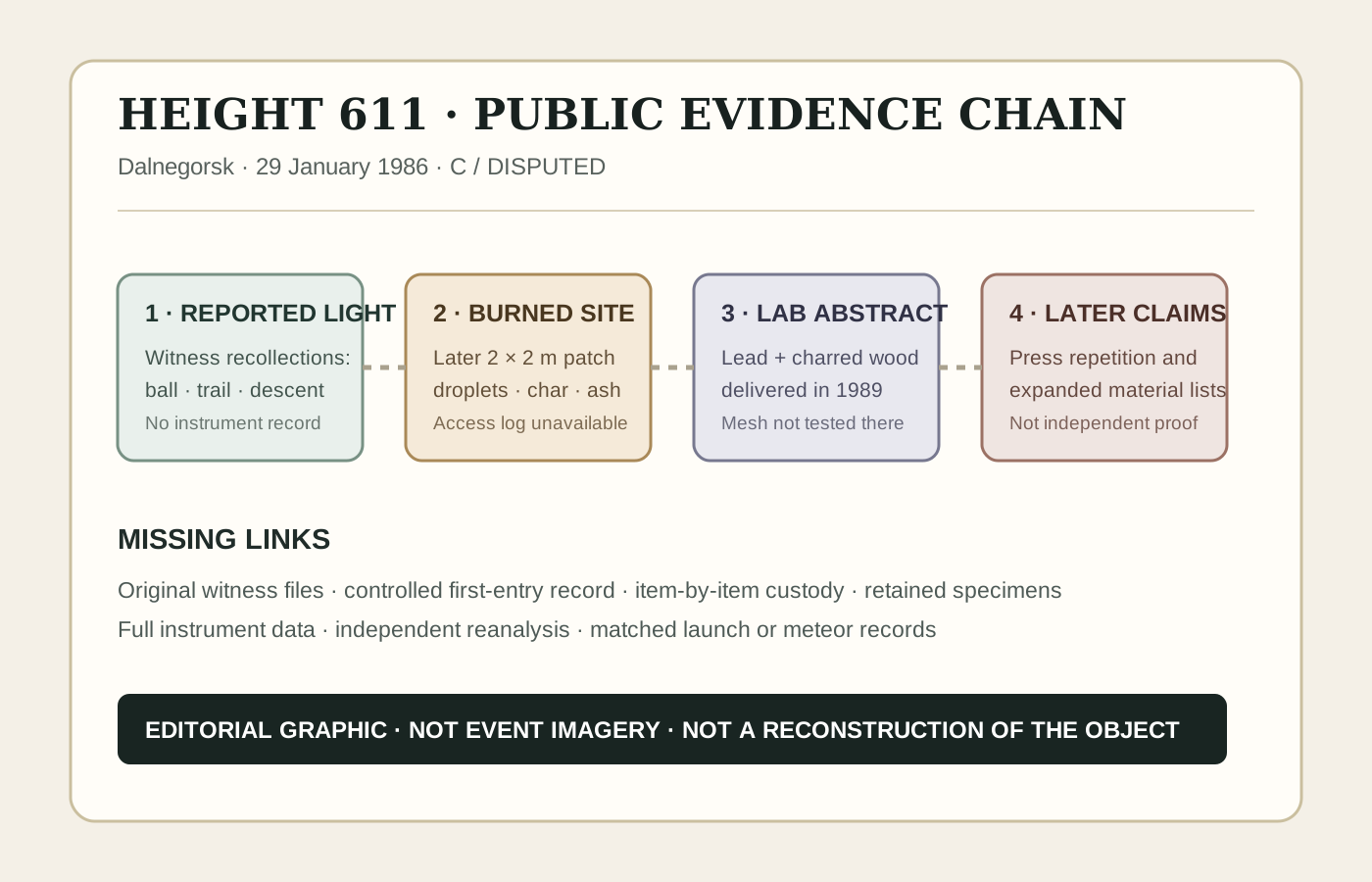
This case is disputed. The archive preserves the claims while separating evidence from interpretation.
- Documentation
- High documentation
- Primary location
- Dalnegorsk, Primorsky Krai
- Source base
- 7 linked records
- Research use
- Comparison case
What the public record supports
- Event anchor
- Later near-period records consistently place the report at about 19:55 on 29 January 1986 in Dalnegorsk.[1][5]
- Observation boundary
- The luminous ball, trail, descent and fire are witness reports; no public instrument record or original statement set was located.[1][5]
- Sample boundary
- The published custody chain begins with later collection and 1989 delivery; it does not prove that every item came from the reported object.[1][2]
- Laboratory boundary
- The Paton abstract analyzed Dalnegorsk lead and wood; its iron sphere came from Kerch and cannot be counted as Height 611 evidence.[2]
Case dossier
The firmest event anchor is 29 January 1986 at about 19: 55 in Dalnegorsk, then in the Russian SFSR of the Soviet Union. The 1988 Tomsk abstract calls the phenomenon a nocturnal bolide: witnesses described a bright self-luminous ball with a trail and an apparent final “dip” toward Hill 611, roughly one kilometre from the settlement. A later municipal-library history repeats a red ball, northeastward flight and very low estimated speed. Those details are reported recollections, not instrument measurements; no public original witness forms, names, viewing positions or synchronized statements were located.
The reported ground sequence is also indirect. The 1988 abstract says observers saw a fire for about an hour at the apparent descent point. An expedition later described a 2-by-2-metre patch near bedrock, black-grey ash, heat-marked rock and unusually porous charcoal. It reported metal droplets, glassy particles up to 30 milligrams and loose scale-like “mesh.” The public abstract does not state the exact first-entry time, who secured the site, whether other people visited it, how control samples were chosen or how each item was sealed and labelled.
The strongest identifiable laboratory publication has narrower scope than popular retellings. O. D. Smiyan, L. M. Kapitanchuk and S. O. Antonov wrote that objects collected in 1986–1988 were delivered to the E. O. Paton Electric Welding Institute in 1989. For Dalnegorsk they list partially melted lead droplets and four pieces of charred stump. Surface-analysis methods found layered contamination and many elements, but the authors said the lead droplets could in principle be made by known, though expensive, technology. They could not quantify the porous wood reliably. This is an exploratory conference abstract, not a replicated provenance study.
A major source error must be prevented. The same Paton abstract analyzes a 5.3-millimetre iron sphere, but explicitly says it came from the Kerch Peninsula, not Height 611. Its unusual hard surface and layered composition therefore cannot be used as Dalnegorsk evidence. The paper does not report testing the famous “mesh,” gold wire, glass beads or every item later attributed to the hill. Claims about those materials survive mainly through press summaries and Dvuzhilny’s later accounts, without a public specimen inventory tying each result to a sealed Height 611 sample.
Soviet publication history explains why the case became famous. Bibliographies identify a first Sotsialisticheskaya Industriya article on 5 April 1986, follow-ups in July 1988 and July 1989, and a local Trudovoye Slovo article in January 1989. A 22 November 1989 U.S. government media digest translated the Soviet press claims, including scientists studying “mesh,” spheres and glass and competing plasmoid and rocket explanations. Declassification records what Soviet media said; it is not a CIA laboratory validation or a Soviet government finding.
Institutional attention was mixed and incomplete. The 1988 abstract arose from an interdisciplinary technical seminar and called for further geological and geophysical work. The 1991 paper came from named Paton Institute researchers. A 1990 Moscow radio report described a Soviet-Chinese ufology meeting in Dalnegorsk. These facts show that researchers and organized groups examined claims. They do not establish that the USSR Academy of Sciences, a ministry, the military or a standing state commission authenticated an extraterrestrial vehicle; no public final case report from such a body was located.
The case remains worth archiving because it combines a reported aerial event, a claimed impact/fire sequence, physical-sample testing and a traceable glasnost-era publication trail. Its value is historical and methodological: it shows how an observation, an unsecured collection site, heterogeneous samples, exploratory analysis and press amplification can be compressed into a “crash” narrative. What would materially change the assessment is a contemporaneous witness file, launch and meteor records for the time window, a mapped collection log, retained specimens with custody documentation, full instrument data and independent reanalysis.
Timeline
- At about 19:55, residents reportedly saw a luminous body descend toward Hill 611; a hilltop fire or glow was reported afterward.
- A bibliographic record identifies the first Sotsialisticheskaya Industriiya article, “The Dalnegorsk Riddle”; the full article was not located for review.
- The Tomsk interdisciplinary seminar opened; Dvuzhilny and Zhuravlev’s abstract documented the reported flight, fire, collection site and competing hypotheses.
- Dalnegorsk’s Trudovoye Slovo published a local article on the event and sample claims, according to the municipal-library bibliography.
- Dalnegorsk lead droplets and charred wood collected during 1986–1988 were delivered to the Paton Institute, according to its later abstract.
- A U.S. government media digest summarized Soviet coverage, competing views and still-unresolved sample claims.
- Moscow Domestic Service reported a Soviet-Chinese ufology meeting in Dalnegorsk; this was research-group activity, not a final state finding.
- The Paton Institute materials abstract was published in the Tomsk seminar proceedings, separating Dalnegorsk lead and wood from an iron sphere from Kerch.
Height 611 questions
What happened at Height 611 in 1986?
Residents reportedly saw a luminous body descend toward the hill, followed by a prolonged glow or fire. Investigators later described a burned patch and collected small materials.
Did hundreds of named witnesses see a crash?
Later sources say many residents observed the light, but no public roster or original statement set establishes a precise count or that each person saw impact rather than a distant light.
Were extraterrestrial metals proved?
No. The traceable lab abstract analyzed lead droplets and charred wood, lacked a complete custody chain and said the lead could in principle be made by known technology.
What about the mesh and the iron sphere?
The reviewed Paton abstract does not analyze the mesh. Its iron sphere is explicitly from Kerch, so neither result can be silently presented as authenticated Height 611 material.
Did the Soviet government confirm a UFO crash?
No public final state report was located. Scientists, seminars, newspapers and ufology groups examined the claims, but attention is not authentication.
What are the leading conventional explanations?
Meteor or bolide, failed rocket or re-entry, rare atmospheric phenomena and industrial contamination each address part of the record. Missing primary data prevents choosing one conclusively.
Sources
- [1] ResearchThe Dalnegorsk Phenomenon — 1988 seminar abstractV. V. Dvuzhilny and V. K. Zhuravlev / Tomsk seminar transcript archive
- [2] ResearchBeam-diagnostic study of materials attributed to Height 611O. D. Smiyan, L. M. Kapitanchuk and S. O. Antonov / Paton Institute; Tomsk proceedings transcript
- [3] ArchiveUSSR media report: Dalnegorsk claims and competing explanationsU.S. government foreign-media digest, 22 November 1989 / public archive mirror
- [4] Archive1990 Moscow radio report on the Dalnegorsk research meetingCIA Reading Room / FBIS transcript of Moscow Domestic Service
- [5] ArchiveDalnegorsk municipal calendar and Height 611 bibliographyDalnegorsk Central City Library
- [6] ArchiveHeight 611 local museum overviewDalnegorsk Museum and Exhibition Center
- [7] Official fileOfficial geological context for the Dalnegorsk ore districtA. P. Karpinsky Russian Geological Research Institute
The displayed image is a site-authored evidence-boundary graphic. It is not event photography, a sample image, an official document scan or a reconstruction of the reported object.