
United States / 1987 / DISPUTED
Gulf Breeze UFO incident
The Gulf Breeze case began with building contractor Ed Walters's claim that he photographed a lighted object outside his Florida home on 11 November 1987. Five color instant photographs and an anonymous letter reached the Gulf Breeze Sentinel on 16 November; the weekly printed photographs on 19 November, and other residents then reported lights or objects. MUFON investigated and some of its analysts endorsed Walters, while CUFOS and Jet Propulsion Laboratory analyst Robert Nathan argued that the imagery showed features consistent with double exposure. In June 1990, a small foam-and-paper model resembling the photographed form was found in the attic of Walters's former house; newspaper experiments produced similar images. Walters denied making it and said it had been planted. The public record therefore establishes a major local reporting and photographic controversy, not a verified extraordinary craft.
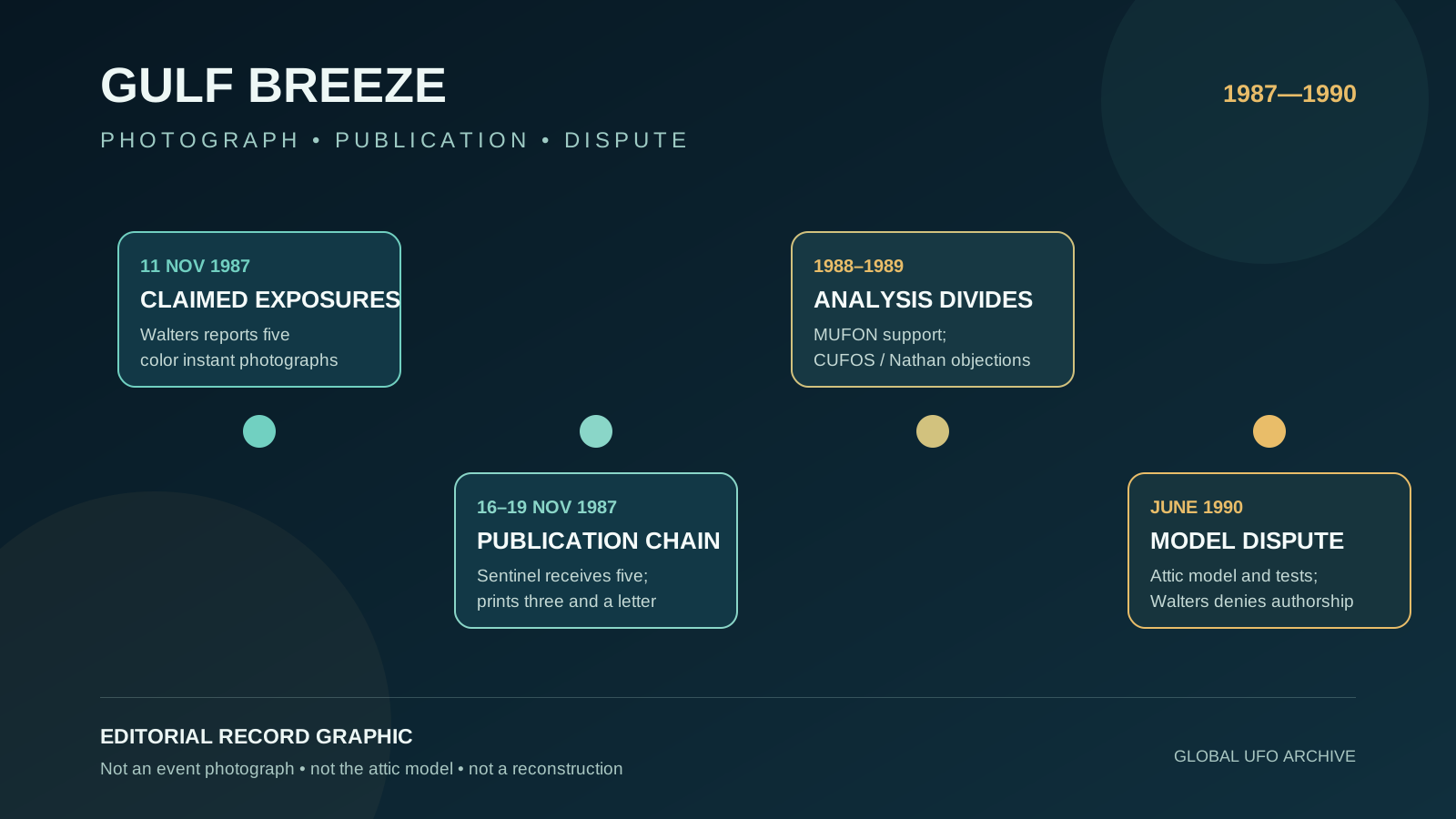
This case is disputed. The archive preserves the claims while separating evidence from interpretation.
- Documentation
- High documentation
- Primary location
- Gulf Breeze, Florida
- Source base
- 6 linked records
- Research use
- Comparison case
What the record establishes
- Documented start
- The Sentinel received five Polaroids on 16 November 1987 and published images on 19 November.[1]
- Photo dispute
- MUFON analysts endorsed the images; CUFOS and Robert Nathan raised double-exposure objections.[2]
- Model finding
- A foam-and-paper model resembling the pictured form was found in Walters's former house in 1990.[3][4]
Case dossier
The case has a precise publication trail, although the first encounter remains Walters's testimony. MUFON's March 1988 journal says Walters brought five color Polaroids and an anonymous letter to Sentinel editor Duane Cook on 16 November 1987. Cook printed three images and the letter in the 19 November issue. Those dates document delivery and publication; they do not independently prove that the claimed 11 November object was present when the film was exposed.
The photographs were not one homogeneous evidence set. The first images were instant color prints made with Walters's own Polaroid equipment. MUFON later supplied a four-lens Nimslo 3-D camera and discussed a paired Polaroid Sun 600 stereo rig intended to add distance information. The July 1988 MUFON account called the Nimslo and stereo material part of its continuing analysis, not a final authentication. Later critics also disputed whether exposure timing, camera control and the stereo baseline could be established from the images themselves.
The dispute was visible while the story was current. A January 1989 United Press International report described MUFON as accepting the pictures and CUFOS as rejecting that conclusion. It quoted Bruce Maccabee's view that the photographs were genuine, but also Robert Nathan's assessment that inconsistencies were typical of double exposure. The report further distinguished Walters's images from residents' separate sighting testimony: one layer does not automatically authenticate the other.
In June 1990, the evidentiary balance changed. A new occupant found a roughly nine-inch foam, paper and plastic model in the attic of the house Walters had occupied. Pensacola News Journal photographers used it in tests and produced pictures resembling examples published in Walters's book. The model's construction and location are documented by near-contemporary reporting; who made it and when it entered the attic were not established by a forensic chain of custody.
The responses must remain attached to the accusation. Los Angeles Times reporting in August 1990 said Walters argued that the model had been planted and could be shown to postdate his 1987 photographs. MUFON's own August account repeated his claim that drafting paper in the model came from a plan discarded in September 1989 and cited a client letter and stress-evaluator test. Those points record Walters's defense; they do not independently prove planting, and such tests do not authenticate photographs.
A separate allegation came from Tommy Smith, described as a former friend of Walters's son. Local officials said Smith told them he had seen model-and-double-exposure methods and had been asked to submit supporting pictures. Walters denied the allegation, and another youth disputed Smith's account in the Sentinel. Because no public court finding tested these competing statements, the dossier treats Smith's account as attributed testimony, not a proved confession by Walters.
The most careful conclusion is narrower than either campaign. People in the area did report unusual lights and objects, but their reports varied and do not establish that they saw the same source shown in Walters's photographs. The model and successful newspaper recreations make a small staged object a strong explanation for at least the signature images. Missing originals, incomplete custody and unresolved camera controls prevent a definitive frame-by-frame reconstruction, so the archival status remains C / disputed rather than confirmed or extraterrestrial.
Timeline
- Walters said he made the first five color instant photographs outside his Gulf Breeze home.
- Five Polaroids and an anonymous letter were delivered to Sentinel editor Duane Cook.
- The Gulf Breeze Sentinel published three images and the anonymous letter.
- MUFON began a four-part journal series while explicitly saying its investigation was not yet concluded.
- UPI reported the split between MUFON's favorable analysis and CUFOS/JPL objections.
- The Pensacola News Journal reported a foam-and-paper model found in Walters's former house and photographic recreation tests.
- The Los Angeles Times published a detailed account of the model, Smith allegation, local officials and Walters's denial.
Gulf Breeze questions
Was the Gulf Breeze UFO incident real?
The reports, publications and controversy are real. The public record does not verify that Walters photographed an extraordinary craft, so the case remains disputed.
What camera did Ed Walters use?
The first set was made as color Polaroid instant photographs with Walters's equipment. MUFON later introduced a four-lens Nimslo 3-D camera and a paired Polaroid Sun 600 stereo arrangement; those later controls did not establish custody for every image.
Did MUFON prove the photographs authentic?
No. Some MUFON investigators and Bruce Maccabee endorsed them, but CUFOS and Robert Nathan disagreed. MUFON is a civilian organization, and its 1988 series initially described an investigation still in progress.
What was found in Walters's former house?
A small foam, paper and plastic model resembling the photographed object was found in the attic in 1990. Newspaper tests made similar pictures, but the model's maker and placement date were not forensically established.
How did Ed Walters answer the model allegation?
He denied knowing or making it and argued it had been planted after his family moved. That defense is part of the record, but no independent public chain proves the planting claim.
Do other witnesses validate the Walters photographs?
They establish that other residents reported unusual things, not that every report had the same source or that they independently witnessed each exposure. Their testimony and the photographic chain must be evaluated separately.
Sources
- [1] ArchiveMUFON's March 1988 opening investigation reportMUFON UFO Journal
- [2] News reportUPI's January 1989 report on the expert splitUnited Press International
- [3] ArchiveMUFON's August 1990 account and Walters responseMUFON UFO Journal
- [4] News reportLos Angeles Times report on the model controversyLos Angeles Times
- [5] News reportPensacola News Journal's 30-year retrospectivePensacola News Journal
- [6] ArchiveMUFON's July 1988 camera and investigation updateMUFON UFO Journal
The hero is an original editorial record-chain graphic, not an event photograph. Walters's images and photographs of the discovered model are not copied because reuse rights are unclear; source pages are linked for research.