
United Kingdom / 1990 / DISPUTED
Calvine UFO photograph
The Calvine case concerns six photographs reportedly taken near Calvine, Perthshire, on 4 August 1990 and passed by the Daily Record through RAF press officer Craig Lindsay to the Ministry of Defence. Released files show that officials prepared press lines, reached no definite conclusion about the diamond-shaped object and were confident that the small aircraft was a Harrier, although they found no record of Harrier activity at the stated time and place. In 2022 Lindsay donated a print he had retained to Sheffield Hallam University. Andrew Robinson’s analysis found it consistent with the 1990 archive copies and with a photographed scene rather than negative or print compositing. The print itself cannot establish date, location, distance or authorship, and it cannot exclude a small model or another construction in front of the camera. The witnesses remain unidentified and the original negatives are unavailable publicly. The correct status is disputed, not proof of an extraordinary aircraft.
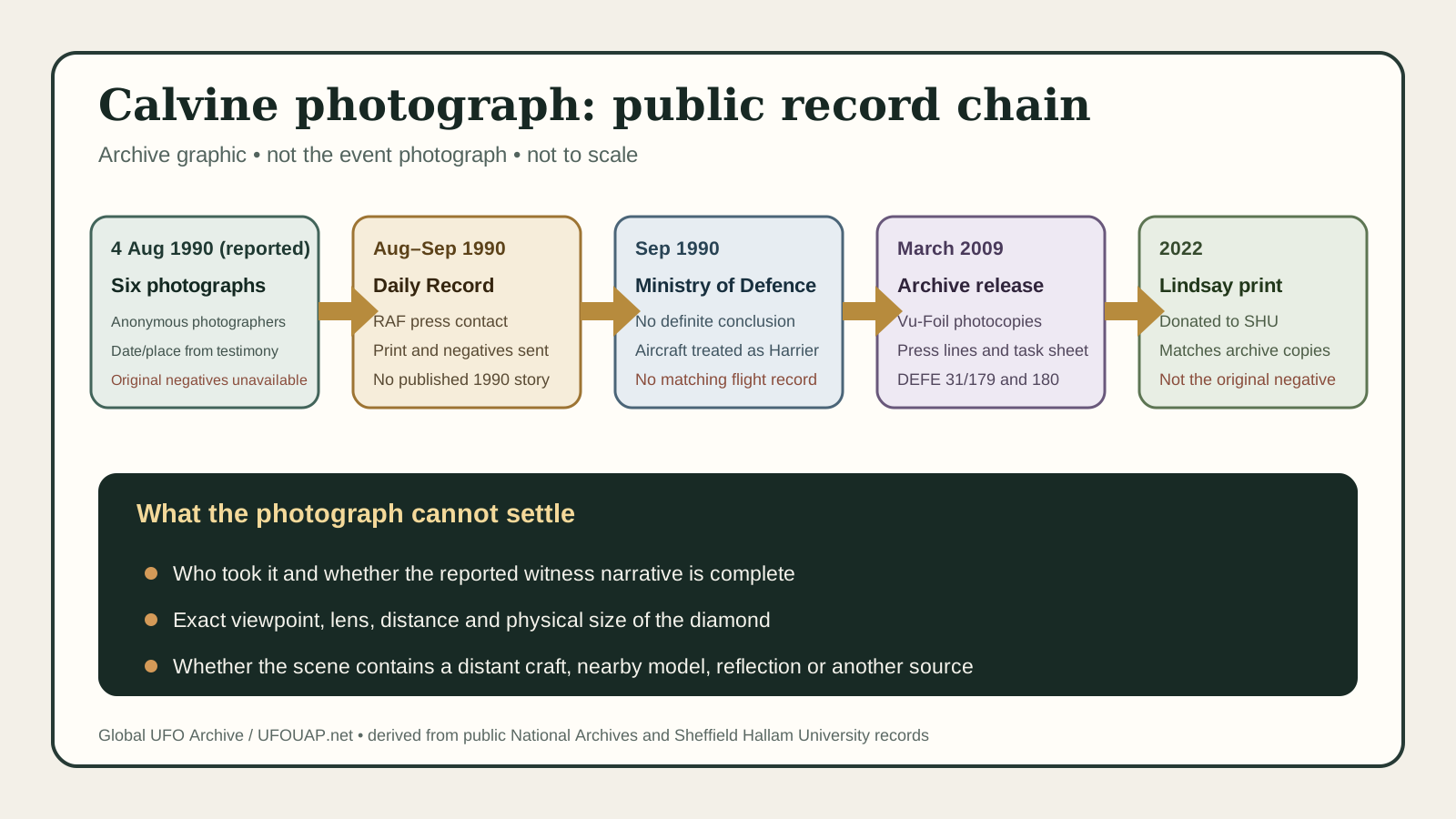
This case is disputed. The archive preserves the claims while separating evidence from interpretation.
- Documentation
- High documentation
- Primary location
- Calvine, Perthshire, Scotland
- Source base
- 6 linked records
- Research use
- Comparison case
What the Calvine record establishes
- What is documented
- MoD files contain Calvine photocopies, internal handling notes and prepared press lines.[1]
- Witness boundary
- The two reported photographers remain unidentified and have not publicly authenticated the account.[2][3]
- Print finding
- The print is consistent with the 1990 copies and shows no detected negative or print compositing.[2]
- What that cannot prove
- A coherent print does not establish distance, physical size, flight or an extraordinary origin.[2]
Case dossier
Two reported photographers, no authenticated public testimony
The event survives first as a reported chain, not as a named witness statement. Two men were said to have photographed a silent diamond-shaped object near Calvine on the evening of 4 August 1990, with a jet also visible. Later accounts identify them as young employees of Fisher’s Hotel in Pitlochry, but neither man has publicly verified the story. The date, place, duration and dramatic vertical departure come through Craig Lindsay’s recollection of a telephone interview and later reporting; they are not recoverable from the surviving print itself. [3] · [4]
Following the negatives through September 1990
The Daily Record received six prints and contacted Lindsay at RAF Pitreavie Castle. Lindsay says he forwarded the clearest print, interviewed one witness at MoD request and then obtained the remaining photographs and negatives for the ministry. The released record shows material reaching the MoD by 10 September and a request for camera and lens details. Robinson reads the file as indicating that the negatives were returned to the newspaper on 14 September. Public sources do not provide a complete receipt-by-receipt chain after that date, so claims that the MoD still holds or destroyed the originals are not established. [2] PDF pp. 33–34 · [3]
What the prepared MoD response established
The official paper trail is narrower than the legend. The National Archives highlights guide points to DEFE 31/179 and DEFE 31/180: officials prepared defensive press lines, recorded that no definite conclusion had been reached about the large diamond and treated the small aircraft as a Harrier. The same press line says no Harrier operation was recorded at the stated location and time and no other unusual activity or sighting was reported. ‘Special handling’ in a task sheet records sensitivity, not the nature of the object. [1] PDF pp. 4–5 · [2]
The narrower scope of the 2026 archive reply
A March 2026 National Archives reply addresses retention paperwork rather than the photographed object. Request CAS-318549 asked for Calvine-specific retention authorisations, 2010–2026 transfer correspondence and matching accessioning entries. The archive reported holding no information meeting those criteria. This does not establish where the negatives are, whether another institution has material, or what the photograph depicts. It also does not substantiate a claim that the archive has confirmed a special withholding order. The request’s description of purported records must not be mistaken for the archive acknowledging their possession. [6]
Matching the Lindsay print to the older copies
The surviving Lindsay print re-entered the record through a separate route. Clarke located Lindsay in 2019; Lindsay later found the print stored in a book and donated it with its envelope and fax photocopies to Sheffield Hallam University in 2022. Robinson dates the donation to June, while Clarke’s publication note says July. Robinson compared repeated marks and the aircraft blur across the print, Lindsay’s fax copy and the archive Vu-Foil photocopies. Their alignment strongly supports that this is a copy of one of the photographs handled in 1990. It does not turn the print into the original negative or supply missing metadata. [2] · [4]
A monochrome image on colour paper
Robinson’s physical examination distinguishes the surviving paper print from the original exposure. Its monochrome image sits on colour photographic paper, whereas contemporary documentation describes colour photographs. He proposes a newspaper copy-negative stage to reconcile them. Paper markings, abrasion and printer codes inform that reconstruction, but no recovered original negative confirms the precise copying sequence. His discussion also leaves cropping unresolved. These details explain why scanning the surviving print at higher resolution cannot restore an unknown original frame, camera setting or colour record. [2] PDF pp. 6–12
Photographic coherence does not establish scale
Robinson found consistent film grain and no sign of negative- or print-based compositing. That conclusion is often shortened misleadingly to ‘the UFO is authentic’. It means the available print records a scene placed before the camera. It cannot decide whether the diamond was distant and large or nearby and small. His size estimates require assumed lens, aircraft identity and placement of the object between fence and jet. Without an independently known distance, apparent size cannot yield physical size. [2] PDF pp. 13–20
Three assumed distances, three calculated sizes
The report’s geometry makes the distance assumption visible. Placing the object 33%, 50% or 66% of the way between the fence and the presumed jet gives calculated lengths of about 20.6, 30.4 or 40.3 metres. These are alternative placements, not three independent measurements. The quoted uncertainty around a chosen calculation cannot supply the missing depth or verify the assumed aircraft and lens. A particular large result therefore should not be presented as a measured minimum that independently excludes a nearby model. [2] PDF pp. 23–24
A Harrier interpretation without a matched flight
The Harrier narrative has two levels. The 1990 ministerial line expressed confidence that the aircraft was a Harrier while noting no matching operation record. Robinson says the blurred silhouette is consistent with a Harrier but cannot be identified conclusively. A Harrier therefore remains a supported interpretation, not a verified flight. The presence of a military-looking aircraft also does not show that it was chasing, escorting or inspecting the diamond; that relationship comes from the reported witness story. [1] PDF pp. 4–5 · [2]
Model and reflection proposals remain tests
Conventional proposals include a suspended model or ornament, a reflection over water and an unknown aircraft. The lake-reflection proposal changes the orientation of the whole scene and Robinson considers it unlikely, but the exact viewpoint remains unconfirmed. A five-point Christmas-star test shows a plausible way to create a similar foreground silhouette; it is an experiment, not proof that this prop was used. The most defensible conclusion is limited: the print belongs to the 1990 Calvine record and appears photographically coherent, while object identity, scale and witness provenance remain unresolved. [2] PDF pp. 21–23 · [5]
Related checks and records
- Salem 1952: a photograph and changing official explanations
Compare the signed statements with the initial double-exposure assessment and later window-reflection interpretation.
- Solway: a family photograph and the limits of later claims
- Lake Cote: negatives, copies and a disputed photograph
- Mariana: film custody and aircraft-reflection tests
Timeline
- Reported date of the Calvine sighting and six photographs; the print itself does not verify the date.
- The released MoD chronology places the photographs and negatives with the ministry by this date.
- The file, as read in Robinson’s report, indicates that the negatives were returned to the Daily Record.
- The National Archives released files containing poor Vu-Foil photocopies and ministerial press lines.
- David Clarke located former RAF press officer Craig Lindsay.
- Lindsay donated the surviving print and related material to Sheffield Hallam University; Robinson dates this to June, while Clarke’s publication note says July.
- Andrew Robinson issued version 5 of his photographic analysis, retaining major limits on identity and scale.
Calvine photograph questions
Is the Calvine photograph genuine?
The surviving print is a genuine period photographic object matching the 1990 archive copies. That does not authenticate the witness story or identify the diamond.
Who took the Calvine photographs?
The photographers have not been reliably identified. A name written on the print led to a former hotel worker who denied involvement.
Did the MoD identify the diamond?
No released record gives a definite identification. The official press line said no definite conclusion had been reached.
Was the aircraft definitely a Harrier?
Officials were confident and the silhouette is consistent, but image resolution prevents certainty and no matching operation record was found.
Could the object be a model or reflection?
Both are proposed. A nearby model remains compatible with unknown scale; the reflection reading has viewpoint and surface problems. Neither is demonstrated.
Why is the famous photograph not shown here?
Its visible copyright notice and repository licence do not provide clear commercial republication permission. This page uses an original archive graphic instead.
Sources
- [1] Official fileMarch 2009 UFO files highlights guideThe National Archives
- [2] ResearchPhotographic analysis of the Calvine print, version 5Sheffield Hallam University Research Archive / Andrew Robinson
- [3] News reportWhat really happened in Calvine?The Guardian
- [4] ResearchThe Calvine UFO photograph – revealedDr David Clarke
- [5] ResearchThe Calvine UFO photo: a Christmas star?Wim van Utrecht
- [6] Official fileFOI response on Calvine retention instrumentsThe National Archives
The displayed image is an original site-authored archive graphic, not the Calvine photograph, an MoD facsimile, a reconstruction or object evidence. The famous print is not reproduced because no clear commercial republication permission was found.