
Brazil / 1966 / UNRESOLVED
Lead Masks case
The Lead Masks case is a real unresolved-death investigation, not a verified UFO encounter. Contemporary Brazilian reports identify electronics technicians Miguel José Viana and Manuel Pereira da Cruz, trace their movements in Niterói on 17 August 1966, and describe their bodies on Morro do Vintém with lead eye masks, raincoats, a water bottle and notes referring to a capsule, protecting metals and awaiting a mask signal. Reports said there was no visible violence, while later coverage still recorded the cause of death as unknown. The notes and the men’s earlier experiments support the inference that they expected some kind of planned test; they do not reveal what the capsule contained, whether anyone else participated or what killed them. Spiritist, poisoning, robbery and technical-accident theories circulated immediately. A reported luminous object helped move the case into UFO culture, but no public police file, original toxicology record or event image reviewed here verifies an anomalous craft or extraterrestrial cause.
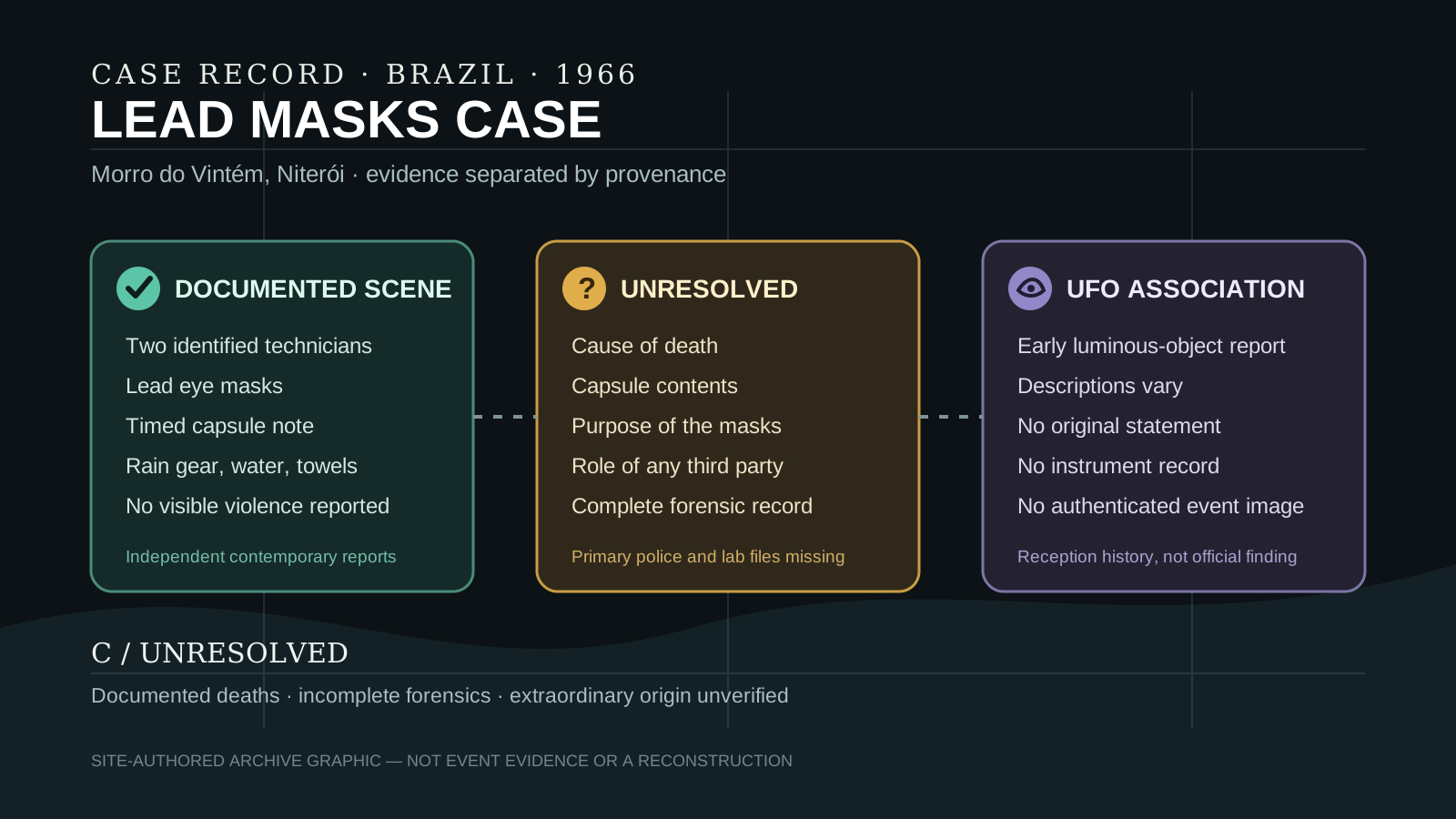
This case remains unresolved in the public record, with credibility grade C.
- Documentation
- High documentation
- Primary location
- Morro do Vintém, Niterói, Rio de Janeiro
- Source base
- 5 linked records
- Research use
- Comparison case
What the record supports
- Confirmed scene
- Two identified technicians were found dead with lead eye masks, notes, rain gear and water.[1][2][3]
- Cause of death
- It remained undetermined in the reviewed reporting; the primary forensic file was not obtained.[1][4]
- Planned action
- The timed note and masks support preparation for an experiment involving a capsule.[2][3]
Case dossier
Miguel José Viana, 34, and Manuel Pereira da Cruz, 32, were electronics technicians from Campos dos Goytacazes. Contemporary magazine accounts say they left on 17 August, telling family they were travelling for work materials or a vehicle. Police reconstructed stops in Niterói: shops, a hardware or electronics contact, raincoat purchases and a bottle of mineral water near the route to Morro do Vintém. Times and shop details differ slightly between reports, so the stable point is their presence in Niterói that afternoon, not every minute of a later reconstruction.
On 20 August, reporting says the bodies were located near the summit of Morro do Vintém after a young person alerted authorities. They lay close together, were already decomposing and showed no visible signs of physical attack. Accounts consistently describe suits, rain protection, an empty water bottle, towels, personal effects and crude lead pieces shaped to cover the eyes. The objects establish an unusual prepared scene, but the public photographs and descriptions do not reveal the physiological mechanism of death.
One note was printed with variants in the contemporary press, but its stable sequence directs the men to be at a set place around 16:30, ingest a capsule around 18:30, protect metals and await a mask signal. Other papers included routine electronics formulae and valve references. The note is strong evidence of a planned action involving a swallowed substance and the masks. It is not a confession, a laboratory result or proof that the instructions came from a third party; later accounts disagreed about handwriting and wording.
The technical-experiment narrative did not appear decades later. September 1966 features attributed to relatives and associates said the men had worked with electronics, lead and explosive or luminous tests before the deaths. The same articles connected Miguel and an associate with spiritist interests. That supports a broad conclusion that technical practice and religious or paranormal expectation may have overlapped in the men’s plans. It does not establish a functioning communication device, a defined ritual, or the claim that either belief system caused their deaths.
Forensics define the limit of the case. The 27 August paper reported no physical violence and said a second doctor confirmed the first review, but that is press wording rather than the underlying autopsy. A 1968 magazine review quoted the cadaver report as ‘cause of death unknown’ and described renewed investigation, exhumation and more tests. Because the original autopsy, chain-of-custody forms, full toxicology scope and laboratory results were not available here, ‘no poison was found’ cannot be converted into ‘poisoning was excluded.’ Decomposition and the incomplete surviving record leave poisoning, medical event and other mechanisms unresolved.
The UFO connection also began early, but as testimony and speculation. On 27 August, Luta Democrática reported that Gracinda Barbosa Coutinho de Souza, her children and another witness had told authorities of a bluish oval object over the area on the probable date of death. O Cruzeiro soon printed a somewhat different description and framed extraterrestrial rays and interplanetary signals among several sensational hypotheses. The witnesses’ report is evidence that an unusual light story entered the investigation; inconsistent descriptions, no original statements, no instrument data and no authenticated image prevent it from identifying a craft or linking it causally to the deaths.
Later television, books and UFO literature made the masks a visual shorthand for alien contact. That reception history explains why the case belongs in a UFO/UAP archive, but it must not be projected backward as an official conclusion. The most defensible reading is narrower: two men prepared for an unusual experiment, died by an undetermined mechanism, and left evidence too incomplete to choose among accident, ingestion, third-party action or medical causes. The luminous-object testimony remains an adjacent, uncorroborated strand.
Timeline
- Viana and Pereira da Cruz travelled from Campos dos Goytacazes to Niterói, visited shops, bought rain protection and mineral water, and headed toward Morro do Vintém.
- Authorities were alerted to two bodies near the summit; the scene included lead eye masks, notes, rain gear, towels and a water bottle.
- Luta Democrática reported no visible violence, continuing forensic and police tests, and attributed a bluish oval-object report to local witnesses.
- Manchete published a detailed reconstruction, the capsule-and-mask instructions and attributed accounts of earlier technical and spiritist interests.
- O Cruzeiro documented the competing robbery, poisoning, electronics, spiritist and flying-saucer hypotheses while stating that the cause was still unknown.
- O Cruzeiro’s review still quoted the cause of death as unknown and described renewed investigation, exhumation and additional testing.
Questions about the Lead Masks case
What was the Lead Masks case?
It was the unresolved 1966 deaths of electronics technicians Miguel José Viana and Manuel Pereira da Cruz on Morro do Vintém in Niterói, with lead eye masks, notes and other prepared items at the scene.
What did the note say?
Contemporary versions direct arrival at a set place around 16:30, capsule ingestion around 18:30, protection of metals and waiting for a mask signal; exact wording varies by publication.
Was the cause of death poisoning?
It is plausible because a capsule was mentioned, but it was not established. The primary toxicology record was unavailable, and later reporting retained an undetermined cause.
Were the men conducting a spiritist experiment?
Contemporary relatives and associates described technical experiments and spiritist interests, so a combined experiment is a reasonable purpose hypothesis. No surviving primary plan defines the ritual or apparatus.
Was a UFO seen over Morro do Vintém?
Newspapers attributed an unusual luminous or oval object report to local witnesses, but descriptions vary and no original statement, instrument record or authenticated image was located.
Why is the case in a UFO archive?
The early luminous-object story and later alien-contact interpretations made it part of UFO culture. The archive preserves that reception history while separating it from the better-documented police mystery.
Sources
- [1] News reportThe mystery of Vintém Hill deepensLuta Democrática / Hemeroteca Digital Brasileira
- [2] News reportThe enigma of the lead masksManchete (third-party scan transcription)
- [3] News reportThe mystery of the masked deadO Cruzeiro (third-party scan transcription)
- [4] News reportThe Lead Masks mystery — 1968 reviewO Cruzeiro (third-party scan transcription)
- [5] News reportLinha Direta Justiça — Lead Masks case participantsRede Globo
The hero is a site-authored evidence-layer graphic, not a crime-scene image or reconstruction. Third-party press photographs and television frames are linked, not copied.