
United States / 1957 / UNRESOLVED
1957 RB-47 radar-visual UFO incident
In the early hours of 17 July 1957, an RB-47H electronic-reconnaissance crew reported a sequence of bright lights and radar-like emissions while flying from Mississippi through Louisiana and Texas. A contemporary Air Force summary also records a brief ground-radar contact near Fort Worth. The case is stronger than a lone visual report because official messages and crew questionnaires survive, but it remains unresolved rather than extraordinary proof: no raw radar film, continuous electronic recording or authenticated photograph of the reported source is public.
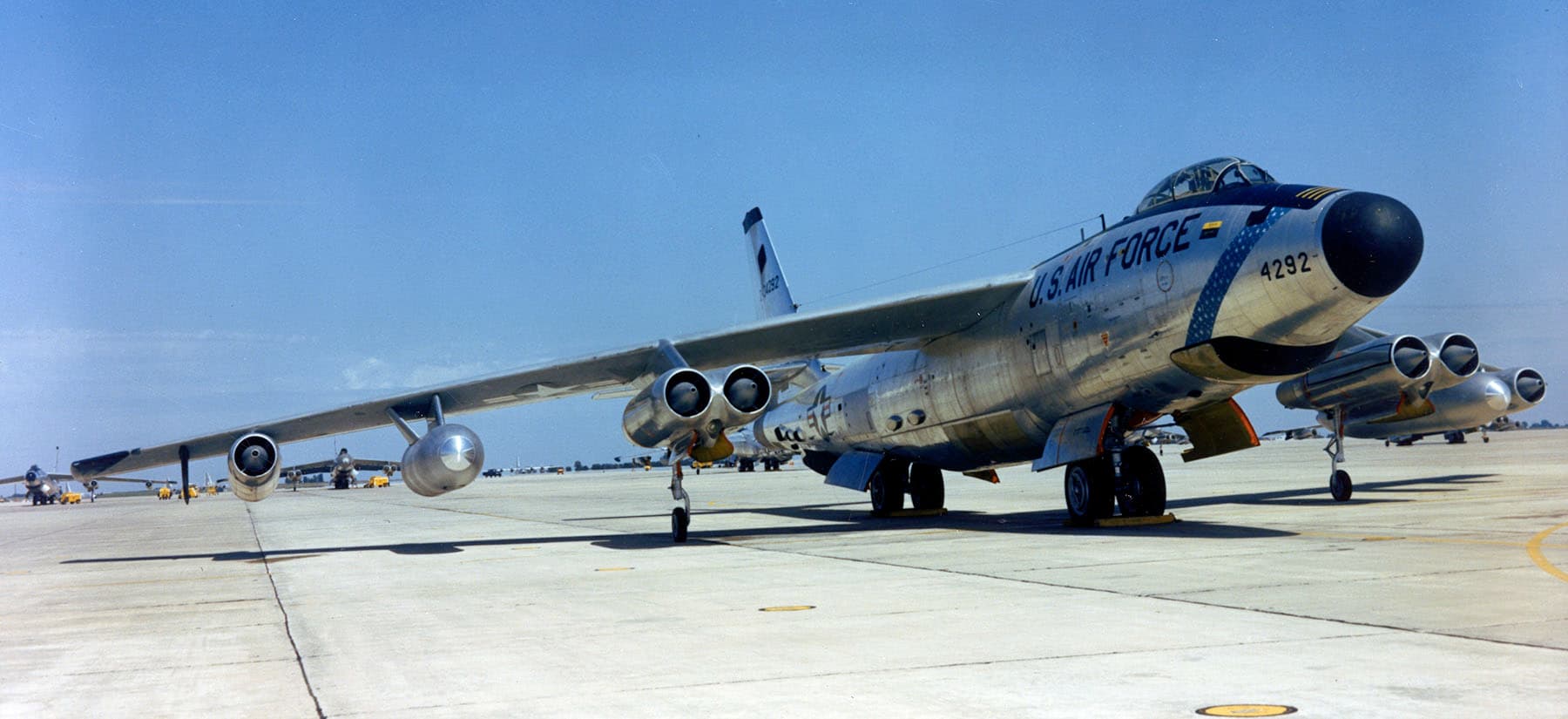
This case remains unresolved in the public record, with credibility grade B.
- Documentation
- High documentation
- Primary location
- Mississippi, Louisiana, Texas and southern Oklahoma
- Source base
- 5 linked records
- Research use
- Comparison case
What the public record establishes
- Confirmed date
- The event occurred on 17 July 1957, not 19–20 September. The later September date came from an error in the Colorado study.[1][2][3]
- Surviving records
- A same-day squadron message, wing intelligence summary and observer questionnaires document the reported sequence.[1][2]
- Sensor boundary
- The airborne system was a passive direction finder, not a ranging radar; the ground-radar claim survives only as written reporting.[1][2]
Official case-file documents
Case dossier
Mission and crew. The RB-47H belonged to the 55th Strategic Reconnaissance Wing and was flying a composite training mission from Forbes Air Force Base. The six officers were aircraft commander Lewis D. Chase, copilot James H. McCoid, navigator Thomas H. Hanley and electronic-warfare officers John J. Provenzano, Frank B. McClure and Walter A. Tuchscherer. Their roles matter because the visual and electronic reports came from different stations aboard the same aircraft, not from a single observer retelling one impression.
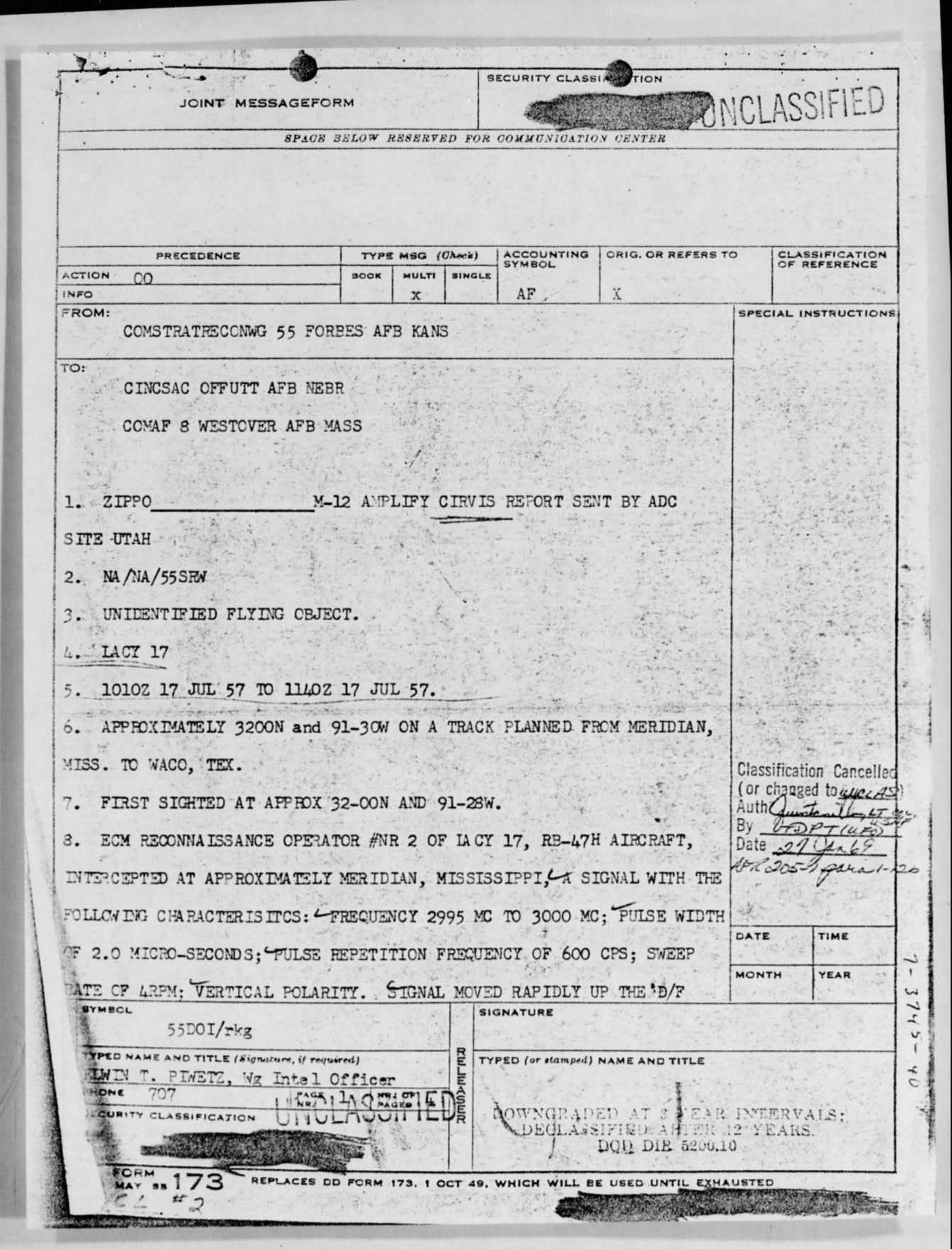
First electronic detection. Near the Meridian-Gulfport area, McClure's number-two monitor received a radar-like signal around 2,995–3,000 MHz, with a roughly two-microsecond pulse, about 600 pulses per second and an apparent four-rpm sweep. The equipment was a passive direction-finding receiver: it listened for an emitter and displayed relative bearing, but it did not measure a target's range or produce a conventional radar echo. That distinction limits what the signal alone can prove.
First visual report. At 1010Z near Winnsboro, Louisiana, Chase and McCoid reported an intense white light with a blue tint crossing from about the aircraft's eleven-o'clock position to roughly two-thirty before vanishing. After Chase alerted the electronic-warfare crew, the receivers found a strong signal in approximately the same relative sector. The written record supports a reported temporal and directional correlation; it does not establish that the light and radio-frequency emission necessarily came from one object.
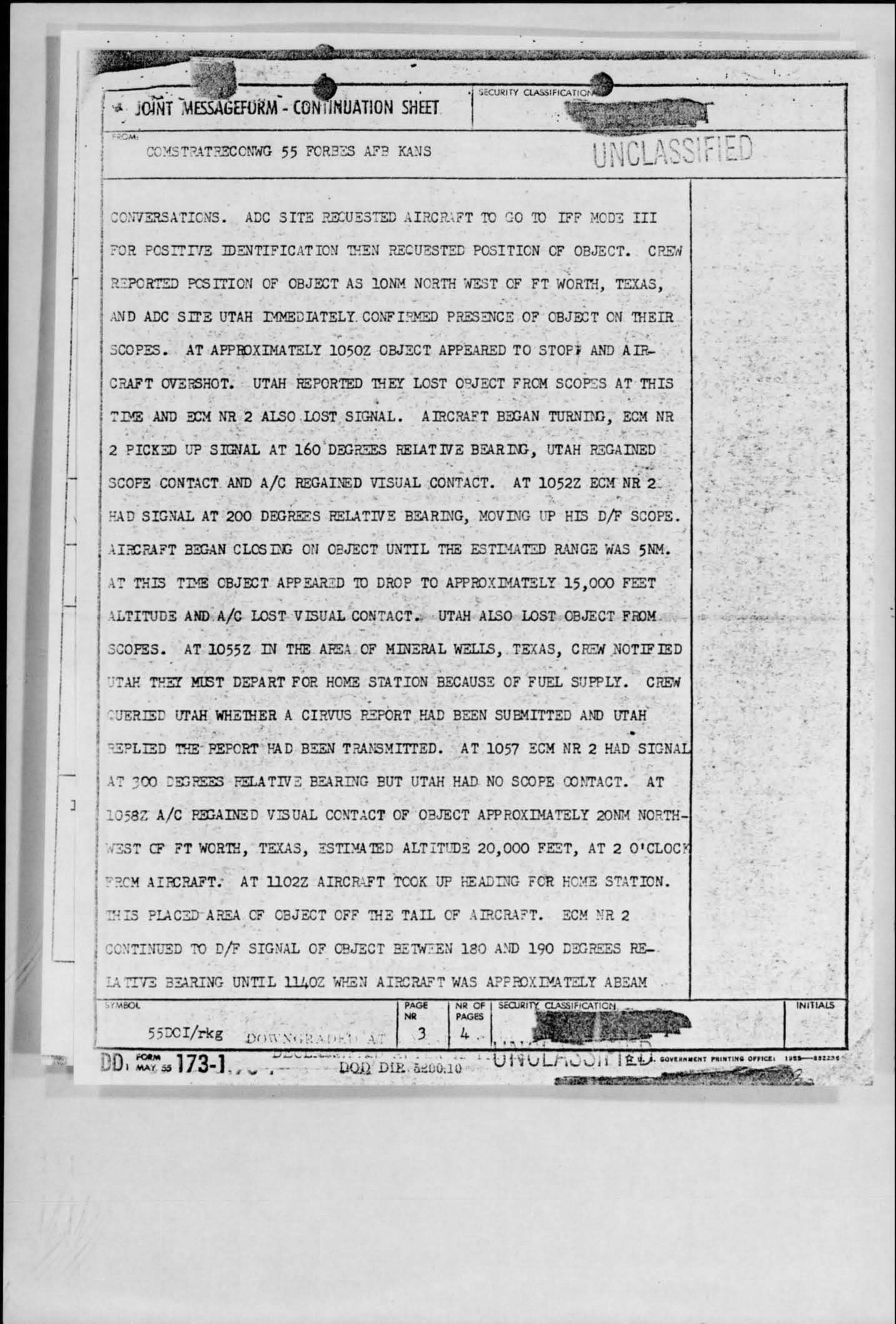
Texas phase and ground radar. Farther west, the crew reported a red light ahead while the passive receiver logged changing bearings. Chase contacted the 745th Aircraft Control and Warning Squadron at Duncanville, call sign Utah, and received permission to leave the flight plan and investigate. The contemporary wing summary states that Utah confirmed an object on its scopes northwest of Fort Worth and that visual, electronic and ground-radar contacts were lost and later reacquired during turns. Those correlations are preserved in typed reports, not in publicly available scope film or raw tracking data.
End of the encounter and surviving paperwork. Fuel requirements ended the investigation near Mineral Wells, although later visual and electronic contacts were still reported on the northbound leg. The surviving file includes a three-page message filed by the Duncanville squadron, a four-page intelligence summary prepared by the 55th Wing, observer questionnaires and later analysis. These records establish that the Air Force processed the incident; they do not preserve every operational exchange or instrument output.
The Condon date error. When the University of Colorado team revisited the case about a decade later, it initially worked from an incorrect fall 1957 date and could not locate the Air Force file. Case 5 therefore relied heavily on delayed crew recollections and concluded that the available descriptions were inadequate for identification. The error matters because weather and radar-propagation work performed for 19 September could not test an event that occurred on 17 July.
McDonald's reconstruction and its limits. Atmospheric physicist James E. McDonald later found the file, interviewed crew members and published a detailed reconstruction in the American Institute of Aeronautics and Astronautics journal in 1971. Aircraft commander Chase confirmed that account to the AIAA subcommittee. The paper is valuable because it quotes contemporary records and corrects the date, but its conclusions remain a later scientific interpretation rather than an Air Force finding.
Why the case remains unresolved. Later testimony conflicts over whether film, wire recordings or other instrument records ever existed: Chase remembered intelligence personnel collecting material, while McCoid and McClure said the aircraft carried no such recording media. Skeptical proposals include reception of ordinary ground radar, switching or relay effects, aircraft lights and mistaken correlation of separate events. None can be tested against a complete raw dataset. The defensible status is therefore unresolved, credibility B: unusually well documented as a report, but unable to identify the reported source or establish exotic technology.
Timeline
- Near Meridian-Gulfport, the number-two ECM monitor receives a radar-like signal near 3,000 MHz.
- Chase and McCoid report an intense white-blue light crossing ahead near Winnsboro, Louisiana.
- The passive receiver logs the roughly 3,000 MHz signal at changing relative bearings while the aircraft continues west.
- The crew reports a red light, contacts Duncanville's Utah site and receives permission to investigate off the flight plan.
- The wing summary says Utah confirms an object northwest of Fort Worth; visual, electronic and radar contacts are then reported lost.
- During a turn, the summary reports renewed visual, electronic and ground-radar contact before another loss near Mineral Wells.
- The 745th Aircraft Control and Warning Squadron files a three-page message about the incident.
- Project Blue Book receives summary information; its file later carries an airliner identification tied to a separate Dallas-Fort Worth report.
- The Colorado UFO study interviews crew members but, working from the wrong date, does not locate the Air Force case file.
- AIAA publishes McDonald's reconstruction, correcting the date to 17 July and quoting the recovered contemporary records.
Frequently asked questions
What happened in the 1957 RB-47 incident?
A six-officer electronic-reconnaissance crew reported bright lights, radar-like emissions detected by passive receivers and a brief ground-radar contact while flying across the south-central United States on 17 July 1957.
Did the RB-47 incident happen in September 1957?
No. Contemporary files and the 1971 AIAA review place it on 17 July 1957. The September date was an error used during the Colorado investigation and in later retellings.
What did the RB-47 electronic equipment detect?
Passive monitors detected a radar-like emission near 3,000 MHz and displayed its relative bearing. They did not measure range, altitude, size or shape, so the signal cannot by itself identify a craft.
Did ground radar track the reported object?
A contemporary Air Force summary says the Duncanville site confirmed, lost and reacquired a contact near the crew's reported position. No raw scope film or track data is public, so that written account cannot be independently reconstructed.
Is there an original RB-47 UFO video or photograph?
No authenticated image of the reported source is public. The aircraft photograph on this page is later type context, and the document images are scans of the case file, not photographs of the object.
Did Project Blue Book explain the RB-47 case as an airliner?
The file carried an American Airlines Flight 655 label, but the recovered record indicates that identification referred to a separate Dallas-Fort Worth airliner report. It does not by itself resolve the full earlier visual and electronic sequence.
Does the RB-47 incident prove extraterrestrial technology?
No. It is a well-documented unresolved report, but missing raw data and uncertain correlations prevent identification of the source, its performance or its origin.
Sources
- [1] ArchiveProject Blue Book file: RB-47, 17 July 1957U.S. Air Force / Project Blue Book
- [2] ResearchAir Force observations of an unidentified object, 17 July 1957James E. McDonald / American Institute of Aeronautics and Astronautics
- [3] ResearchCondon Report Case 5: RB-47 crew interviewsUniversity of Colorado UFO Project / NCAS reproduction
- [4] Official fileProject Blue Book records at the National ArchivesU.S. National Archives and Records Administration
- [5] ArchiveU.S. Air Force RB-47H StratojetsUnited States Air Force / Wikimedia Commons
The main photograph shows RB-47H aircraft in approximately 1965 and is aircraft-type context, not an image of the 1957 flight or reported light. The supplementary pages are public-domain Air Force case-file scans. No authenticated event photograph, original video, radar-scope film or continuous ECM recording is publicly available.