United States / 1952 / DISPUTED
1952 Washington, D.C., UFO Radar Incidents
On 19-20 and 26-27 July 1952, air-traffic and military radar operators around Washington National Airport and Andrews Air Force Base reported intermittent unidentified returns while pilots and ground observers described unusual lights. Fighters were dispatched during the second weekend, but the surviving Project Blue Book file does not document one object tracked continuously across every radar, visual report and interception. Contemporary records distinguish strong, aircraft-like returns from later weak or unstable echoes and note that interceptor reports and many witness details were missing. The Air Force emphasized temperature inversions and radar propagation; a 1953 Civil Aeronautics Administration study showed that refracting layers could produce comparable false targets, although its Washington tests focused on August observations rather than reconstructing every July report. The incidents are historically important and genuinely documented, but the public record supports a disputed radar-visual episode, not proof of an extraordinary craft over the capital.
This case is disputed. The archive preserves the claims while separating evidence from interpretation.
- Documentation
- High documentation
- Primary location
- Washington, D.C.
- Source base
- 8 linked records
- Research use
- Comparison case
What the surviving record supports
- Confirmed event
- Official files document two July weekends of radar and visual reports around Washington-area aviation facilities.[1][2]
- Operational response
- Controllers reported strong returns, pilots described lights and two F-94 interceptors were dispatched on 26 July.[2]
- Record limit
- The case file says official interceptor reports and many follow-up witness details were unavailable to investigators.[2][4]
Project Blue Book archive graphic
Case dossier
Case scope: On 19-20 and 26-27 July 1952, air-traffic and military radar operators around Washington National Airport and Andrews Air Force Base reported intermittent unidentified returns while pilots and ground observers described unusual lights. Fighters were dispatched during the second weekend, but the surviving Project Blue Book file does not document one object tracked continuously across every radar, visual report and interception. Contemporary records distinguish strong, aircraft-like returns from later weak or unstable echoes and note that interceptor reports and many witness details were missing. The Air Force emphasized temperature inversions and radar propagation; a 1953 Civil Aeronautics Administration study showed that refracting layers could produce comparable false targets, although its Washington tests focused on August observations rather than reconstructing every July report. The incidents are historically important and genuinely documented, but the public record supports a disputed radar-visual episode, not proof of an extraordinary craft over the capital.
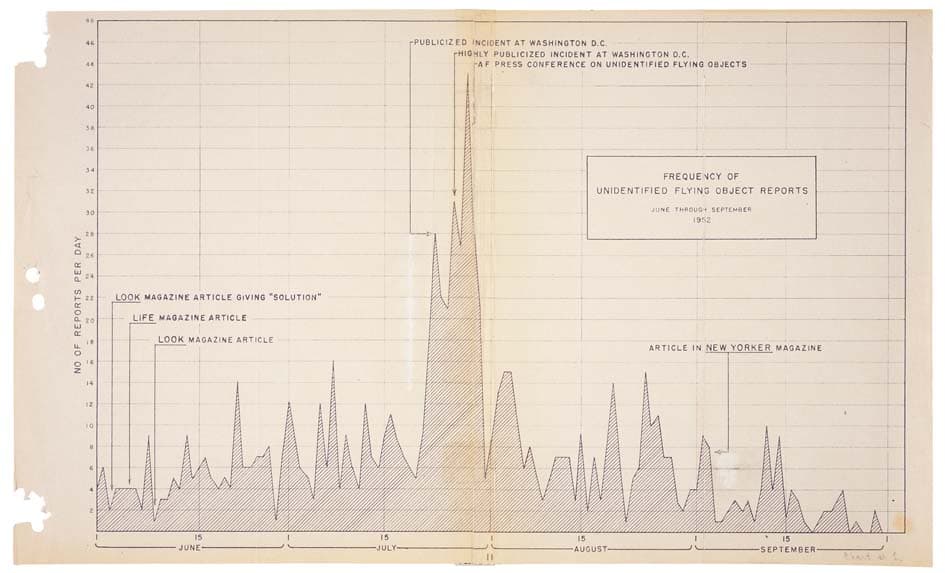
Source finding — U.S. National Archives: The National Archives article identifies the 19 July Washington incident, its catalog record and the Project Blue Book Status Report No. 8 report-frequency chart.
Source finding — U.S. National Archives: This is authoritative archival identification and collection context. It does not reconstruct every radar track or endorse an extraordinary interpretation.
Source finding — U.S. Air Force record / NICAP mirror: The scanned Air Force case file records 26-27 July radar returns, pilot and controller reports, alert times, fighter dispatch and the investigators' weather discussion.
Source finding — U.S. Air Force record / NICAP mirror: NICAP hosts a mirror of a U.S. Air Force record. The file itself notes missing official interceptor reports and incomplete follow-up, so relayed pilot statements are not a complete flight record.
Public chronology: 1952-07-19 to 1952-07-20: The first weekend produces radar returns and visual reports around Washington National Airport, Andrews Air Force Base and the capital region. This is the event date attached to the structured archive record. Dates on later archive pages, news reports or documentary programs describe the source history and are not treated as a second occurrence or as contemporaneous evidence.
Evidence basis: The linked record includes material published or preserved by PBS / WETA, U.S. National Archives, U.S. Air Force record / NICAP mirror, and U.S. Department of Transportation National Transportation Library. Agreement between independent records carries more weight than repeated summaries of the same claim, while later broadcasts and documentary programs are treated as context rather than original sighting evidence.
Archive assessment: 1952 Washington, D.C., UFO radar incidents remains in the archive as a disputed report because its public record can be tied to Washington, D.C. in 1952 and compared across 8 linked sources. Those sources document the report, its reception and later analysis; they do not by themselves prove that an extraordinary craft or non-human cause was present.
Official 1952 Air Force statement
The National Archives preserves Major General John Samford's filmed statement after the Washington events. It is an official retrospective statement, not footage of the reported objects.
Related video
Timeline
- The first weekend produces radar returns and visual reports around Washington National Airport, Andrews Air Force Base and the capital region.
- The surviving Blue Book case file places the beginning of the second major radar episode late on Saturday evening.
- The Air Force Command Post is notified of unidentified targets reported by Washington-area controllers.
- The Air Defense Command reporting chain is alerted as radar and visual reports continue.
- Two F-94 interceptors are scrambled and controllers attempt to vector them toward reported targets.
- Major Dewey Fournet and Lieutenant John Holcomb arrive at the air-route traffic-control center; Holcomb records seven solid targets.
- Strong intermittent targets diminish; later weaker and unstable returns are considered compatible with inversion effects.
- The Air Force holds a press conference, followed by Major General John Samford's filmed statement on the investigation and the absence of a known threat.
- The Civil Aeronautics Administration publishes Technical Development Report No. 180 on false radar targets and anomalous propagation.
Frequently asked questions
What happened over Washington in July 1952?
Controllers, pilots and ground observers reported intermittent radar targets and unusual lights on two weekends. Fighters were dispatched during the second episode.
Were the objects tracked on multiple radars?
Several radar facilities reported returns, but the surviving record does not consistently correlate one target across every radar and visual observation.
Did Air Force fighters see the UFOs?
The case file relays limited pilot light reports, including one attempted pursuit, but also says official interceptor reports had not reached the investigating office.
Did a temperature inversion explain the incident?
Anomalous propagation is a technically supported explanation for many returns. The measured slight inversion did not satisfy every contemporary investigator, and the CAA's explicit Washington tests concerned August rather than every July track.
Are there authentic photographs or films of the objects?
No authenticated event photograph or motion picture is established in the public case file. Many familiar images are illustrations, later media or unrelated lights.
What did Major General John Samford say?
He described most UFO reports as mistakes, natural phenomena or hoaxes, said credible residual reports were being studied and reported no known threat.
Is the Washington case solved?
Many observations have plausible astronomical or atmospheric explanations, but incomplete correlation and missing primary data prevent a confident identification of every strong return.
Sources
- [1] ArchiveNational Archives identifies the Washington case and Blue Book report-frequency chartU.S. National Archives and Records Administration
- [2] ArchiveProject Blue Book Case 1661: Washington radar and visual reportsU.S. Air Force record / NICAP document mirror
- [3] Official fileCAA Technical Development Report No. 180 on unidentified radar targetsU.S. Civil Aeronautics Administration / National Transportation Library
- [4] Official fileNational Archives film record of John Samford's 31 July 1952 statementU.S. National Archives / YouTube
- [5] ResearchColorado Project retrospective analysis of the 1952 Washington incidentsColorado Project / NCAS text archive
- [6] ArchiveNational Archives guide to Project Blue Book case filesU.S. National Archives and Records Administration
- [7] News reportWETA retrospective: UFOs Above WashingtonWETA / PBS
- [8] ArchiveUK National Archives overview of the 1952 Washington eventsThe National Archives (United Kingdom)
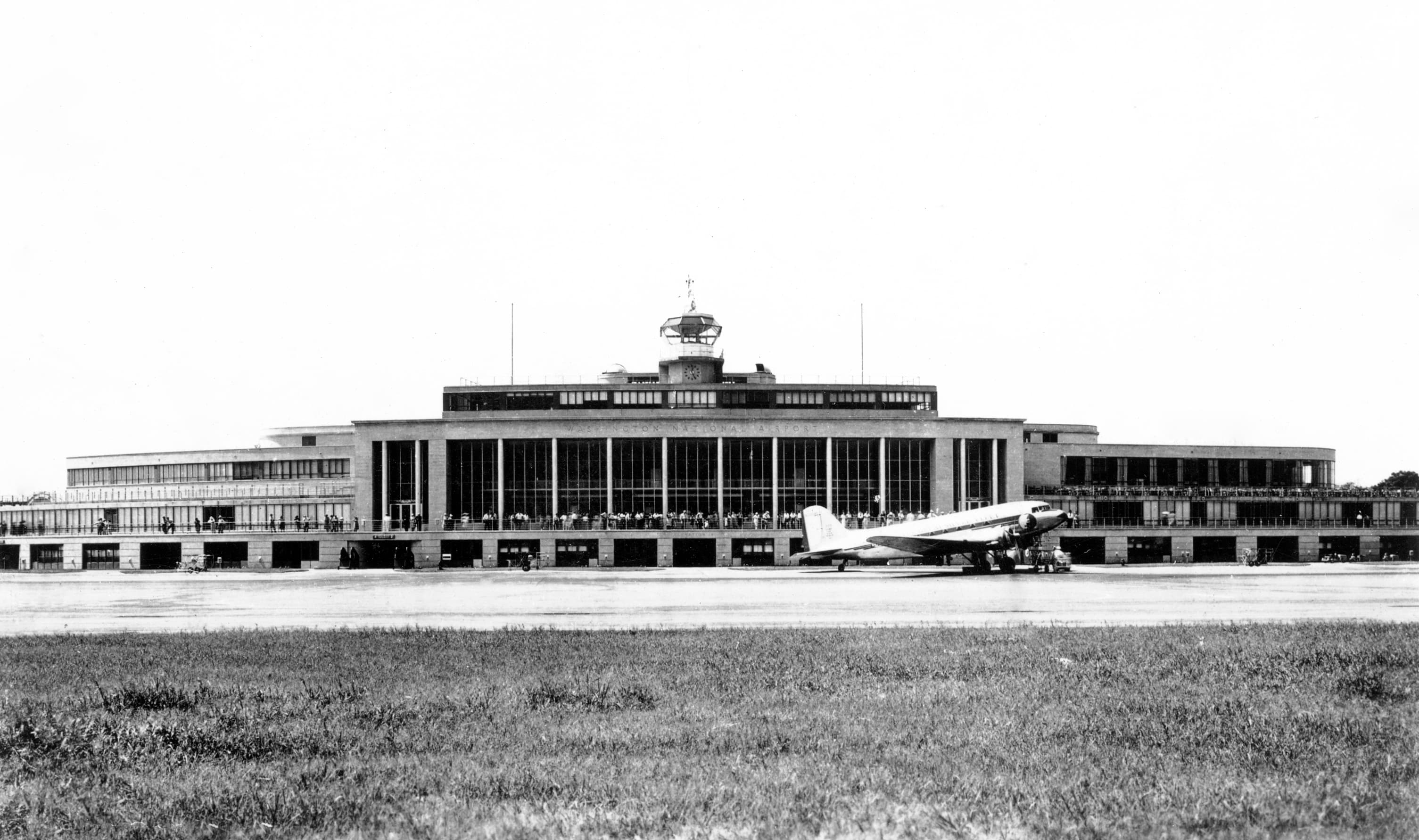
The hero photograph shows Washington National Airport in 1944 and provides historical location context. It is not an image of the July 1952 radar returns, reported lights or interceptors.