
United States / 1979 / DISPUTED
Val Johnson incident
Marshall County deputy Val Johnson reported seeing a sharply bounded light low over Minnesota Highway 220 at about 1:40 a.m. on 27 August 1979. He drove toward it, recalled a flash and breaking glass, and next reported himself stopped across the road after an interval he could not account for. Responders found him injured and his 1977 Ford LTD with a cracked windshield, damaged lights, a small hood dent and two bent police antennas. Johnson later stated that his mechanical wristwatch and the dashboard clock were both fourteen minutes slow. Those are documented reports and surviving damage, not proof of a craft or of altered time. The sheriff’s office and the civilian Center for UFO Studies investigated; later testing produced observations and hypotheses, but no public, reproducible report established a single cause. Ball lightning, road debris or an accident, deliberate damage and an unidentified ordinary event remain disputed possibilities. The careful classification is C / DISPUTED.
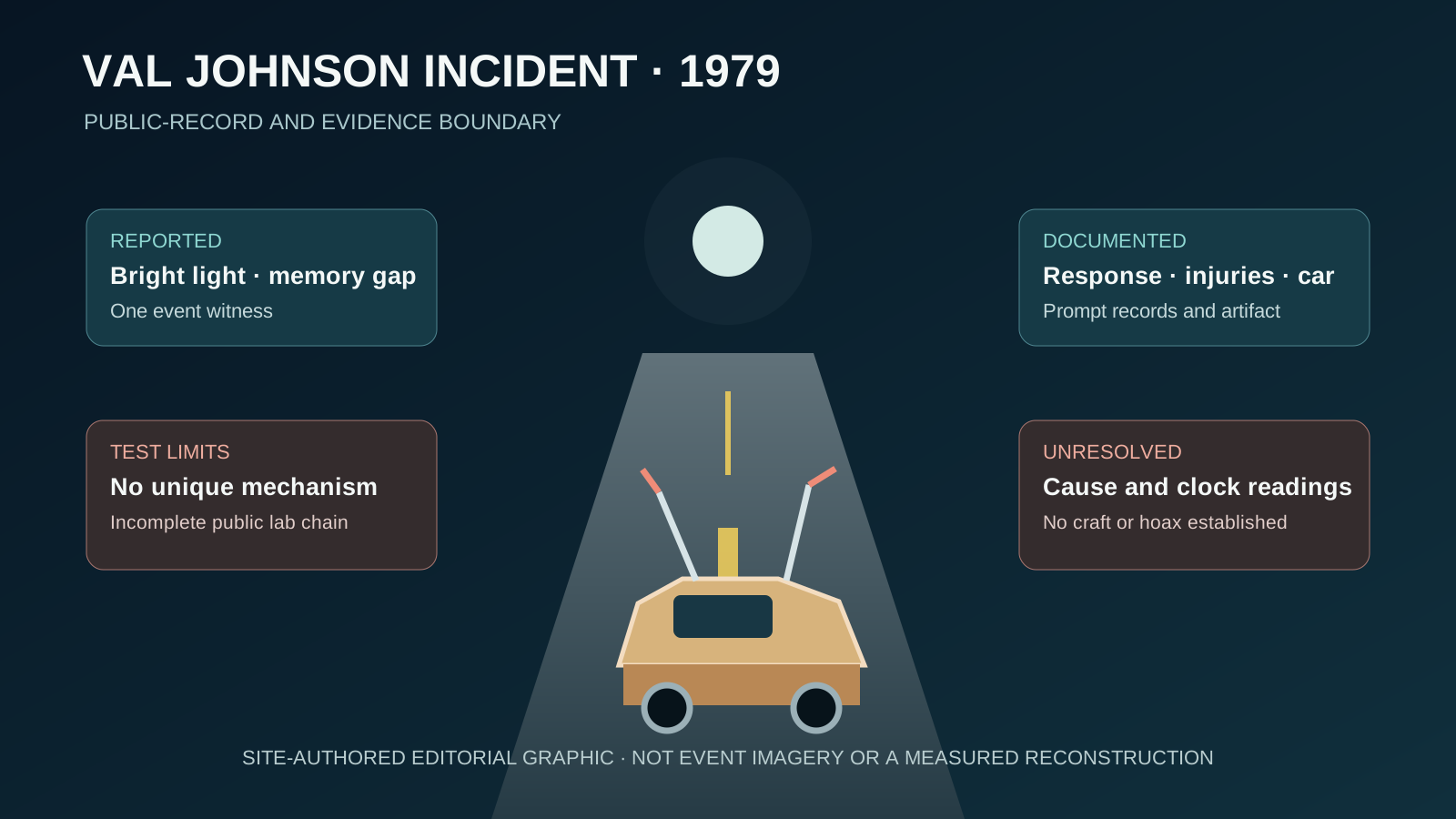
This case is disputed. The archive preserves the claims while separating evidence from interpretation.
- Documentation
- High documentation
- Primary location
- Minnesota Highway 220 near Stephen, Marshall County, Minnesota
- Source base
- 5 linked records
- Research use
- Comparison case
What the Val Johnson record establishes
- Confirmed record
- A deputy made a prompt report, responders attended and the damaged car survives.[1][2][4]
- Witness boundary
- No independent witness observed the light approaching or striking the car.[2]
- Vehicle evidence
- The windshield, lights, hood and antennas were damaged, but public tests did not establish one mechanism.[1][2]
- Clock claim
- Johnson reported both clocks fourteen minutes slow; no calibration or controlled retest is public.[1][2]
Case dossier
Johnson was patrolling west on County Road 5 and turned south onto Highway 220 after seeing a bright light he first considered a possible aircraft landing light. In the taped account reproduced by the Center for UFO Studies (CUFOS), he estimated it at eight to twelve inches in apparent diameter and three to four feet above the road. Apparent size is not physical size, and no second observer, photograph, radar return or instrument record fixes the light’s distance or motion.
Johnson said the light rapidly met the car; he remembered glass breaking and then no continuous experience until he recovered. His radio call was logged roughly thirty-nine minutes after the reported encounter. Deputy Everett Doolittle responded, and Johnson was taken for medical attention. Later accounts describe eye irritation consistent with exposure to a bright light and a forehead bump. The public material reviewed here does not include the complete hospital chart or an independent medical causal finding.
The 1977 Ford LTD is the case’s strongest surviving object. Contemporary investigation photographs and later museum records show a cracked windshield, broken headlight and emergency-light lens, a small hood dent, and two bent roof or trunk antennas. CUFOS reported that different damage features did not readily reduce to one impact. That mismatch is a problem to explain, not evidence that a single exotic force acted. The car’s later preservation at the Marshall County Historical Society establishes custody of an artifact, not the cause of its damage.
The antenna claim needs restraint. CUFOS arranged materials and magnetic checks and later wrote that a sufficiently strong electrical force should have produced arcing that scorched insect residue on the antenna shafts; it reported that this was not observed. A comparative magnetic survey also yielded no decisive anomaly in later summaries. The bends are real features of the car, but the surviving public account does not provide a unique deformation mechanism or a complete chain of laboratory worksheets.
Johnson’s statement that both clocks were fourteen minutes slow is often presented as ‘missing time’. The wristwatch was mechanical and the dashboard clock electrical, so a shared reading was noteworthy. Yet the reviewed sources do not provide pre-shift calibration records, instrument serial numbers, controlled retesting or a demonstrated field capable of shifting both devices by exactly the same amount. The statement supports a reported clock discrepancy; it cannot independently measure unconsciousness or a physical time anomaly.
The institutional trail is limited. The Marshall County Sheriff’s Office documented and investigated the report. MNopedia says the Air Force and Federal Aviation Administration reported no known aircraft in the area, but the underlying agency replies were not located for this review. CUFOS was a private research organization, not a government laboratory. A November newspaper report attributed an ‘electrical force or thing’ interpretation to Honeywell metallurgical engineer Roland Wardell, but no signed Honeywell corporate report, methods or reproducible dataset has been found publicly.
No single ordinary proposal has been demonstrated to reproduce the full report. Ball lightning could address a compact bright phenomenon and possible electrical effects, but no contemporaneous weather or discharge record ties it to the car and the antenna test raised difficulties. Road debris, loss of control or a staged event can account for selected damage but not automatically every reported detail; motive and mechanism remain unproved. The evidence supports that Johnson promptly made a report, was attended, and a damaged car survived. It does not establish an extraordinary vehicle, deliberate deception or one complete conventional cause.
Timeline
- Johnson reports seeing the low bright light and driving south on Highway 220.
- Johnson radios for help; Doolittle responds and medical care follows.
- The damaged Ford, road position and reported clock discrepancy are documented.
- The sheriff’s office releases the incident publicly.
- CUFOS investigator Guy Westcott records an interview with Johnson.
- CUFOS publishes its preliminary field account and lists planned materials, magnetic, optical and terrain checks.
- Wardell examines the car; his interpretation survives through newspaper reporting, not a public full laboratory report.
- MPR publishes a later interview in which Johnson still describes a ball of light but does not identify it as extraterrestrial.
Questions about the Val Johnson incident
What happened to Val Johnson in 1979?
He reported a bright light, a break in conscious memory and a damaged patrol car. Responders and the car corroborate the aftermath, not the light’s identity.
Was the patrol car really damaged?
Yes. Photographs and the preserved Ford show multiple damaged features. Their cause and whether they share one cause remain disputed.
Did both clocks lose fourteen minutes?
Johnson reported that result. Without calibration and controlled retesting it remains a reported discrepancy, not proof of missing time.
What did the antenna tests show?
The bends were examined, but CUFOS later noted that expected electrical arcing effects were absent. No unique mechanism was established.
Did Honeywell prove an electrical force?
No public signed Honeywell report has been located. The claim survives through a newspaper account of one engineer’s examination.
Could ball lightning explain the incident?
It is a relevant hypothesis for the light, but no weather record or experiment connects it to the full damage and clock report.
Does the museum car prove a UFO collision?
No. It preserves the damaged artifact and local history; museum custody does not identify the damaging agent.
Sources
- [1] ArchiveVal Johnson Incident, 1979MNopedia / Minnesota Historical Society
- [2] ResearchThe Val Johnson incident: preliminary investigationCenter for UFO Studies, International UFO Reporter 4:3–4
- [3] ResearchElectrical-force test boundary in the Val Johnson caseCenter for UFO Studies, Frontiers of Science
- [4] News reportWhatever happened to the Marshall County cop who hit a UFO?MPR News
- [5] ResearchSkeptics UFO Newsletter: Val Johnson hoax argumentSkeptics UFO Newsletter / Center for Inquiry archive
The displayed image is a site-authored evidence-boundary diagram. It is not an event photograph, a reconstruction of the light, a police diagram or physical evidence. Copyrighted museum and newspaper photographs are linked through sources but not copied here.